
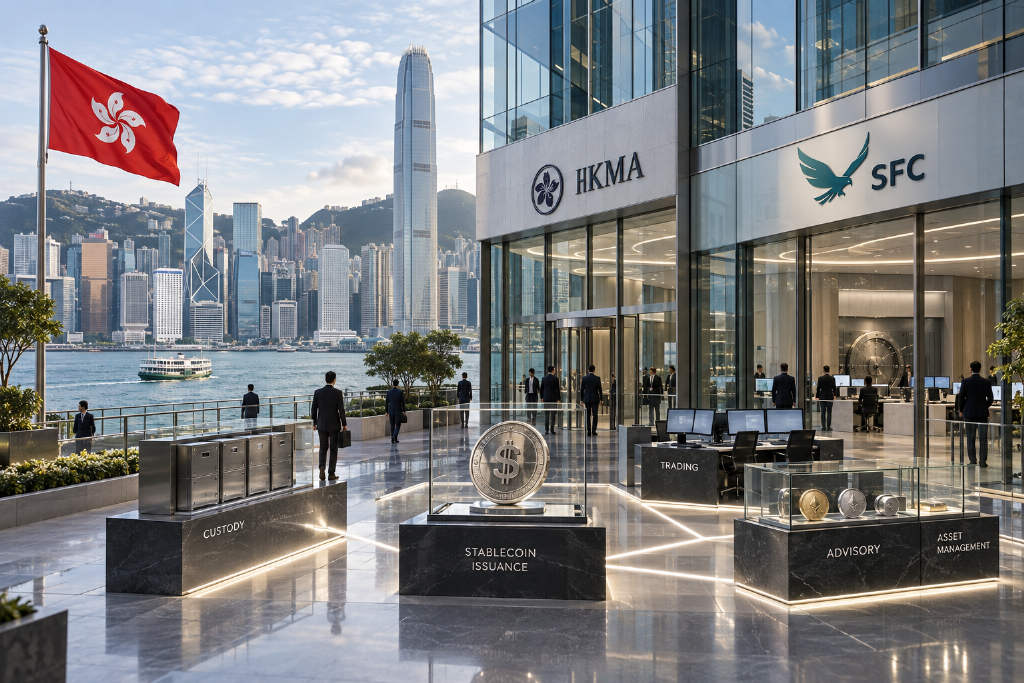
Hong Kong’s crypto framework is being assembled through separate statutes rather than a single code, and the links between those regimes became clearer in 2026. On April 10, 2026, the Hong Kong Monetary Authority issued the first two stablecoin issuer licenses under the Stablecoins Ordinance. More than a month later, the Securities and Futures Commission published a circular explaining how licensed virtual asset trading platforms and licensed corporations may provide those two licensed stablecoins to clients. Issuance, trading, client onboarding and custody were brought into the same regulatory chain.
At present, Hong Kong does not use one unified law to cover every crypto activity. Security tokens remain under the Securities and Futures Ordinance (Cap. 571). Non-security virtual asset trading platforms are governed by the Anti-Money Laundering and Counter-Terrorist Financing Ordinance (Cap. 615, or AMLO). Fiat-referenced stablecoin issuance is handled under the Stablecoins Ordinance (Cap. 656), which took effect in August 2025. The HKMA oversees stablecoin issuance and the banking system, while the SFC oversees trading platforms, licensed corporations and capital markets activity.
New licensing regimes for trading, custody, advisory and asset management are still moving through the legislative process. To understand the Hong Kong model, the article says it is necessary to separate rules already in force from systems still under consultation, then look at who controls assets, orders and client relationships in each business line. It organizes the map in this order: asset classification, trading platforms, stablecoins, intermediaries and proposed licenses.
Asset classification comes first
Schedule 1, Part 1 of the Securities and Futures Ordinance defines “securities” and “collective investment schemes,” while Schedule 5 lists regulated activities. When a token represents shares, debt, fund interests or collective investment rights, issuance and promotion, brokerage trading, automated trading and asset management may connect to Type 1, Type 4, Type 7 or Type 9 regulated activity. Section 114 of the ordinance sets the licensing requirement for carrying on regulated activity, and Section 116 provides the legal basis for granting a corporate license.
Many spot crypto assets do not fall within the definition of securities, which is why centralized trading platforms are brought under Part 5B of AMLO. Section 53ZRA defines “virtual asset.” Section 53ZR, together with Schedule 3B, treats the operation of a virtual asset exchange as a “virtual asset service.” Section 53ZRD prohibits carrying on, or holding out as carrying on, a virtual asset service without a license. Section 53ZRK allows the SFC to grant a virtual asset service provider license to a qualified corporation.
Hong Kong also writes offshore solicitation into the licensing perimeter. Under Section 53ZRB of AMLO, an overseas institution that actively markets to the Hong Kong public a business that would amount to a virtual asset service if provided in Hong Kong may be treated as providing that service in Hong Kong. Server location and place of incorporation are only part of the picture. Chinese-language advertising, offline events in Hong Kong, HKD rails and customer support aimed at local users may all be relevant.
The same platform will often need two sets of licenses. If it trades security tokens, it needs Type 1 dealing in securities and Type 7 automated trading services licenses under Section 116 of the Securities and Futures Ordinance. If it trades non-security virtual assets, it needs a virtual asset service provider license under Section 53ZRK. That structure allows a platform to keep operating the relevant business even if the legal characterization of a token changes.
Fiat-referenced stablecoins have a separate entry point. Sections 3 and 4 of the Stablecoins Ordinance define “stablecoin” and “specified stablecoin,” and Section 5 defines “regulated stablecoin activity.” At this stage, the core activities include issuing specified stablecoins in Hong Kong and issuing outside Hong Kong specified stablecoins that purport to reference the Hong Kong dollar to maintain a stable value. The HKMA handles issuance. Once trading and client services begin, the SFC regime becomes part of the picture.
How virtual asset trading platforms get licensed
Hong Kong’s virtual asset trading platform regime has been in operation since June 2023. Applicants must apply as corporations, and responsible officers, directors and ultimate controllers are subject to fit-and-proper review. The SFC examines shareholder and management background, business plans, financial resources, information security, client asset arrangements and anti-money laundering systems. Section 53ZRK authorizes the SFC to grant a license when the applicant and relevant persons are fit and proper and the company can comply with statutory requirements.
The financial thresholds are set out in the Guidelines for Virtual Asset Trading Platform Operators. Paragraph 6.1 requires a platform to maintain in Hong Kong liquid assets equal to at least 12 months of actual operating expenses. Paragraph 6.2 requires paid-up share capital of no less than HK$5 million. Paragraph 6.3 requires liquid capital of HK$3 million or the applicable basic amount under the Financial Resources Rules, whichever is higher. Platforms must calculate these figures on an ongoing basis and file financial returns with the SFC.
Governance requirements are also specific. Paragraphs 3.4 and 3.7 place corporate governance, internal controls, risk management and compliance within the capability assessment. Paragraphs 11.4 to 11.19 require clear reporting lines and independent risk management, compliance and internal audit functions. Technology, custody and market surveillance are often spread across multiple teams, and the SFC uses those roles and reporting structures to determine who is accountable.
Once a platform serves retail clients, token admission becomes a daily supervisory focus. Paragraph 7.1 requires a token admission and review committee. Paragraph 7.6 requires pre-listing review of the project team, regulatory status, supply and liquidity, technology, governance, legal risk and money laundering risk. Paragraph 7.10 requires independent security audits for smart contract tokens. Paragraphs 7.11 and 7.12 require ongoing review of token risk and any change in securities status.
Assets offered to retail clients must also satisfy paragraphs 7.7 and 7.8. In general, a token should be highly liquid and included in a large-cap virtual asset index maintained by at least two independent qualified index providers, one of which should have experience in traditional securities market indices. The article notes that after 2025 the SFC gradually adjusted some product thresholds, and licensed stablecoins gained a more direct retail channel in 2026.
How client assets must be held
Because a trading platform also performs a custody function, client assets are subject to a separate set of rules. Paragraph 10.1 of the platform guidelines requires client assets to be held on trust through an associated entity, and that entity may only receive and hold client assets on behalf of the platform. Paragraph 10.5 requires client virtual assets to be kept in dedicated wallets established by the associated entity and segregated from the proprietary assets of both the platform and the associated entity.
Paragraph 10.6(c) requires the platform and its associated entity to place 98% of client virtual assets in cold storage, with any adjustment requiring case-by-case permission from the SFC. Paragraphs 10.6(e) and 10.8 set rules for key generation, authorization, backup and access control. Keys and their backups must be securely kept in Hong Kong, and no single person may hold the full key material. Paragraph 10.10 adds operational requirements covering whitelists, unusual withdrawals, authorization review and tamper protection for withdrawal addresses.
Those provisions shape the wallet architecture of licensed platforms. Hot wallets keep only the assets needed for routine withdrawals, while most balances move into offline environments. Platforms must document who can initiate transactions, who reviews them and how assets would be migrated if a private key were compromised. An SFC custody circular issued in 2025 added minimum standards for hardware security modules, isolated devices, whitelists and management responsibility.
Anti-money laundering obligations come from Schedule 2 to AMLO and from AML guidelines issued by the SFC for licensed corporations and virtual asset service providers. Customer due diligence, beneficial ownership verification, ongoing monitoring, suspicious transaction reporting and record keeping all apply to platform operations. Sections 53ZRT to 53ZRX also set continuing obligations for licensed service providers and their associated entities, including approved premises, responsible officers and client asset arrangements.
What the Stablecoins Ordinance covers
Section 8 of the Stablecoins Ordinance is the core prohibition for issuance licensing. Anyone carrying on, or holding out as carrying on, a regulated stablecoin activity must hold an HKMA license or fall within an exemption. A breach of Section 8 may amount to a criminal offense. Section 15 provides the legal basis for the HKMA to grant a license, and applicants must continue to satisfy the minimum criteria in Schedule 2.
Paragraph 4 of Schedule 2 requires an issuer to have adequate financial resources and liquid assets, with paid-up share capital of at least HK$25 million or equivalent financial resources accepted by the HKMA. Paragraph 5 requires a separate reserve asset pool for each class of specified stablecoin. The market value of reserves must at all times be at least equal to the par value of stablecoins in circulation, and the reserves must be segregated from the issuer’s other funds and from other reserve pools. Reserve assets must be high quality, highly liquid and low risk, and they are subject to independent attestation and audit.
Paragraph 6 of Schedule 2 gives redemption rights directly to holders. Issuers must redeem stablecoins at par. Redemption conditions must be reasonable, fees must remain reasonable, and once a valid request is received the reference currency should be paid to the holder as soon as practicable. Section 3.2 of the HKMA Guideline on Supervision of Licensed Stablecoin Issuers adds that issuers must maintain an effective redemption mechanism and address holders’ rights to the reserve pool and any shortfall if the issuer enters insolvency proceedings.
Paragraph 11 of Schedule 2 requires issuance arrangements to be prudent, sound and matched to the business purpose, business model and operating structure. Section 4.3 of the supervisory guideline requires issuers to submit an executable business plan, maintain a reliable issuance mechanism and show they can handle business disruption. Reserve management, redemption, technical security, risk governance and anti-money laundering together form an ongoing operating framework.
Distribution channels are also restricted. Section 9 of the Stablecoins Ordinance says only “permitted offerors” may offer specified stablecoins to clients. The main categories are licensed stablecoin issuers, SFC-licensed virtual asset trading platforms, Type 1 licensed corporations, authorized institutions and licensed stored value facility operators. Stablecoins issued by a licensed issuer may be offered to retail clients through those institutions. Specified stablecoins without a Hong Kong license may only be offered to professional investors under statutory conditions.
How the first licensed stablecoins reach the market
In its May 27, 2026 circular, the SFC used the term “relevant stablecoins” for stablecoins that meet two conditions: they are specified stablecoins under the Stablecoins Ordinance, and they are issued by an HKMA-licensed issuer within the scope of that license. After the first two licenses were granted, trading platforms and licensed corporations were able to structure client services under that circular.
Paragraph 4 of the circular removes the usual liquidity and index requirements for relevant stablecoins offered to retail clients, meaning part of the thresholds in paragraphs 7.7 and 7.8 of the platform guidelines no longer apply. The article’s explanation is straightforward: reserve management and redemption are already under ongoing HKMA supervision, and the SFC carries the issuance-side regulatory outcome into the trading side. Platforms still need to complete token due diligence and, under paragraph 5 of the circular, disclose the stabilization mechanism and the reserve and redemption arrangements.
Client onboarding rules were also adjusted. Paragraph 6 says that if an institution provides only relevant stablecoin services to a particular client, it may be exempt from the general virtual asset knowledge assessment. Paragraph 7 allows holdings of relevant stablecoins to be excluded from a client’s virtual asset risk exposure limit. Paragraph 8 still requires suitability obligations when the institution solicits or recommends the product. Once the client starts trading other virtual assets, the full knowledge assessment and risk controls apply.
The scope for cooperation by licensed corporations was widened at the same time. Paragraph 9 allows them to work with HKMA-licensed stablecoin issuers to provide dealing services. Paragraph 10 allows licensed corporations to use omnibus account services on platforms subject to a “professional investors only” condition in order to serve retail clients, with the licensed corporation taking responsibility for retail onboarding and suitability. Paragraph 11 also allows client-related receipts and payments in relevant stablecoins through segregated accounts opened with the issuer.
Paragraph 12 deals with listing notifications. Platforms and licensed corporations do not need separate written approval from the SFC each time before introducing a relevant stablecoin, but they must give prior written notice of plans to add, suspend or remove one. The issuer handles reserves and redemption, the platform handles token admission and market operations, and the licensed corporation handles client relationships and suitability. Those responsibilities now connect around a single stablecoin.
Where banks and licensed corporations fit
Hong Kong banks are authorized institutions under Section 2(1) of the Banking Ordinance. When banks provide virtual asset trading, distribution and account services, they remain subject to HKMA prudential supervision and must comply with joint circulars issued by the HKMA and the SFC. Client suitability, anti-money laundering, technology risk and complaint handling sit with the client-facing bank, while the underlying execution is usually completed through an SFC-licensed platform.
Licensed securities corporations mainly operate under Section 116 of the Securities and Futures Ordinance and the conditions attached to their licenses. Paragraphs 17 to 31 of the 2023 joint circular set out cooperation models, client assessment and notification obligations for virtual asset dealing, advisory and asset management. Licensed corporations may execute trades for clients through omnibus accounts on platforms, and they may also provide advisory services or manage portfolios containing virtual assets if they hold the relevant licensing conditions.
The relevant stablecoin circular separates the client interface from the execution layer even more clearly. Platforms restricted to professional investors may take retail orders routed by licensed corporations. The licensed corporation handles client knowledge, suitability and product explanation. The platform handles execution, token review and custody. Large financial groups can therefore place banks, securities brokers and platforms in different entities, then connect responsibility through account segregation, data transfer and incident reporting.
Custody, trading, advisory and management licenses are still being added
Hong Kong published consultation conclusions on virtual asset custody and trading services in December 2025, and it continued in 2026 to advance advisory and asset management regimes. The relevant bills have not yet completed the legislative process, so there are no effective section numbers that can be directly applied at this stage. Still, the consultation conclusions have already set the main direction. The plan is to place the new licenses into AMLO and have the SFC supervise them.
The proposed custody license is built around one question: who controls the tools that can move assets. An institution that holds private keys, seed phrases or other tools capable of transferring virtual assets for clients would fall within the proposed regime. A software or hardware provider that only supplies technology without controlling client assets would be assessed based on the actual service structure. Proposed licensees would also need to meet requirements on local presence, fit and proper status, segregation of client assets, key governance, insurance or compensation, audit and business continuity.
The proposed trading services license is intended to cover buying and selling activity beyond centralized exchanges, including brokerage matching, over-the-counter trading and order execution for clients. The focus is on who receives the order, who determines the counterparty, who handles client funds and who actively markets to the Hong Kong market. Current Section 53ZRD mainly covers operating a virtual asset exchange. The new regime would bring more trading intermediaries into licensing and AML obligations.
The advisory and asset management regime addresses recommendations and investment discretion. A policy paper published in May 2026 plans to place virtual asset advisory and management services into a more complete statutory licensing framework. Institutions that recommend specific assets, decide portfolio allocations for clients, or control rebalancing and risk limits would be regulated according to the functions they actually perform. Existing Type 4 and Type 9 licensed corporations and their licensing conditions would continue to connect with the new regime.
Tokenized securities remain within the securities law system. When they represent traditional securities rights, custody, trading and management continue to be governed by the Securities and Futures Ordinance, product authorization conditions and rules for licensed corporations. In 2026, the SFC introduced a secondary trading framework for tokenized authorized investment products, focusing on consistency between token registration and underlying rights, technical arrangements, liquidity and investor disclosure.
Tokenized products and settlement infrastructure
As of March 2026, Hong Kong had several tokenized public products, with about HK$10.7 billion in assets under management tied to tokenized units. In April, the SFC published a secondary trading framework that allows eligible products to explore longer trading hours through regulated channels. Issuance, registration and transfer of fund units are gradually moving on-chain, while the legal rights attached to the funds continue to be confirmed by existing product documents and securities regulation.
The HKMA’s Ensemble project addresses a different layer: how tokenized deposits, tokenized assets and settlement funds can be exchanged on the same infrastructure. Its 2026 priorities include advancing EnsembleTX and testing round-the-clock settlement supported by tokenized central bank money. Bank liabilities, stablecoins and tokenized securities each have different issuers and legal rights, and Ensemble is intended to provide a controlled environment for connection and settlement.
That infrastructure path works alongside the licensing system. Stablecoin issuers are responsible for reserves and redemption. Banks are responsible for tokenized deposits. Securities issuers and fund managers are responsible for the underlying investment rights. Platforms and custodians are responsible for trading and asset safety. Cross-platform delivery and settlement only have a stable foundation once the legal responsibility for each type of asset is fixed.
The article’s closing observations
The article says Hong Kong’s virtual asset regime has now formed a three-layer structure. The first layer continues to rely on securities law and banking law, with regulation determined by the rights represented by the token. The second layer manages centralized virtual asset trading platforms through Part 5B of AMLO. The third layer separately regulates fiat-referenced stablecoin issuance through the Stablecoins Ordinance, with SFC circulars then governing how those products enter trading and intermediary channels.
The next stage is to write rules now scattered across consultation papers and licensing conditions into law for trading, custody, advisory and asset management. At that point, any business line will need to answer several concrete questions: who issues the liability, who keeps the private keys, who receives client orders, who gives investment advice, who has portfolio allocation authority and who markets to the Hong Kong public. Each answer connects to a specific license, responsible personnel and continuing obligations.
For institutions preparing to enter Hong Kong, the article’s practical suggestion is to map activities by entity and place the relevant statutory provisions on each business line. Platform business connects to Sections 53ZRD and 53ZRK. Securities activity connects to Sections 114 and 116 of the Securities and Futures Ordinance. Stablecoin issuance and distribution connect to Sections 8 and 9 of the Stablecoins Ordinance and Schedule 2. That is how firms can identify, at the product design stage, which licenses are needed, where client assets will sit and where regulatory responsibility ultimately lands.
The article ends with a disclaimer that it is intended only for legal, policy and industry research exchange and does not constitute investment advice, legal advice, tax advice or any other professional advice. It also does not amount to a recommendation, promotion or solicitation for any financial product, digital asset or commercial project. The regulatory rules, market data and institutional information cited are mainly drawn from public materials and may change with laws, regulatory policy, market conditions and project progress. Readers are asked to make independent judgments based on the latest public information and comply with the laws and regulations applicable in their own jurisdictions. The author and publishing platform disclaim responsibility for investment, trading or other commercial decisions made in reliance on the article.