

In a weaker tape, earnings need to answer a harder question
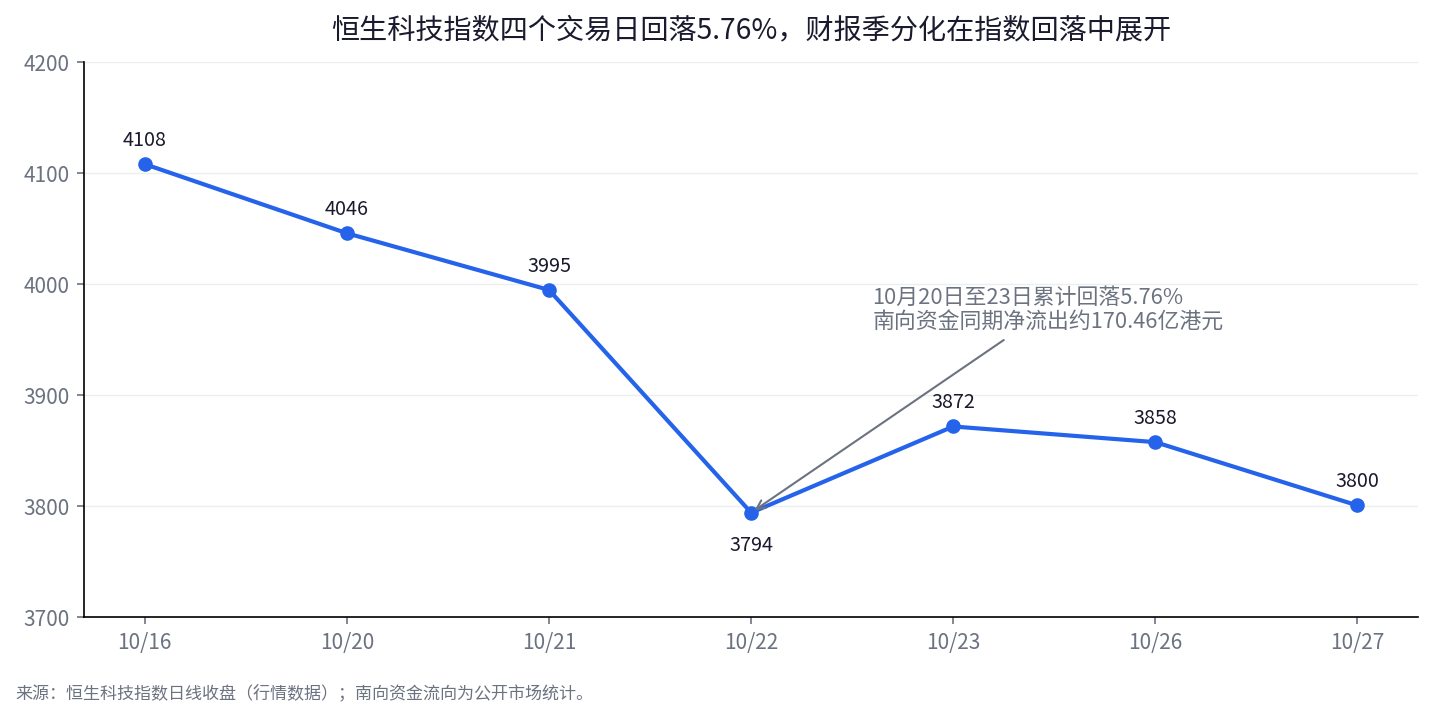
Hong Kong’s earnings season is unfolding in a market that has already turned more demanding. From Oct. 20 to Oct. 23, the Hang Seng Index fell 4.52% and the Hang Seng Tech Index lost 5.76%. On Oct. 22 alone, the Hang Seng Index dropped 3.03% and the tech gauge fell 5.03%. Over the same four trading days, southbound funds recorded net outflows of about HK$17.046 billion, with net selling on each day.
The deeper pullback in technology shares suggests the pressure was not spread evenly across all assets. Higher-volatility growth names saw larger swings as risk appetite shifted. In that setting, the market’s focus moved away from whether a company was still growing and toward a more specific issue: what is driving that growth, how repeatable is it, and how much should investors pay for it.
The article points to at least three forces behind the move. First, the global pullback in technology stocks revived debate over the payback period for AI capital spending. Investors had been willing to assign richer valuations to computing power, semiconductors and AI infrastructure on the assumption that current spending would convert into future revenue and profit. As investment keeps rising while commercialization still takes time to verify, valuation math changes. AI demand has not disappeared, but the timing of revenue realization, margins and return on capital now carry more weight in pricing.
Second, there is a gap between policy expectations and actual data. If the market has already priced in the possibility of stronger stimulus, economic data that merely avoids deterioration may not be enough to push valuations higher. Stocks trade on changes relative to prior expectations, not on isolated data points alone. Third, southbound flows turned negative, adding pressure to sectors that had already rallied sharply and where positioning had become concentrated.
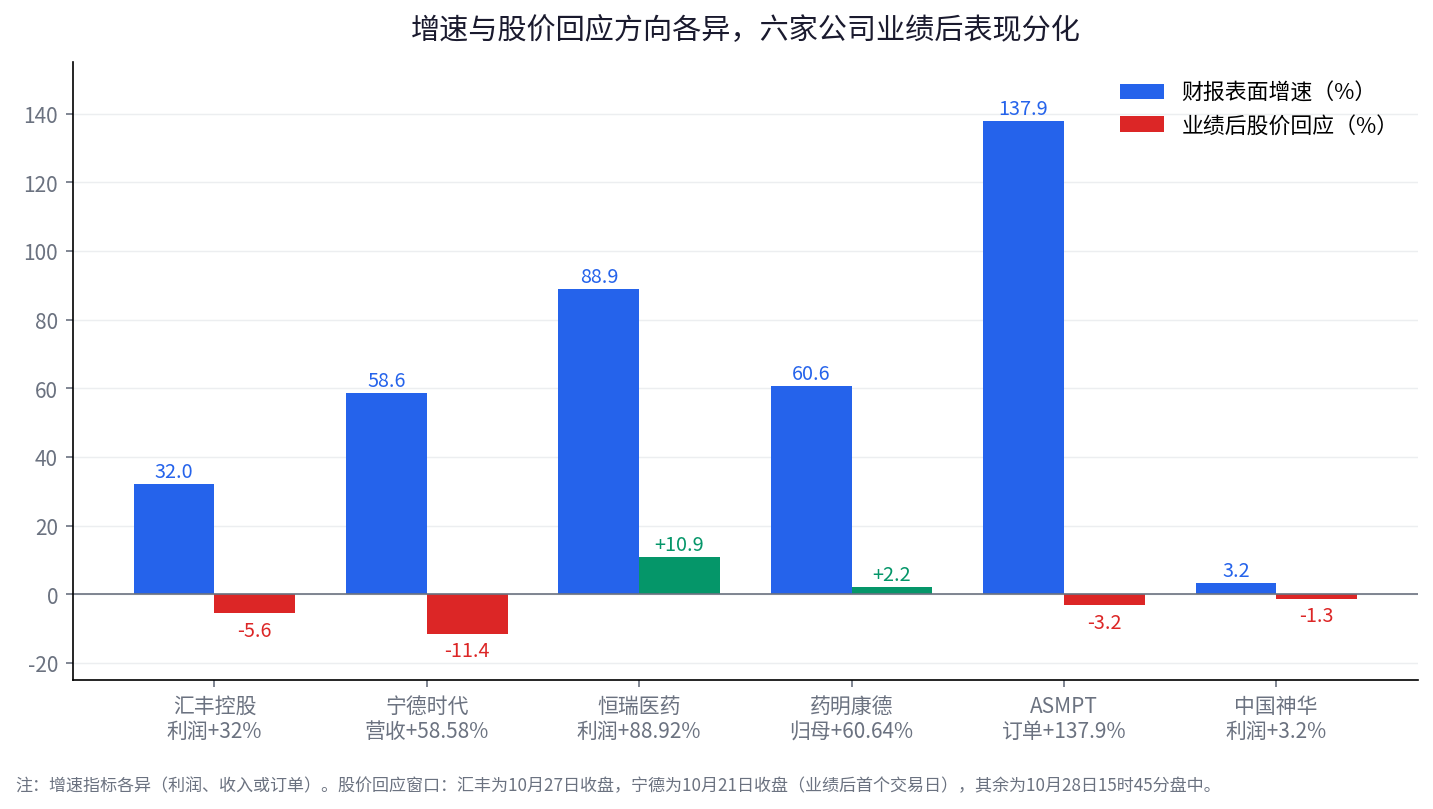
That does not mean the market has turned uniformly bearish on growth. The more important signal is the widening split at the company level. HSBC and CATL show why strong headline numbers can still be discounted. Hengrui Pharma, WuXi AppTec and ASMPT show different forms of evidence that investors may still reward. China Shenhua adds another point: the market may buy certainty of cash returns even when growth is not especially fast.
HSBC: 32% profit growth, but a 5.56% drop in the stock
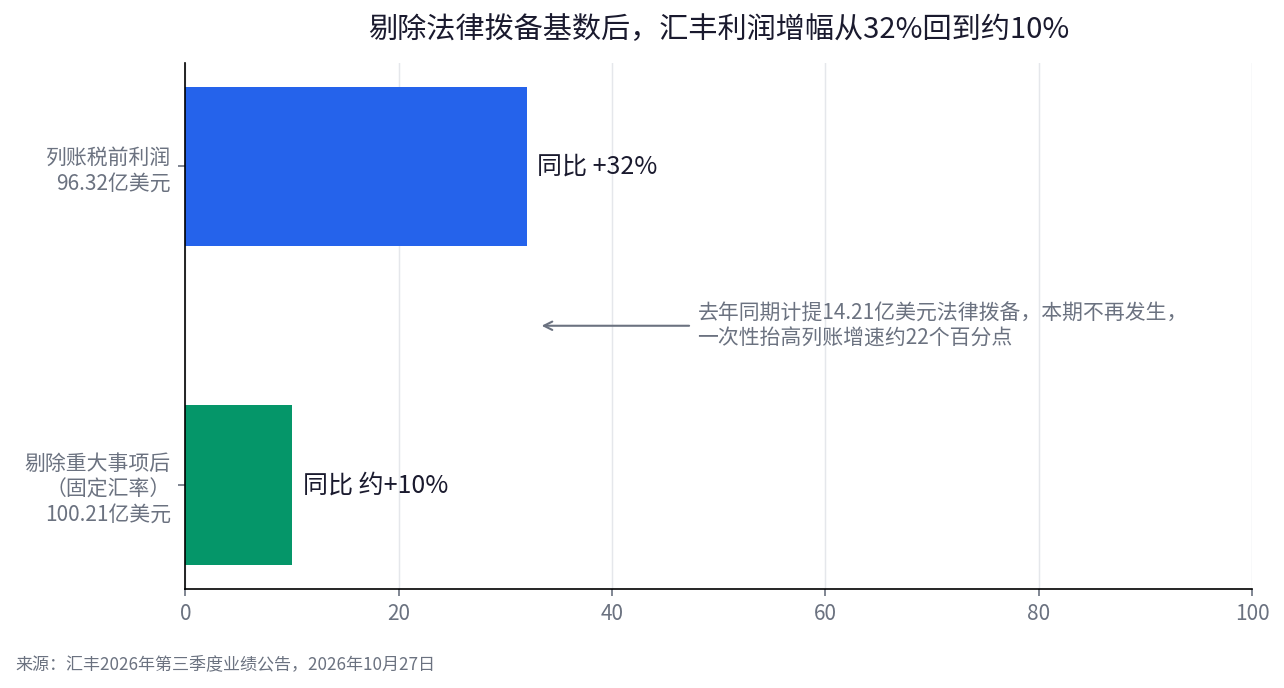
On the surface, HSBC’s third-quarter report looked solid. Reported profit before tax came in at $9.632 billion, up 32% year over year. Profit after tax rose 38% to $7.6 billion. Net interest income reached $9.3 billion, up 6%. The bank also announced a third interim dividend of $0.1 per share and said it planned to launch a share buyback of up to $1 billion.
Yet on the Hong Kong trading day after the results, HSBC shares fell 5.56% to HK$134.30.
The gap comes down to what sits inside that 32% growth figure. In the same period of 2025, HSBC booked about $1.421 billion in legal provisions related to a Luxembourg claim tied to the Madoff fraud case. There was no comparable charge this period, creating a favorable base effect. Excluding notable items and using constant currency, third-quarter pre-tax profit was about $10.021 billion, implying growth of roughly 10%, far below the reported 32% pace.
Revenue also failed to fully support the headline profit number. HSBC reported revenue of $18.62 billion, up 4.7% year over year, below market expectations of $18.93 billion. Wealth management revenue was about $2.7 billion, broadly flat from a year earlier and no longer showing the stronger momentum seen in the prior two quarters.
That does not mean the bank’s operations suddenly weakened. Net interest margin held at 1.57%, annualized return on tangible equity was 17.7%, and dividends plus buybacks continued to support shareholder returns. But investors do not stop at the profit line. They break growth into components: how much comes from genuine operating improvement, how much comes from a low base, and how much can be repeated in future quarters.
A one-off provision that does not recur can lift current profit, but it does not create the same earnings power every year. If revenue growth also misses expectations, the market may trim its view of future earnings. Profit growth is what has already happened. Sustainable earnings power is what valuation is paying for. The article says the market had been looking for a further guidance upgrade, and without that, strong reported growth alone was not enough to hold up the stock.
CATL: revenue surged, but profit and cash flow did not keep pace
If HSBC’s issue was how much of profit growth came from one-off factors, Contemporary Amperex Technology Co. Ltd. (CATL) faced a different split, one that may be even more important to track: revenue, profit and cash flow were not moving together.
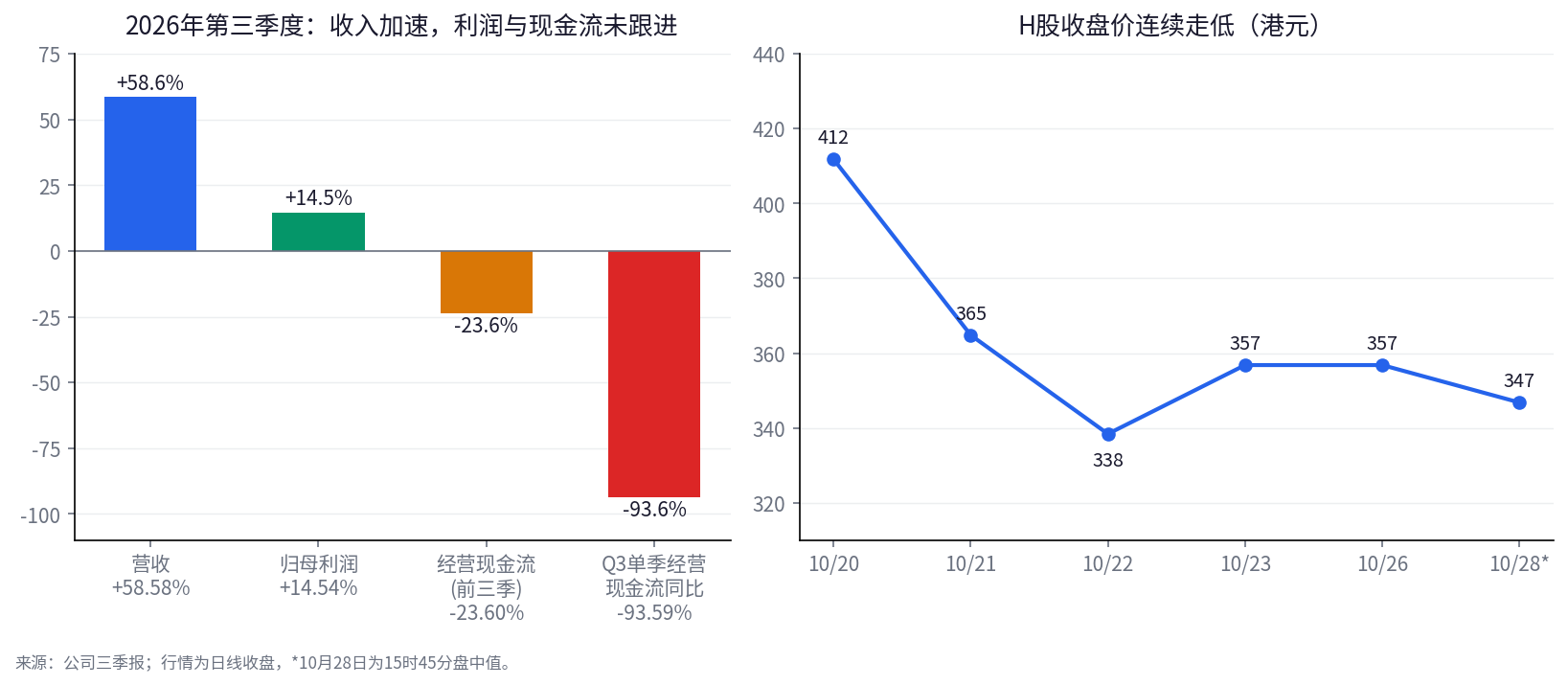
CATL reported third-quarter revenue of RMB 165.221 billion, up 58.58% year over year and 11.8% from the prior quarter. Net profit attributable to shareholders reached RMB 21.246 billion, up 14.54% year over year but down 5.77% from the second quarter, below earlier expectations from institutions including Bernstein and Goldman Sachs. For the first three quarters, revenue totaled RMB 442.137 billion, up 56.19%, while net profit attributable to shareholders rose 31.60% to RMB 64.530 billion. Revenue growth remained strong, but profit growth in the third quarter lagged well behind the top line.
Cash flow made the divergence more visible. Net cash flow from operating activities for the first three quarters was RMB 61.625 billion, down 23.60% year over year. Based on a breakdown using the interim report and the third-quarter report, operating cash flow for the quarter alone was about RMB 1.409 billion, down 93.59% from a year earlier and the lowest quarterly level since the second quarter of 2018. It was also far below quarterly net profit.
Management said the cash flow change was related to supplier payment policy adjustments and prepayments, while current-period earnings were affected by changes in product mix and tax policy adjustments. The company also said it still sees room for market demand growth in 2027. CATL later disclosed an A-share buyback plan of about RMB 800 million, but the article notes that buybacks do not replace close reading of operating data.
The stock reaction showed that investors were cautious. CATL’s H shares fell 6.58% on Oct. 20, 11.41% on Oct. 21 and 7.24% on Oct. 22. As of 3:45 p.m. on Oct. 28, the shares were at HK$346.8, down about 0.5% from the previous close.
The article stops short of saying that weaker cash flow automatically means deteriorating growth quality. Operating cash flow can be affected by payment cycles, prepayments and working-capital changes, and single-quarter data can be volatile. Instead, it frames three questions that matter next: whether revenue growth is coming from volume expansion or from changes in product and pricing mix; whether profit growth lagging revenue reflects temporary mix effects or more persistent competition and cost pressure; and whether the cash flow decline is a settlement-timing issue or a more durable change in profit conversion.
Those three lines of inquiry shape how the next reports will be read. If revenue keeps growing, margins stabilize and operating cash flow recovers, the current mismatch may prove temporary. If revenue continues to expand while profit and cash flow keep lagging, the economic value of that growth will need to be reassessed. For CATL, the next task is to show that demand growth can turn into profit and then into cash flow.
Hengrui Pharma: a rally of more than 12%, but not a number to extrapolate blindly
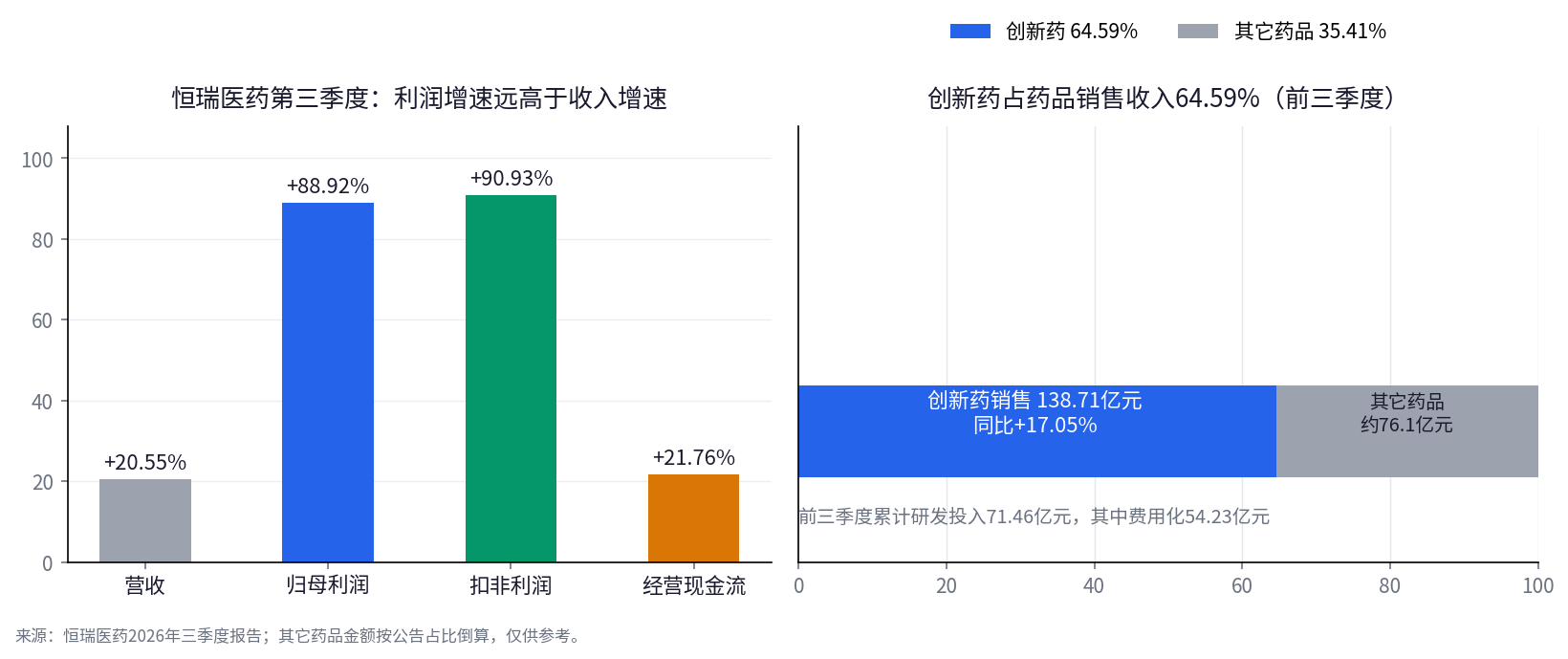
Hengrui Pharma received a much warmer market response than HSBC or CATL. On the evening of Oct. 27, the company reported third-quarter revenue of RMB 8.953 billion, up 20.55% year over year. Net profit attributable to shareholders rose 88.92% to RMB 2.458 billion, while net profit excluding non-recurring items increased 90.93% to RMB 2.514 billion. Net operating cash flow for the quarter was RMB 5.857 billion, up 21.76%.
On Oct. 28, Hengrui’s H shares rose more than 12% intraday. As of 3:45 p.m., the stock was up about 10.9% at HK$49.58.
Still, the article argues that the 88.92% profit increase should not be read in isolation. Hengrui said higher out-licensing income was one of the key drivers of profit growth in the quarter. For innovative drug companies, revenue does not come only from product sales. Upfront payments and milestone payments from overseas licensing deals can also contribute meaningfully to revenue and profit. Those deals can reflect the value of a company’s R&D pipeline and its commercial potential, but the timing of revenue recognition is uneven. A single quarter’s profit growth therefore cannot be projected mechanically into every future quarter.
At the same time, Hengrui was not relying entirely on one-off licensing income. In the first three quarters, innovative drug sales reached RMB 13.871 billion, up 17.05% year over year and accounting for 64.59% of pharmaceutical sales revenue. Cumulative R&D spending was RMB 7.146 billion. The fact that third-quarter growth in profit excluding non-recurring items was close to reported net profit growth suggests the improvement was not driven solely by non-recurring gains.
That makes the more important issue the interaction of three earnings paths: innovative drug sales, R&D output and external licensing. Product sales provide recurring operating revenue. R&D spending determines future product reserves. Overseas licensing can accelerate monetization of innovation. If all three improve together, that carries more weight than a sudden jump in one quarter’s profit.
Licensing income also has a second side. It can lift current profit sharply, but because deal timing and revenue recognition vary, it can also create quarter-to-quarter volatility. If profit growth slows later, that should not automatically be read as a deterioration in operations. By the same token, the current high growth rate should not be treated as the new normal. Investors still need to separate changes in the licensing base, the durability of innovative drug sales growth and whether R&D output can keep turning into new partnerships and commercial returns.
Hengrui’s rally shows that the market is still willing to pay for growth in innovative pharma, provided investors understand where that growth comes from and believe it can continue. What matters for valuation is whether different revenue streams can form a sustainable earnings model.
WuXi AppTec and ASMPT: orders point to future activity, not guaranteed realization
Hengrui shows how multiple revenue streams can support profit. WuXi AppTec and ASMPT offer a different lens. Compared with one quarter’s profit, orders and guidance can help investors judge whether business activity is still expanding. But orders have limits of their own. Winning an order is not the same as delivering it. Delivery is not the same as earning high margins. Record orders do not guarantee future revenue will rise by the same rate.
WuXi AppTec reported first-three-quarter revenue of RMB 45.537 billion, up 38.59% year over year. Net profit attributable to shareholders rose 60.64% to RMB 19.398 billion, while net profit excluding non-recurring items increased 73.03%. Third-quarter net profit attributable to shareholders was RMB 8.318 billion, up 136.67%, including about RMB 3.102 billion in one-off gains from the sale of part of its stake in associate WuXi XDC. Growth in quarterly net profit excluding non-recurring items was 49.85%, which the article says is a better gauge of the core business.
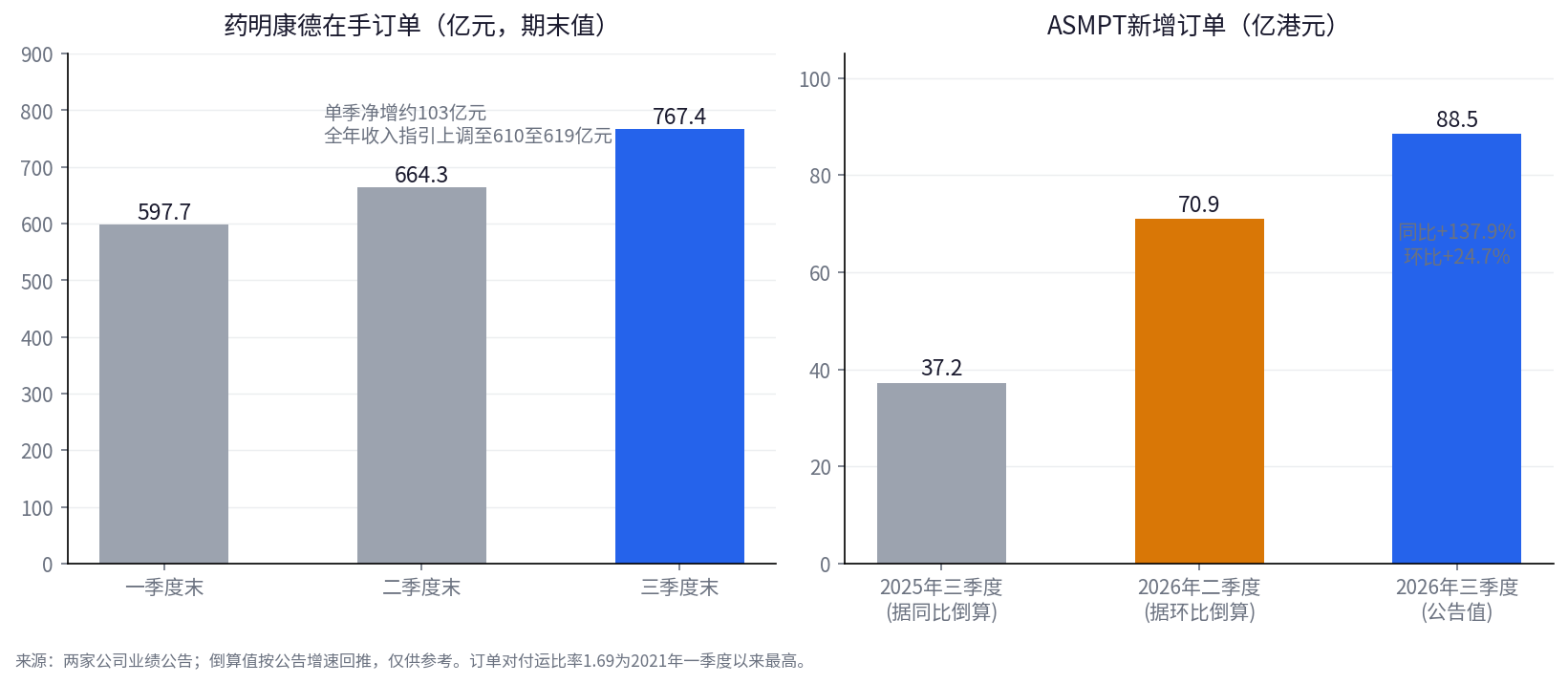
More important than the quarter’s profit was the order book. As of the end of September, WuXi AppTec had RMB 76.74 billion in backlog, up 36.4% year over year, with a net increase of about RMB 10.3 billion in the quarter. The company also raised its full-year revenue guidance from RMB 58.5 billion-60.5 billion to RMB 61.0 billion-61.9 billion, and lifted its adjusted free cash flow outlook to RMB 14.5 billion-15.5 billion. Order growth, higher revenue guidance and better cash flow expectations formed a set of signals that reinforced one another.
ASMPT’s order data stood out even more. On Oct. 28, the company reported third-quarter sales revenue of HK$5.247 billion, up 48.7% year over year. New orders totaled HK$8.845 billion, up 137.9% and a record high, while rising 24.7% from the prior quarter. The book-to-bill ratio reached 1.69, the highest level since the first quarter of 2021. The company guided fourth-quarter revenue to $670 million-$730 million. Using the midpoint of that range, the implied growth rate is about 4.6% quarter over quarter and about 37.5% year over year.
Those figures provide more direct evidence of AI supply-chain demand than a broad narrative alone. For AI investment to become revenue for equipment and supply-chain companies, customers still need to place orders, companies need to deliver equipment, and revenue needs to be recognized. ASMPT’s new orders and fourth-quarter guidance offer a trackable basis for the next few quarters. But the company also said the order number included one-off large orders and the effect of customers ordering early because of longer delivery cycles. In other words, order growth is a real operating signal, but it should not be translated mechanically into 137.9% future revenue growth.
The market response was not a straight line higher. WuXi AppTec opened more than 4% higher after earnings on Oct. 27, and by 3:45 p.m. on Oct. 28 it was up about 2.2%. ASMPT opened nearly 5% higher on the day of its results, then gave back gains in the afternoon. By 3:45 p.m., it was at HK$117.3, down about 3.2% from the previous close.
That is a reminder that even when operating indicators improve, stock prices still depend on whether the improvement beats prior expectations, whether valuation had already priced it in, and how investors judge the pace at which future orders will convert. WuXi AppTec and ASMPT share one feature: both provided operating variables that can be tracked over time, including order size, revenue guidance and cash flow expectations. The difference is that WuXi AppTec’s backlog more directly reflects future work to be executed, while ASMPT’s new orders still need to be tested against delivery cycles, early ordering and product mix.
The next stage is straightforward in concept, even if not in outcome: can orders turn into revenue, can revenue turn into profit, and can profit turn into cash flow?
China Shenhua: the market also pays for visible cash returns
If Hengrui, WuXi AppTec and ASMPT represent different forms of growth, China Shenhua points to another pricing logic. Growth does not have to be fast if current yield and shareholder returns are clear enough.
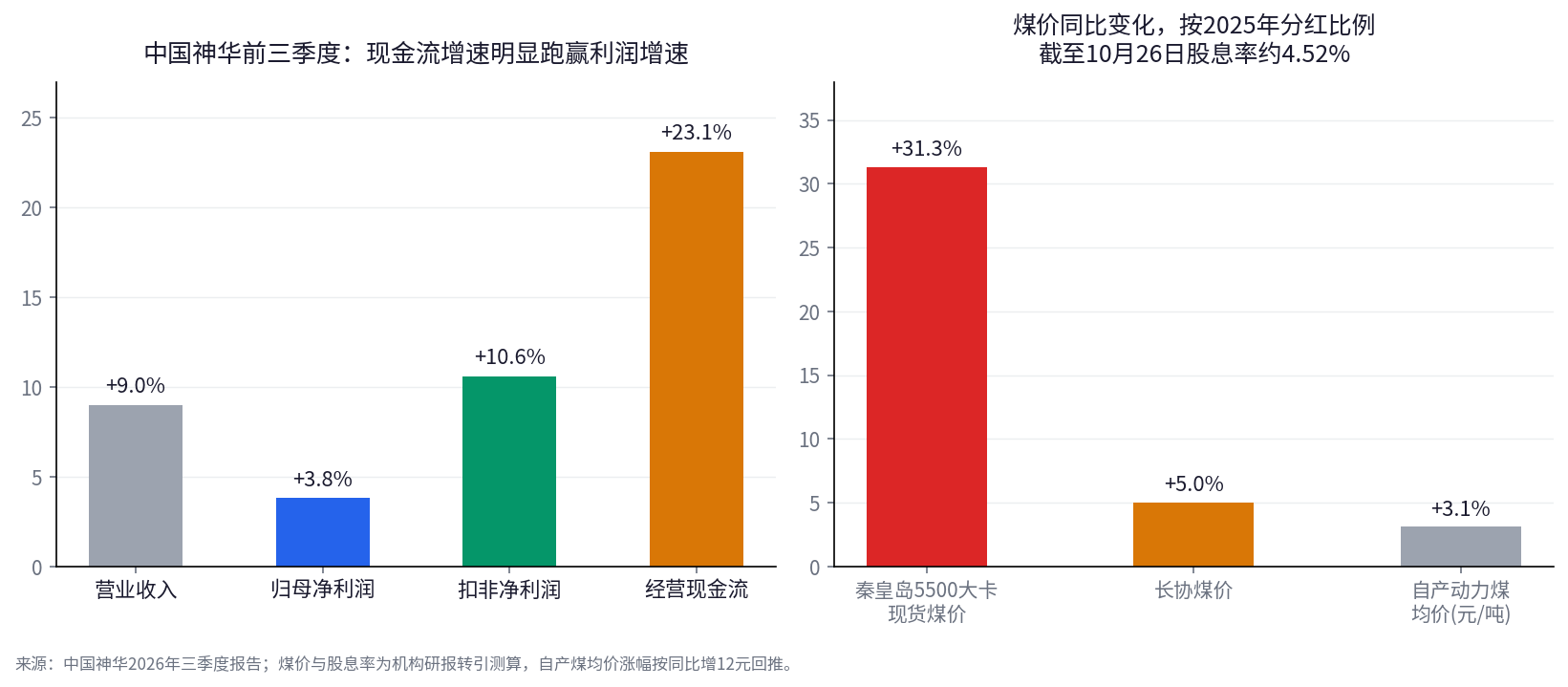
China Shenhua reported third-quarter net profit attributable to shareholders of RMB 15.688 billion, up 3.2% year over year, while net profit excluding non-recurring items rose 10.6%. For the first three quarters, revenue was RMB 296.031 billion, up 9.0%; net profit attributable to shareholders was RMB 44.403 billion, up 3.8%; and net cash flow from operating activities was RMB 92.7 billion, up 23.1%. Based on the company’s 2025 payout ratio, the dividend yield was about 4.52% as of Oct. 26.
Unlike innovative drug makers or AI supply-chain companies, China Shenhua does not need rapid growth to justify all of its investment case. For this kind of asset, investors care more about changes in coal and power prices, the stability of long-term contract mechanisms, capital spending and whether operating cash flow can cover dividends. Qinhuangdao 5,500 kcal spot coal prices were up 31.3% year over year, while long-term contract prices rose 5.0%, giving cash flow support from the pricing side.
Slower profit growth does not automatically reduce the stock’s appeal. If cash flow is stable, capital allocation discipline is clear and dividends look sustainable, investors may still be willing to pay for current returns.
But high dividend yield also needs verification. Lower commodity prices, higher capital spending or a sustained decline in earnings could all weaken future dividend capacity. Dividend yield is a return metric based on the current share price. It is not a promise of future payouts. The key question is how much of the dividend comes from sustainable free cash flow and whether the company must sacrifice necessary investment to maintain distributions.
That is where China Shenhua differs from Hengrui and WuXi AppTec. Growth companies need to prove that future profit can be realized. Cash-return companies need to prove that current income can last. The article argues that the market is re-comparing growth, risk and the certainty of cash returns across different assets, and that a simple growth-versus-value split does not capture the shift.
The market is looking for a verifiable premium
Put together, the six cases make the logic behind the earnings split clearer. The market is not uniformly rewarding high profit growth, and it is not uniformly rewarding orders or high dividends either. It is looking for whichever metric best proves that a company’s growth or shareholder return can continue in the way investors expect.
The value of that framework is not that it predicts stock moves from a single number. It tells investors what to watch next. High profit growth does not mean future profit will necessarily be higher. Fast order growth does not mean every order will be delivered on time. Strong cash flow does not mean dividends will stay stable forever. Each metric answers a different question, and only when it is placed in the context of a company’s business model, balance sheet and valuation expectations does it become useful for a fuller judgment.
The article also stresses that stock prices reflect changes relative to expectations, which is more complicated than simply grading an earnings report. A company can grow and still see its shares fall if the result misses what the market had already expected. A company can post modest growth and still rise if operations come in better than feared. In that sense, a “verifiability premium” does not mean investors only want cash flow or only want orders. It means that when valuations are under pressure and capital is more cautious, investors care more about the source of growth, the path to realization and the durability of returns.
The current Hong Kong market pullback mainly reflects pressure from valuation and the funding environment. The divergence in individual stocks has more to do with the relationship between earnings expectations, growth quality and valuation. Temporary southbound outflows describe the funding backdrop at that moment, but they are not enough to prove that the market has completed a long-term shift from growth to value. To confirm that, investors would still need to watch later fund flows, relative sector performance and whether post-earnings stock reactions can hold.
The next earnings round may test realization, not just growth rates
HSBC, CATL, Hengrui Pharma, WuXi AppTec, ASMPT and China Shenhua represent six different operating and pricing situations. HSBC needs to show that core earnings improvement is not just a base effect. CATL needs to bring revenue, profit and cash flow back into a more convincing alignment. Hengrui needs to show that licensing income and innovative drug sales can support earnings together. WuXi AppTec and ASMPT need to convert orders into revenue and cash flow. China Shenhua needs to show that current cash returns are sustainable.
None of these companies can be judged conclusively from a single quarter. But together they point to a change worth tracking: in a market where valuations are under pressure, growth still matters, but investors increasingly want to know how that growth will actually be realized.
The next pieces of evidence will come from whether CATL’s operating cash flow recovers, whether WuXi AppTec’s orders keep converting, whether ASMPT’s strong order intake turns into later revenue, and whether Hengrui can maintain growth in its innovative drug business. If later earnings reports show that profit growth driven by one-off factors still receives the same valuation response as core operating improvement, then the explanation built around a verifiability premium would need to be revised. What the market ultimately rewards will be answered by the next set of results, not by a slogan.
Data notes
- HSBC third-quarter results and stock-price reaction: company earnings release, 21st Century Business Herald, China News Service, Oct. 27-28, 2026.
- Third-quarter reports for Hengrui Pharma, WuXi AppTec and China Shenhua: company filings, Xinhua Finance, Shanghai Securities News, Oct. 23-27, 2026.
- CATL third-quarter report, earnings briefing and quarterly cash-flow breakdown: company filings, Caijing, Phoenix Finance, Sohu Finance, Oct. 20-23, 2026.
- ASMPT third-quarter results: company earnings release, Finet, Zhitong Caijing, Oct. 28, 2026.
- Coal-price and dividend-yield calculations: research reports from institutions including Everbright Securities, cited in the article, Oct. 26-27, 2026.
- Hang Seng Index, Hang Seng Tech Index and southbound fund flows: public market statistics, Oct. 20-23, 2026, with Hang Seng Tech closing levels cross-checked against market data.
Disclaimer: The article says the content is for general information and market commentary only, based on public materials available up to the times stated. Market data and expectations may change with market conditions. Views and strategies cited from third-party institutions, analysts or other parties represent only those parties’ views at the relevant time and do not represent BIT’s views or recommendations. The article does not constitute investment advice, investment research, solicitation, invitation or a recommendation regarding any security, investment product or trading strategy, and should not be used as the basis for any investment decision. Financial markets involve risk, and security prices and market performance may fluctuate. Historical performance and past market trends do not represent or guarantee future results. Investors should independently assess relevant risks based on their own circumstances and seek professional advice when needed. BIT’s Hong Kong stock trading service is not offered to Hong Kong residents or users in other restricted jurisdictions.


