
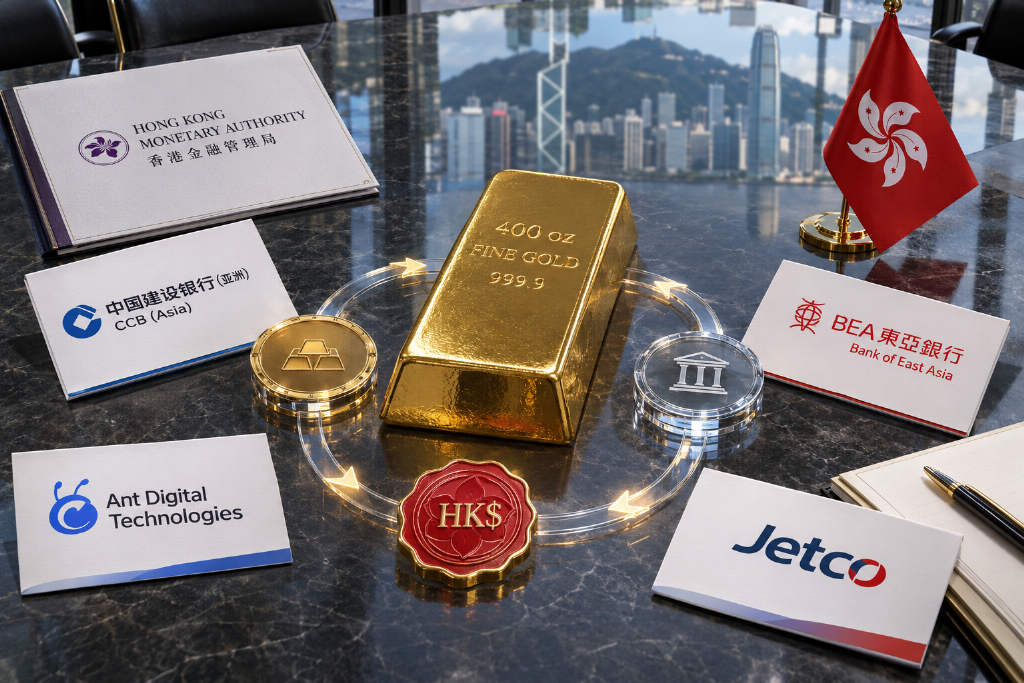
Hong Kong has completed its first interbank transaction that combined tokenized gold with tokenized deposits, a move that brought the gold ledger and the money ledger into the same settlement loop for a single trade.
The announcement was made on Nov. 2, the opening day of Hong Kong FinTech Week, by Secretary for Financial Services and the Treasury Christopher Hui. Spot gold was trading near $3,945 per ounce that day, up 1.8%.
What made earlier cross-bank gold trades slow
At first glance, the development looks like another case of putting gold on-chain. The bigger shift lies elsewhere: this was the first time the ledger for gold and the ledger for cash were handled inside one settlement loop.
The article illustrated the old process with a 400-ounce gold bar sold by one institution to a corporate client of another bank. The trade itself could be agreed within minutes, but settlement took much longer. The seller had to place the gold into a delivery vault, and the custody system had to record the change in ownership. The buyer, on the other side, paid from its bank account, and the banking system moved the funds.
Those two ledgers ran separately. Only after reconciliation could both sides treat the transaction as fully matched. Settlement cycles such as T+1 and T+2 effectively existed to leave time for that reconciliation window.
Using the account-layered settlement framework cited in the article, the asset layer for gold and the monetary layer for deposits had long been two separate ledger systems. Settlement between them depended on manual reconciliation and time delays.
How the EnsembleTX trade was structured
The transaction involved Zhaojin Mining as the gold issuer, China Construction Bank (Asia) as custodian and paying bank, Bank of East Asia together with Jetco as receiving banks, and Ant Digital Technologies’ Anvita TaaS platform as the technology provider.
The structure had two core steps.
First, the gold was given an on-chain digital certificate, or gToken. Without changing the existing bank gold account structure or the legal path for transfer of title, ownership transfer records were synchronized on-chain. All parties viewed the same on-chain record, and key information and holding status for the gold could be verified in real time.
Second, the payment leg did not use a traditional interbank transfer. It used tokenized deposits, or TD, routed through the Ensemble project’s interoperability layer into the Hong Kong dollar Real Time Gross Settlement system, or RTGS, allowing funds to arrive across banks immediately.
Taken together, those two steps created a delivery-versus-payment style settlement loop in a single transaction. There was no need to wait for T+2, and no need for manual reconciliation. Ownership of the gold and ownership of the funds were confirmed under the same settlement logic at the same time.
The article compared the old and new models this way: before, the gold ledger changed the owner’s name on one book while the money ledger changed the numbers on another, and then both books had to be checked against each other. Now, both ledgers can confirm at the same moment that the gold bar has changed hands and the money has changed hands as well.
Why tokenized deposits were used instead of stablecoins
A central design choice in the transaction was the use of tokenized deposits rather than stablecoins for settlement.
Tokenized deposits are essentially an on-chain representation of commercial bank deposits. They are bank liabilities and sit within the banking regulatory framework. Stablecoins are liabilities of private issuers. The article said the two differ in both credit hierarchy and legal status.
The path described for EnsembleTX was: tokenized gold at the asset layer, tokenized deposits as an on-chain extension of second-layer bank accounts, the Ensemble interoperability layer, and then Hong Kong dollar RTGS as an extension of the first-layer account system.
That means the model did not bypass the banking system. It shortened the settlement path between second-layer accounts and asset-layer accounts from within the banking system’s own account hierarchy. The article also said the gold token was backed by LGD-standard gold bars, a custodian bank, and Hong Kong gold settlement standards. The tokenized deposit leg ultimately connected back to the central bank RTGS system.
That is why the significance of the trade was not simply that gold became a token. The point was that tokenization, inside a regulated interbank framework, reduced the number of settlement layers between assets and money to the minimum.
From gold to a broader settlement architecture
The move was not presented as a one-off. On the same day, the Hong Kong Monetary Authority said EnsembleTX had entered a new phase. Tokenized central bank money, or CeBM, will support 24/7 settlement for interbank tokenized deposits. The number of participating banks increased to 12, and the number of industry pioneers rose to 20.
That means settlement for tokenized deposits would no longer be limited by traditional banking hours. It could be completed at any time, with central bank money serving as the final settlement asset.
Tests by the Hong Kong Gold Exchange and China CITIC Bank International also showed that tokenized deposits had reduced settlement time for gold trades to T+5 minutes. The target is T+0 real-time delivery, and the article said this is expected to lift trading volume and circulation by 2 to 3 times.
Viewed together, the direction is clear in the article’s framing: EnsembleTX is building a reusable settlement architecture made up of an asset layer, a tokenized deposit layer, and a final settlement layer based on central bank money. Gold is the first asset class to complete the loop. The same logic could extend to tokenized money market funds, tokenized bonds, and potentially tokenized carbon credits and warehouse receipts.
In that framework, putting an asset on-chain no longer means giving it a digital shadow. It means allowing the asset and the money leg to reach final settlement within the same settlement layer.
How it differs from tokenized gold in open crypto markets
The article also compared EnsembleTX’s gold token with open-market crypto products such as XAUT and PAXG. The difference, it argued, comes down to who defines settlement finality.
XAUT and PAXG are tokenized gold products traded on public blockchains. Trading and settlement happen on-chain, and finality comes from blockchain consensus and issuer credit. But they are not connected to the interbank settlement system. A holder of XAUT can sell it to another person, yet cannot directly use XAUT to complete a regulated delivery-versus-payment transaction in Hong Kong’s interbank market with RTGS as the final settlement layer.
By contrast, finality for EnsembleTX’s gold token is anchored in Hong Kong dollar RTGS and tokenized central bank money. It gives up part of the openness associated with permissionless systems in exchange for interbank-grade settlement certainty.
The article did not frame the two models as substitutes. Instead, it described them as parallel implementations of the same logic across two account systems: open markets define finality through on-chain consensus, while regulated markets define finality through central bank money. The settlement layer that confirms the trade depends on the account system in which the asset is traded.
The unresolved issue: settlement across separate ledgers
The article closed by noting that EnsembleTX solves the asset-money settlement loop within one interbank account system. It has RTGS and tokenized central bank money as the final backstop. The path is shorter, but it still operates in an environment with a centralized final settlement layer.
Open crypto markets face a different problem. Assets and money are spread across Ethereum, Solana, multiple public chains, and exchange ledgers. There is no single equivalent of Hong Kong dollar RTGS or tokenized central bank money to serve as the final settlement layer for all of them. In that setting, the question becomes who confirms finality for delivery-versus-payment across separate ledgers.
Rather than weakening the case for EnsembleTX, the article argued that the project shows something important: settlement efficiency for tokenized assets depends on how strong the final settlement layer is. In the interbank system, that strength comes from central bank money. In open markets, it would require a cross-ledger delivery confirmation protocol that does not depend on a single institution.
EnsembleTX has already completed the asset-layer and money-layer settlement loop inside a regulated framework. The next test, according to the article, is whether that loop can be extended from a system covered by one RTGS network to multiple ledgers that do not belong to the same hierarchy.



