
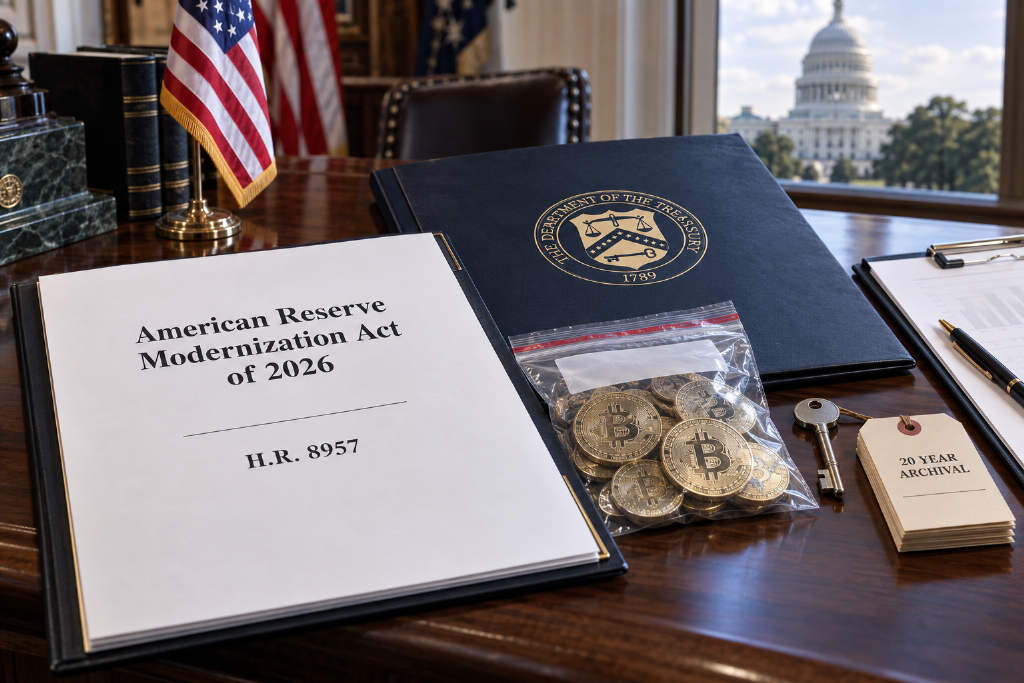
The U.S. House Financial Services Committee has advanced legislation that would write President Donald Trump’s Strategic Bitcoin Reserve into federal law, converting it from an executive-order policy into a permanent statutory framework.
On Sept. 16 Eastern Time, the committee approved the American Reserve Modernization Act of 2026, or ARMA, bill number H.R. 8957, by a 28-21 vote.
Under the bill, bitcoin obtained by the U.S. government through criminal and civil forfeitures would be placed into a Strategic Bitcoin Reserve managed by the Treasury Department. The proposal says the government must hold those assets for at least 20 years.
The measure is not yet law. It still must pass the full House and the Senate before it can be sent to the president for signature.
From executive order to statute
Trump established the Strategic Bitcoin Reserve through an executive order in March 2025. That order directed the federal government to retain bitcoin seized through criminal and civil forfeiture processes rather than sell it at auction.
An executive order can be changed or revoked by a future president. ARMA would move that policy into federal statute, making it harder for later administrations to unwind the reserve structure.
A 20-year holding requirement sits at the center of the proposal
Estimates put current U.S. government bitcoin holdings at more than 300,000 BTC. Blockchain analytics firm Arkham Intelligence has estimated the figure at about 324,527 BTC, valued at roughly $24.7 billion based on the data cited in the report.
The exact total remains uncertain because the government has never published a single reconciled ledger of its bitcoin holdings.
For bitcoin holders, one of the most consequential provisions in the bill is the proposed 20-year holding period.
According to the legislation, bitcoin deposited into the Strategic Bitcoin Reserve generally could not be sold, exchanged, auctioned, or pledged as collateral during that period. In practice, that would keep a large block of government-held bitcoin out of potential selling supply for the next two decades.
Study required on budget-neutral bitcoin accumulation
The bill directs the Treasury Department and the Commerce Department to study how the government could accumulate additional bitcoin over the next five years without raising taxes, increasing government borrowing, or expanding the federal deficit.
At the same time, ARMA does not appropriate funds for the government to directly buy bitcoin in the market.
The legislation also requires federal agencies to report digital assets they hold or control.
Public proof-of-reserve disclosures and independent audits
ARMA would establish public proof-of-reserve disclosure requirements and independent audits designed to give the public a clearer picture of how much bitcoin the government holds and whether it controls the corresponding private keys.
The bill requires the Treasury Department to make regular public disclosures on the federal government’s Strategic Bitcoin Reserve, with different requirements for quarterly and annual reports.
What quarterly reports must include
Quarterly reports, prepared by the Treasury secretary, would need to disclose the reserve’s total bitcoin holdings, transaction records during the reporting period, and proof that the government still controls the private keys tied to those assets.
Each report would also need to include a public cryptographic attestation and be posted on the Treasury Department’s website.
Third-party verification and oversight
The bill calls for the selection of an independent third-party audit firm with expertise in cryptographic attestations to verify the accuracy and completeness of the quarterly reports.
The Comptroller General would oversee the reserve, the reporting process, and the audits.
Treasury and Commerce must report to Congress
Beyond the disclosure rules, the Treasury secretary and the commerce secretary would be required to submit an initial study and annual updates to Congress assessing the feasibility of acquiring more bitcoin over the next five years.
Those reports would examine the risks, costs, and potential benefits of increasing the government’s bitcoin holdings, and evaluate whether purchases could be made on a budget-neutral basis.
The reports would be submitted to the Senate Banking Committee and Finance Committee, as well as the House Financial Services Committee and Ways and Means Committee.
Begich says the current system is too fragmented
Begich, the bill’s sponsor, said the current framework is too fragmented.
“We cannot allow federally held bitcoin to sit idle in fragmented custodial arrangements with inconsistent standards,” Begich said, pointing to cybersecurity and accounting concerns.
Bitcoin would be treated differently from other digital assets
The bill draws a distinction between bitcoin and other digital assets.
Other digital assets acquired through government forfeiture processes would generally go into a separate Digital Asset Stockpile rather than the Strategic Bitcoin Reserve. That means Ether and other tokens would not necessarily face the same 20-year restriction applied to bitcoin.
The legislation also includes language protecting private bitcoin ownership and self-custody. It states that nothing in the act may be used to authorize the government to seize or interfere with lawfully held private bitcoin.
Supporters say the bill would provide a clearer long-term framework for bitcoin the government already holds.