
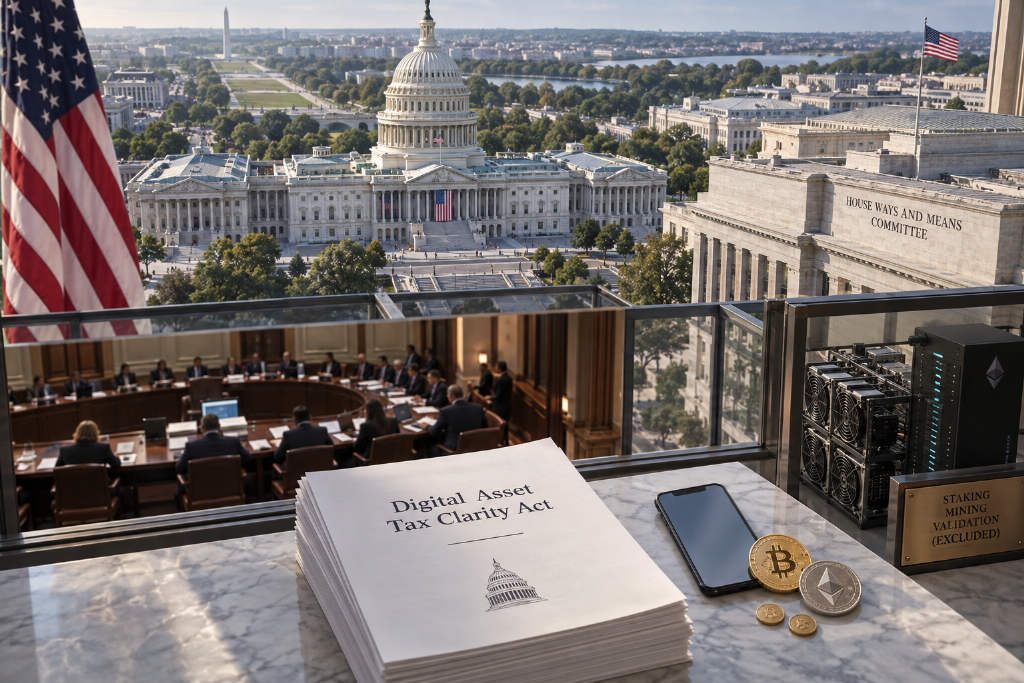
The House Ways and Means Committee released the text of a 114-page crypto tax bill on Monday and set a markup for Wednesday at 10 a.m. ET, sending a sweeping rewrite of how the tax code treats digital assets to a committee vote.
The Digital Asset Tax Certainty Act was introduced by Committee Chairman Jason Smith of Missouri with eight cosponsors. They include Steven Horsford and Max Miller, the two lawmakers Smith highlighted in June when he described crypto tax policy as a bipartisan effort.
Fee exemption is limited to $10 and does not cover purchases
One of the bill’s most closely watched provisions falls short of the tax-free spending treatment the crypto industry had been seeking. A new Section 1044 would provide that no gain or loss is recognized when a digital asset is used to pay a network or transaction fee of $10 or less.
The carveout covers gas fees and brokerage costs rather than the purchase itself. It also excludes traders, brokers, dealers, businesses that batch validations for others, and anyone who made more than 5,000 digital asset transfers in the prior year.
The provision would apply to dispositions after Dec. 31, 2027.
Senator Cynthia Lummis had pushed for a $300 per-transaction exemption covering purchases during last year’s reconciliation fight. That approach does not appear in the House text.
Staking and mining rewards remain ordinary income
Title IV adds a one-sentence rule: income from digital asset validation supporting activities is treated as ordinary income.
The bill does not give miners or stakers an election to defer tax on newly minted tokens. In June, Smith described a mining and staking bill that would let miners and stakers treat that income as self-created property, depending on the method that best matched the timing and character of the rewards.
That flexibility is missing from the introduced version.
The bill also says a trust would not lose its status as a trust solely because its trustee has the power to stake the digital assets it holds. That protection does not extend to an entity that is actively in the business of validating transactions.
Wash-sale rule, stablecoin basis band, and disclosure program
The legislation would extend wash-sale rules to traded digital assets, disallowing a loss if the seller buys back the same or a near-identical asset within the 30 days before or after the sale.
It also keeps qualified lending transfers from being treated as sales, sets a stablecoin basis band at 99.5% to 100.5% of redemption value, and gives the Treasury Department one year after enactment to launch a Digital Asset Voluntary Disclosure Program.
Under that program, qualifying taxpayers could amend past returns and pay taxes they owe.
Wednesday vote comes just before the House leaves Washington
The timing leaves little room for action this year. The House is scheduled to leave Washington later this week and will not return until after the November election, which means Wednesday’s vote is more likely to set up work for the next Congress than to produce a new law in 2026.
The Senate, meanwhile, is scheduled to hold its own cloture vote on the Clarity Act on Tuesday. If that market structure bill advances, it would also demand House attention.