
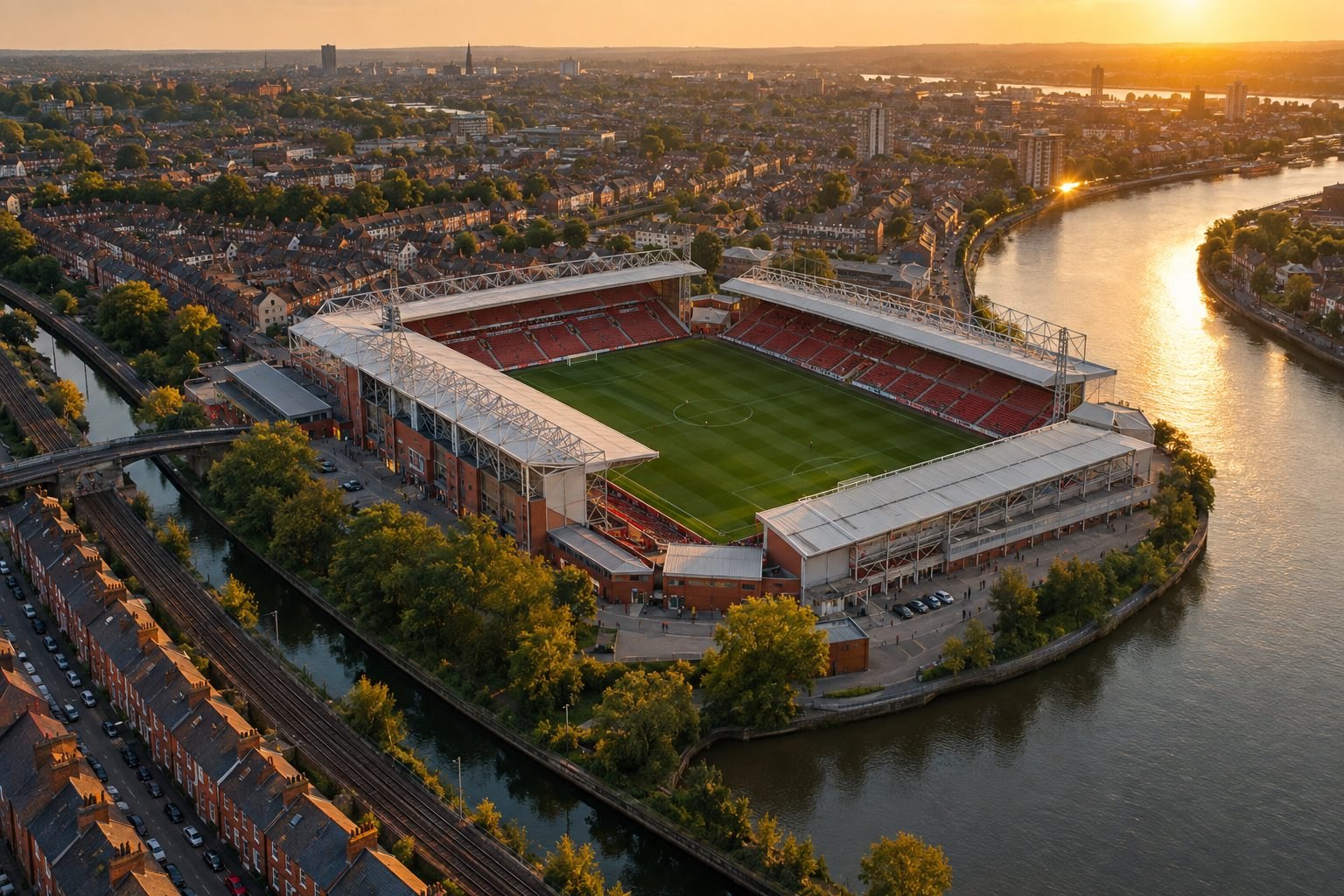
The Premier League is England's top division. It has 20 clubs playing each other home and away from August to May, with 38 matches per club and 380 in total; 3 points for a win, 1 for a draw, and the bottom 3 go down to the Championship.
How the league format is set up
| Item | Detail |
|---|---|
| Clubs | 20 |
| Matches per club | 38 |
| Home and away split | 19 home, 19 away |
| Total matches | 380 |
| Season dates | 21 August 2026 to 30 May 2027 |
Every club plays every other club twice, once at home and once away.
That setup gives every club the same league opposition list over the course of the season. What changes is the order of fixtures, not the underlying structure.
How points, ranking and the title are decided
| Rule | Outcome |
|---|---|
| Win | 3 points |
| Draw | 1 point |
| Defeat | 0 points |
| Most points at season's end | Premier League champions |
| Level on points: first tiebreaker | Goal difference |
| Level on points: second tiebreaker | Goals scored |
| Level on points: third tiebreaker | Points and away goals in head-to-head matches |
The title goes to the club with the most points after the full league season.
If clubs finish level on points, the table is sorted first by goal difference and then by goals scored. If they still cannot be separated, the next step is the points and away goals from the matches between those clubs.
European places and relegation
| Position or result | What it means |
|---|---|
| Top 4 | Qualify for next season's UEFA Champions League |
| Extra place when the league earns the European Performance Spot | 1 more Champions League berth |
| Bottom 3 | Relegated to the Championship |
| Championship top 2 | Promoted automatically |
| Championship play-off winners | Promoted to the Premier League |
League position shapes more than the title race. The top 4 qualify for the next season's Champions League, and the Premier League also had a fifth place in 2024/25 and 2025/26.
At the other end, the bottom 3 are relegated to the EFL Championship. They are replaced by the Championship's top 2 and the winners of its end-of-season play-offs.
The scale and history behind the competition
Premier League matches are shown in 920 million homes across 189 countries. Since 1992, 51 clubs have played in the league.
Seven clubs have won the title in that period: Manchester United, Manchester City, Chelsea, Arsenal, Liverpool, Blackburn Rovers and Leicester City. Arsenal remain the only club to complete a whole Premier League season unbeaten, doing so in 2003/04.
Luton Town were the latest club to make their debut, in 2023/24. The champions in the last 5 seasons were Manchester City in 2021/22, 2022/23 and 2023/24, Liverpool in 2024/25, and Arsenal in 2025/26.
FAQ
What makes the Premier League a league rather than a cup competition?
The Premier League is decided by points collected over the full season. Cup competitions are usually built around knockout rounds, so one result can end a team's run.
Is the champion always decided by goal difference?
No. Goal difference only matters when clubs finish level on points. If one club ends the season with more points than everyone else, that club are champions without needing any tiebreaker.
How many teams go down from the Premier League?
3 clubs are relegated at the end of the season. They drop into the Championship and are replaced by promoted clubs from that division.
Why can the Champions League places rise above 4?
The standard route is a top-4 finish. When the league earns the European Performance Spot, it gains 1 extra Champions League place, which happened in 2024/25 and 2025/26.