
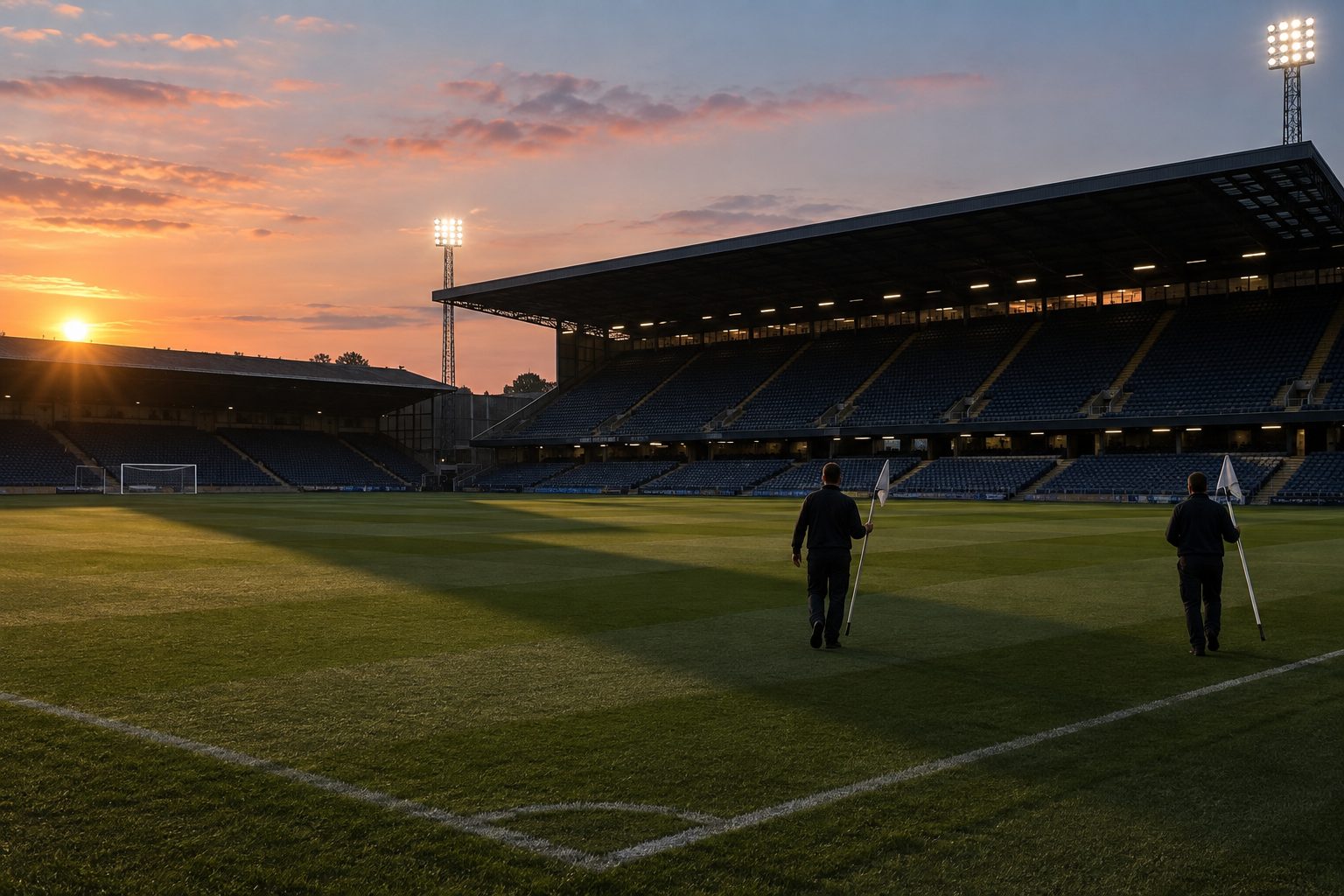
A Premier League match lasts 90 minutes of playing time, split into 2 halves of 45 minutes, with a 15-minute half-time interval and added time at the end of each half.
The standard length of a Premier League match
Premier League rules set the duration of a league match at 90 minutes. Law 7 of the IFAB Laws of the Game says a match is played in 2 equal halves of 45 minutes.
That is the official playing time in normal league play. Premier League matches do not use extra time or penalties after the 90 minutes.
| Item | Rule or outcome |
|---|---|
| Official match duration | 90 minutes |
| Half structure | 2 halves of 45 minutes each |
| Half-time interval | 15 minutes |
| Extra time after 90 minutes | No |
| Penalty shootout after 90 minutes | No |
Why matches go beyond 90 minutes
Added time is there to account for time lost during each half. The Laws list substitutions, injury assessment or removal, time-wasting, disciplinary sanctions, permitted medical stoppages such as drinks breaks and cooling breaks, VAR checks and reviews, goal celebrations, and any other cause.
Each half is timed separately. At the end of the final minute of a half, the fourth official shows the minimum added time decided by the referee; the referee can increase it, but not reduce it. A timekeeping error in the first half cannot be corrected by changing the length of the second half.
If a penalty kick must be taken or retaken at the end of a half, that half is extended until the penalty is completed.
How long a match usually lasts in practice
In real match conditions, the final whistle usually comes after the clock has gone past 90 minutes because both halves can carry added time. The Premier League's January 2024 analysis gives a clear season-by-season snapshot.
| Season | Average match time | Average ball-in-play time |
|---|---|---|
| 2020/21 | 96:34 | 56:22 |
| 2021/22 | 97:29 | 55:08 |
| 2022/23 | 98:27 | 54:52 |
| 2023/24 (first 203 matches) | 101:42 | 58:37 |
In that January 2024 sample, the average Premier League match in the first 203 games of 2023/24 lasted 101 minutes 42 seconds, which was 3 minutes 15 seconds longer than in 2022/23. Average ball-in-play time also rose to 58 minutes 37 seconds.
Once the 15-minute half-time interval is included, the average span from kick-off to full-time in those 2023/24 matches was 116 minutes 42 seconds.
Why 2023/24 matches became longer
The Premier League said the rise followed new timekeeping directives introduced in summer 2023. In the same January 2024 analysis, the average time played beyond 90 minutes went from 507 seconds in 2022/23 to 702 seconds in the first 203 matches of 2023/24.
The key point is that the 90-minute match length did not change. What changed was the amount of lost time being added back on.
FAQ
How long is half-time in the Premier League?
The half-time interval in Premier League matches is 15 minutes. IFAB says players are entitled to an interval of no more than 15 minutes, and the competition rules must set the exact length.
Who decides the amount of added time?
The referee decides it. The fourth official displays the minimum added time at the end of the final minute of each half, but that number comes from the referee.
How long is a Premier League match including added time?
There is no single fixed length because added time depends on what happens in the match. In the Premier League's January 2024 analysis, the average match time in the first 203 games of 2023/24 was 101:42, and 116:42 from kick-off to full-time once half-time was included.
Can added time be cut short?
No, not once the minimum added time has been shown. The Laws allow the referee to increase added time, but not reduce it.