
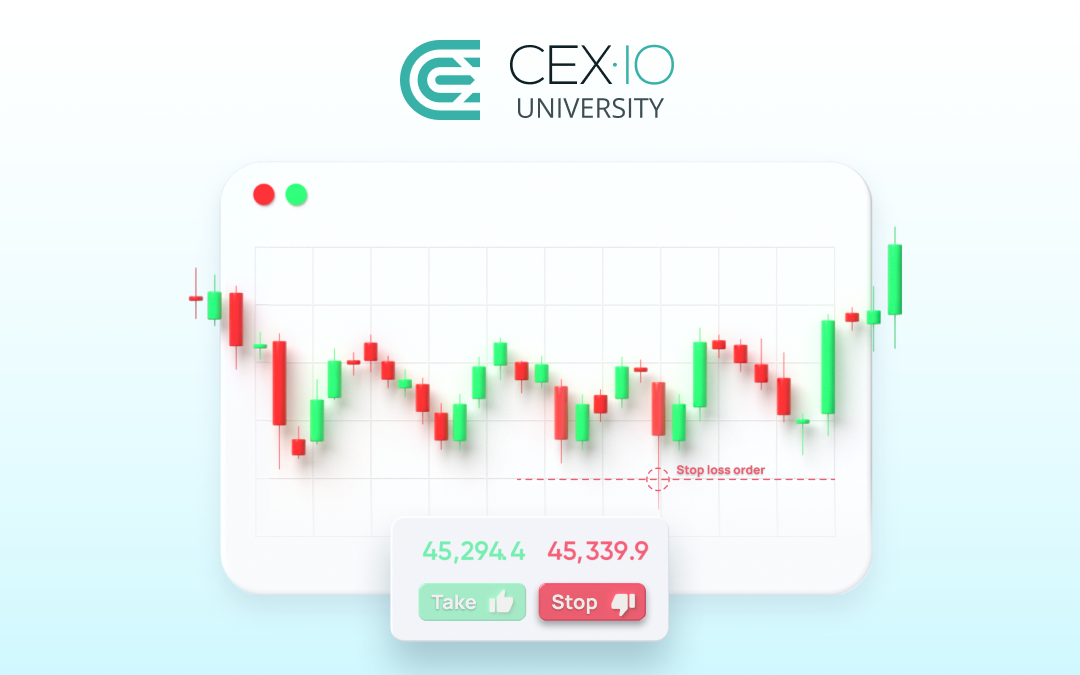
In spot trading, stop orders are not limited to protecting an open position. They can also be used as standalone pending orders to buy or sell once price reaches a predefined level. The source article frames them as conditional orders: the trade is activated only after the market touches a chosen stop level. In spot markets, the two main forms discussed are Stop Market and Stop Limit.
The difference between Stop Market and Stop Limit
A Stop Market order becomes a market order once the stop price is reached. Its main advantage is execution, not price certainty. In fast conditions or thin liquidity, the final fill may suffer slippage. The article uses a simple example: if a trader wants to buy Bitcoin when it reaches $25,000, setting that price as the stop level will trigger an immediate market order as soon as the level is hit.
A Stop Limit order works differently. After the stop level is triggered, the order turns into a limit order. That gives the trader more control over the execution price, but it also introduces the risk of a partial fill or no fill at all. The example provided is a trader who wants to buy Bitcoin at $25,000 but no higher than $25,200. In that setup, $25,000 is the stop level and $25,200 is the limit price. The order can be completed only if the market is willing to fill within that range.
How traders choose stop levels
The article outlines two methods for placing a stop order: a financial method and a technical method. The financial method starts with risk tolerance. A trader defines how much loss is acceptable in money terms, then places the stop accordingly. In the example, Bitcoin is bought at $25,000, and the trader does not want to risk more than $500. That leads to a protective stop at $24,500.
The technical method uses chart-based levels identified through technical analysis. Those may include prior highs and lows, moving averages, or Fibonacci retracement levels. The example in the source places Bitcoin at $25,000, with the trader expecting momentum to increase after a break above $26,000 resistance. To wait for confirmation, the stop level is set at $26,050, slightly above resistance.
Three practical uses in spot trading
The first is stop loss. The article notes that experienced traders often pair every trade with a stop order because markets can move against the original plan. A stop loss helps cap downside around a predefined level. The second is take profit. If a trader cannot monitor the market constantly, a pending stop-sell order can be used to exit at a planned target, bringing more structure to the trade.
The third use is moving stop orders. When price advances in the trader’s favor, the original stop loss can be replaced with a higher one to lock in a better exit point. The article’s example starts with a Bitcoin purchase at $25,000 and an initial stop at $24,500. After price rises to $26,000, the stop is moved up to $25,500. The market later reverses, but the trader exits at $25,500, which the source says preserves an extra $1,000 compared with the earlier stop setup.
The article also notes that this process can be automated with trailing stops, though those tools are typically more common in futures, options, or margin trading. In spot markets, using a trailing stop may require a trading bot if the platform does not natively support it.
The piece closes on a practical point: experienced traders tend to define entry, stop loss, and take profit before entering the market. In spot trading, stop orders sit at the center of that process, serving as a core execution and risk-management tool rather than a minor add-on.