
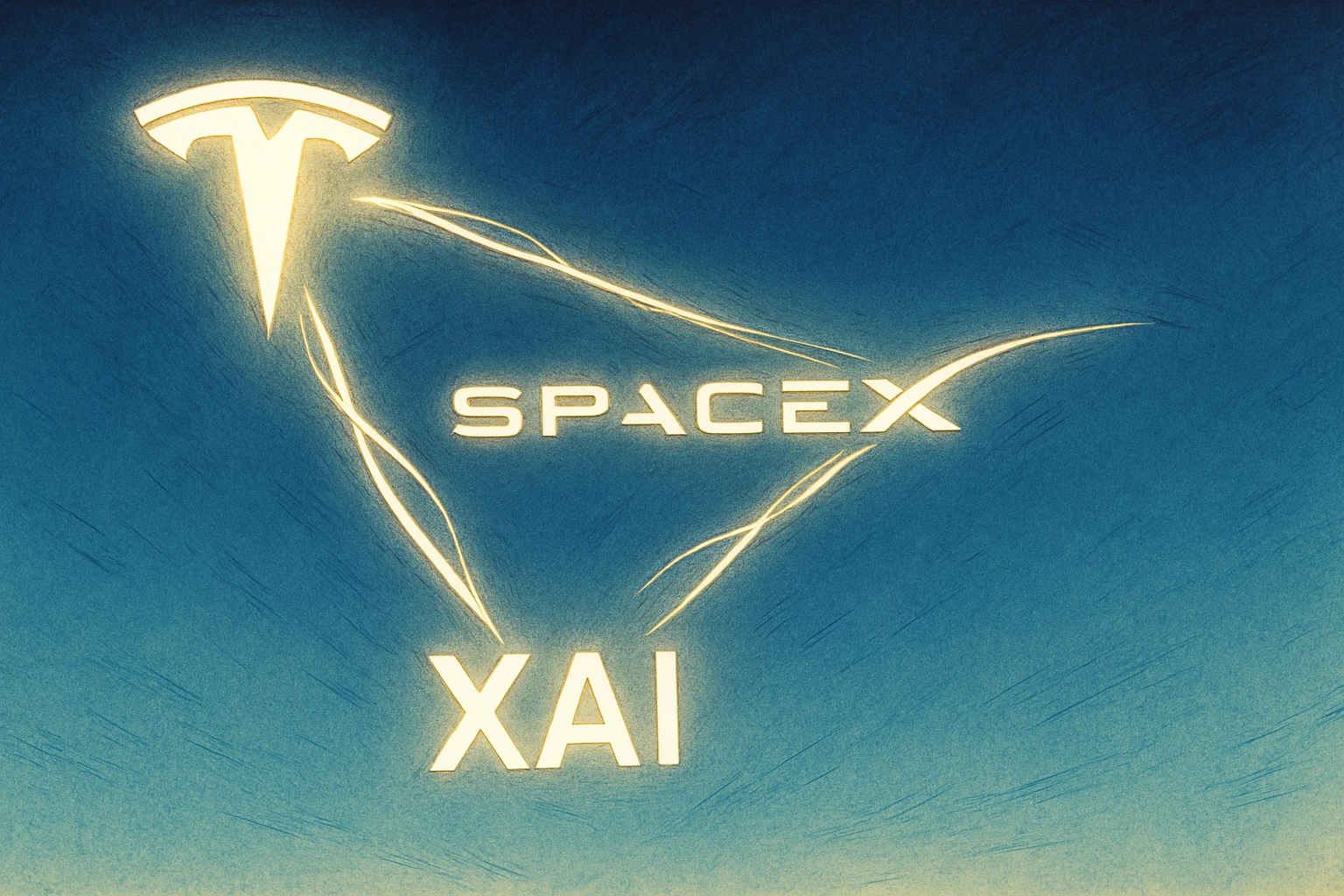
An analysis article compiled and translated by PANews argues that Tesla, xAI and SpaceX are being misread when treated as separate bets. Its core claim is simple: the three companies are increasingly tied together across energy, chips, compute, data and network distribution. The point is not just scale. It is the way each business feeds the next.
Energy storage is presented as the starting layer
The piece begins with Tesla’s energy business. It says Tesla deployed 46.7 GWh of energy storage in 2025, up 48.7% year over year. A 50 GWh factory in Houston is scheduled to start production this year, lifting total planned annual capacity to 133 GWh. Gross margin in energy storage is listed at 31.4%, compared with 16.1% for the auto business.
That matters in the article’s framework because xAI has already bought $375 million worth of Tesla Megapacks for Colossus, described as the world’s largest AI training facility. The system has 336 Megapacks deployed, supports 555,000 GPUs, and draws more than 1 gigawatt of power. Batteries are positioned here as backup capacity and demand-response infrastructure.
Chip strategy is aimed at reducing dependence on Nvidia
The article then shifts from batteries to silicon. It says Nvidia still controls roughly 80% of the AI training hardware market, with H100 and Blackwell chips acting as bottlenecks for major labs. In that setup, relying on an external supplier becomes a strategic weakness, especially if the long-term goal involves large fleets of vehicles and humanoid robots.
According to the piece, Tesla’s AI5 chip is expected between late this year and 2027. It also says AI6 is covered by a $16.5 billion foundry agreement with Samsung. Musk is cited as saying AI6 is designed for “Optimus robots and data centers,” which the author reads as a sign that Tesla hardware and xAI infrastructure could converge on a shared chip stack.
Space-based compute is treated as the outer edge of the plan
SpaceX enters the picture through a more ambitious idea. The article says Musk referenced “space-based AI compute” in Tesla’s Dojo 3 roadmap and restarted the Dojo 3 project around that vision. The scenario laid out is orbital data centers launched by Starship into low Earth orbit, with each rocket carrying 100 to 150 tons. Those centers would run xAI models, use Tesla-designed chips, and draw power from solar energy paired with Tesla batteries.
The communications layer matters just as much in this telling. SpaceX is described as having nearly 10,000 Starlink satellites already in orbit, plus approval for another 7,500. It also has 6 million direct-to-cell customers. The new V3 satellite is said to deliver 1 Tbps of downlink capacity, or 10 times the current generation. In the article’s view, that creates a path for global model delivery rather than a collection of separate products.
The hardest moat to copy is the data loop
The piece says the real advantage sits in the feedback loop between data collection and deployed endpoints. Tesla is credited with 7.1 billion miles of FSD driving data, more than 50 times Waymo’s total. xAI, in parallel, is described as having exclusive access to real-time data generated by about 600 million monthly active users on X. The article also lists 3 trillion parameters for Grok 3 and says a 6 trillion-parameter Grok 5 is scheduled for Q1 2026.
Those models are already moving into products, the article says. Grok has been available in Tesla vehicles since July 2025 for chat and navigation. Optimus is projected to produce 50,000 to 100,000 units this year and reach 1 million units in 2027. The structure described is clear: xAI builds models, Tesla makes chips, robots and batteries, and SpaceX provides launch and connectivity. The argument is that the value lies in the system formed by those links, not in any single company viewed on its own.
The valuation figures cited at the end follow the same logic. The article places xAI at $250 billion, SpaceX at roughly $800 billion with a targeted $1.5 trillion IPO, and Tesla at $1.2 trillion. Its conclusion is not about one business line outrunning another. It is that the synergy premium may be the main story.