
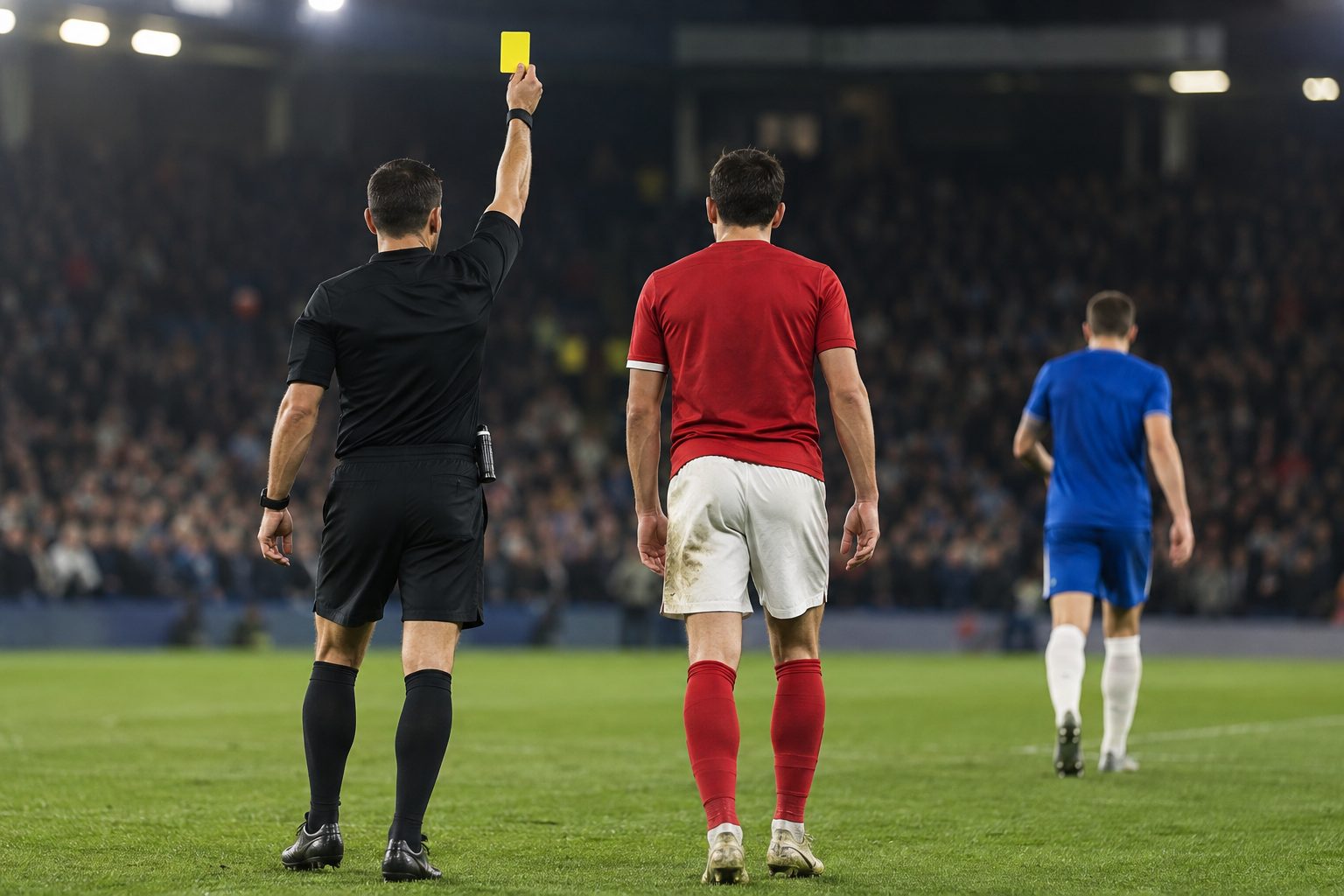
A yellow card is a caution in the Premier League, and a second yellow in the same match leads to a red card and a sending-off. Across the league season, reaching set yellow-card totals can also bring a suspension in Premier League matches.
What a yellow card means
Under IFAB Law 12, the yellow card communicates a caution and the red card a sending-off. Yellow and red cards can be shown not only to players on the field, but also to substitutes, substituted players, and team officials.
Disciplinary matters in the Premier League are overseen by the FA. For yellow cards, that matters in two ways: the caution affects the match itself, and league accumulation can later produce a ban in the same competition.
What actions bring a yellow card
Law 12 lists several cautionable offences that apply in Premier League matches. They cover restart management, behaviour toward the referee, how players enter and leave the field, and a group of actions classed as unsporting behaviour.
- Delaying the restart of play: slowing down a restart on purpose.
- Dissent by word or action: arguing with or showing clear disagreement toward the referee.
- Entering, re-entering, or deliberately leaving the field without permission.
- Failing to respect the required distance at a dropped ball, corner kick, free kick, or throw-in.
- Persistent offences: there is no fixed number or set pattern that automatically counts as persistent.
- Unsporting behaviour: this includes simulation, such as feigning injury or pretending to have been fouled; a reckless foul; stopping a promising attack with a foul or handball; handling the ball in an attempt to score; and showing a lack of respect for the game.
- Entering the referee review area.
- Excessively using the review signal: repeatedly making the TV-screen gesture.
Celebrations can also lead straight to a caution. A player must be booked for removing his shirt or covering his head with it while celebrating, even if the goal is later disallowed. Climbing a perimeter fence, or approaching spectators in a way that creates safety or security problems, also requires a yellow card.
Premier League suspension thresholds for yellow cards
The Premier League has reported the following league suspension thresholds across 2023/24 to 2025/26. These are Premier League yellow-card totals, and the ban is served in the same competition.
| Yellow cards | Reached within | Ban |
|---|---|---|
| 5 | The club's first 19 league matches | 1 match |
| 10 | The club's first 32 league matches | 2 matches |
| 15 | The season | 3 matches |
The match limits are tied to the club's league schedule, not to a calendar month. In December 2025, the Premier League stated that a player on 4 yellow cards would receive a 1-match ban if he was cautioned again within his club's first 19 matches.
There are published examples of the rule being applied. In April 2024, Douglas Luiz of Aston Villa collected his 10th yellow card in Gameweek 32 and was suspended for his club's next 2 matches. In December 2025, Marcos Senesi and David Brooks of AFC Bournemouth reached their 5th yellow cards of the season and faced suspensions.
What happens after 2 yellow cards in one match
A second caution in the same match is a sending-off offence. The player is shown a red card after that second yellow.
Law 12 also makes clear that 2 separate cautionable offences can produce 2 yellow cards even if they happen close together. That is different from season-long accumulation, which is about league totals over time rather than the disciplinary outcome inside one match.
FAQ
Do Premier League yellow cards count in the FA Cup?
No. The Premier League has stated that Premier League yellow cards do not carry over to the EFL Cup or the FA Cup. League bookings and league suspensions stay within the league competition.
Can a manager be shown a yellow card?
Yes. IFAB Law 12 allows yellow or red cards to be shown to team officials. That includes a manager on the touchline.
Is there a set number of fouls that counts as persistent offences?
No fixed number is written into the law. Persistent offending is left to the referee's judgment based on the pattern and nature of the offences.
If a player takes his shirt off to celebrate and the goal is ruled out, does the yellow card still stand?
Yes. Law 12 says the player must still be cautioned for removing his shirt or covering his head with it during the celebration, even when the goal is disallowed. The caution is for the celebration itself.