

HTX started rapidly rotating on-chain addresses after sanctions from the European Union and the United Kingdom’s Foreign Commonwealth & Development Office, according to a Protos report that cited TRM Labs. TRM said the activity made it harder to identify the exchange’s holdings.
Protos said the picture became less clear after HTX changed its proof-of-reserves format. The exchange shifted reserve locations into a new “ThirdParty” category, which it said was meant to describe funds held by third-party custodians. HTX said users could still verify those funds by contacting the custodians involved, but Protos wrote that HTX did not respond to its requests asking for the identity of that custodian.
TRM also said HTX was rotating wallets to stay ahead of screening. Protos linked that point to its earlier reporting that HTX moved $1.3 billion from reserves into an undisclosed “ThirdParty” category.
The stETH trail from HTX to Poloniex-labeled addresses
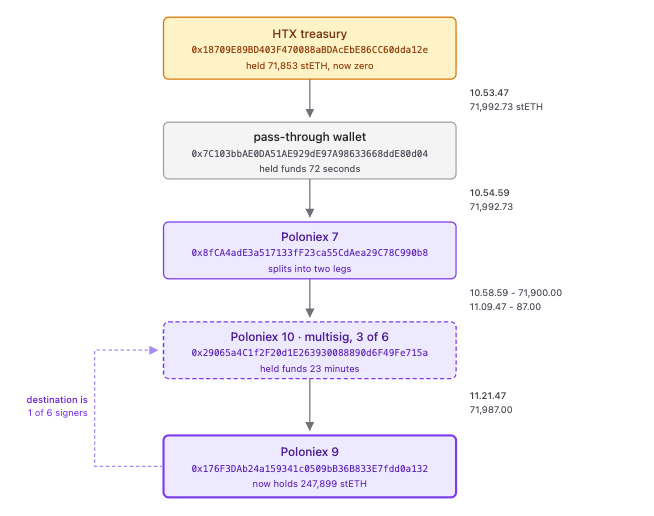
Before those changes, HTX published a proof of reserves that listed a range of addresses. Protos said it tried to follow the stETH held in one of those wallets to its final destination and argued that the transfer path may show how HTX has been operating.
In HTX’s May 1 proof of reserves, address 0x18709e89bd403f470088abdacebe86cc60dda12e held 71,853.22 stETH. Protos said that position was worth about $135 million at today’s price.
On May 30, shortly before HTX was due to produce its June proof of reserves and move funds into the “ThirdParty” category, those assets were sent to 0x7C103bbAE0DA51AE929dE97A98633668ddE80d04.
Moments later, the funds were transferred to 0x8fCA4adE3a517133fF23ca55CdAea29C78C990b8, an address labeled on Etherscan as Poloniex 7. They were then moved to 0x29065a4C1f2F20d1E263930088890d6F49Fe715a, which Etherscan labels as Poloniex 10. Shortly after that, the assets were transferred again to 0x176F3DAb24a159341c0509bB36B833E7fdd0a132, labeled on Etherscan as Poloniex 9.
Protos added that 0x176F3DAb24a159341c0509bB36B833E7fdd0a132 had previously been labeled “Justin Sun 4” on Etherscan before later being listed as a Poloniex address.
Based on that sequence, Protos said the transaction pattern shows a large quantity of funds moving from HTX into a Poloniex address, where the assets were commingled with Poloniex reserves.
Another reserve question tied to wrapped BTC
Protos said this was not the first time HTX had leaned heavily on Poloniex to hold certain assets. The report said that more than half of the BTC held at HTX was often in tokenized form, specifically a tokenized version that appeared to be held by Poloniex. It said that exposure often represented hundreds of millions of dollars in value.
According to Protos, Poloniex was unwilling to disclose the addresses where it presumably held that BTC.
As presented in the report, the question over whether HTX reserves were being mixed with Poloniex funds rests on Protos’ tracking of public on-chain transfers and TRM Labs’ statement about wallet rotation after sanctions.
