


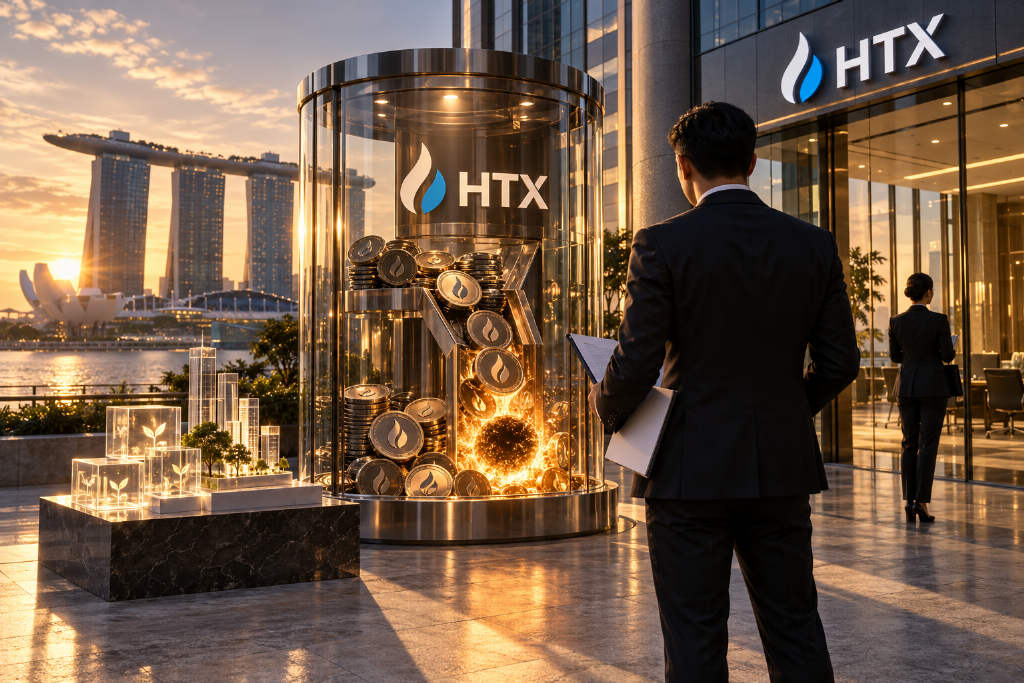
About 9.39 trillion HTX tokens were permanently sent to a burn address on Oct. 15, according to data disclosed by HTX DAO. The batch was valued at about $15.48 million, and the amount burned was 25.6% higher than in the previous quarter. In total, HTX DAO said cumulative HTX token burns and donations have reached about 127.18 trillion tokens.
Token burns are common across the crypto sector. What makes Huobi HTX stand out in this case is the structure behind them: under the current mechanism, 50% of quarterly revenue is used for HTX token buybacks and burns. That creates a direct link between the platform’s operating income and changes in token supply. In that sense, the bigger question is not the burn count itself, but where the revenue supporting those buybacks comes from and whether it can keep growing.
Revenue mix expands from crypto trading into TradFi-linked products
According to a third-quarter business report cited by PANews, Huobi HTX has been expanding beyond spot trading, derivatives, earn products and lending. Its TradFi-related business has become a major new line. By mid-October 2026, cumulative TradFi trading volume on the platform had approached $6 billion, with about $4.1 billion of that recorded in the third quarter alone, nearly 70% of the total.
The third quarter of 2026 also coincided with Huobi HTX’s 13th anniversary. The platform rolled out a series of campaigns across spot, futures, earn and lending products. Its quarterly report said the third trading competition drew 45,000 registered users, while futures trading volume during the event reached 6.8 billion USDT. Over the same period, copy trading volume in futures rose 21% from the prior quarter. On the spot side, the exchange ran 14 themed trading campaigns, attracting more than 46,000 registrations and generating over 500 million USDT in related trading volume.
The sharper shift came from products tied to traditional financial assets. Huobi HTX said it added 183 futures trading assets in the third quarter, including 154 linked to stocks and indexes, more than 80% of the new listings. By the time the quarterly report was released, the platform supported 278 stock-related and similar trading instruments, covering U.S.-listed companies, major global indexes, ETFs, some Japanese and South Korean companies, and products tied to pre-IPO firms.
That expansion also required product changes. During the third quarter, Huobi HTX upgraded the dividend settlement mechanism for stock perpetual contracts and added company profiles, market data and news information to improve the trading experience for traditional asset-linked products. Corporate actions such as dividends and stock splits require dedicated contract handling, and the report points to those adjustments as part of the platform’s product buildout.
Wealth products and lending are being used to keep capital on-platform
Huobi HTX is not only broadening the range of tradable assets. It is also trying to create more ways for user funds to remain inside the platform. In the third quarter, nearly 500,000 users participated in its earn products, with cumulative subscriptions approaching 1 billion USDT. The exchange also expanded the asset range for its SVIP flexible wealth products by adding BTC and ETH, and launched SmartEarn, a product that ties yield tiers to trading volume, allowing eligible users to access higher returns.
On the lending side, Huobi HTX added assets for margin and flash exchange trading and dynamically adjusted lending rates for more than 50 cryptocurrencies. Compared with trading alone, these products are more focused on retaining user assets and encouraging repeated use. For an exchange, that can translate into a broader customer relationship and potential income from interest, fees and other financial services.
PANews described the company’s expansion as two coordinated tracks. One track adds more tradable assets through TradFi-linked products. The other raises the frequency of capital use through wealth management and lending. Under HTX DAO’s current buyback-and-burn model, any stable income generated by those businesses could widen the funding base for future HTX repurchases and burns.
HTX token economics rest on three value-capture channels
Business growth at an exchange does not automatically translate into value for its platform token. The key issue is whether there is a clear economic connection between the two. HTX DAO currently relies on three main mechanisms to tie the HTX token to platform operations and ecosystem development: buybacks and burns, platform utility, and staking-based governance.
The most visible piece is the buyback-and-burn program. Under rules published by HTX DAO, Huobi HTX, as an ecosystem partner, uses 50% of quarterly revenue for HTX token buybacks and burns. HTX DAO’s website publishes records for each execution, including the date, token amount, U.S. dollar valuation and on-chain transaction hash. The mechanism has continued on a quarterly basis in 2026. The latest burn was 25.6% larger than the one in July. As of Oct. 15, HTX DAO said cumulative donations and burns had reached about 127.18 trillion HTX tokens, worth about $235 million.
The report noted that some tokens in the early stage were used to provide on-chain liquidity. Since the third quarter of 2024, HTX DAO has ended the liquidity donation mechanism and redirected those funds entirely to direct HTX burns. In either form, public on-chain records provide a basis for outside verification of how the tokens were handled.
On the demand side, HTX has been integrated into fee discounts, Prime membership benefits, Launchpool, new token rewards, Trade to Earn and wealth management products. Users can obtain platform benefits by holding or using HTX, tying token demand to everyday trading activity and platform campaigns. As Huobi HTX keeps expanding its TradFi and asset management businesses, the room to extend that utility framework also grows.
HTX DAO added another layer in March this year when it launched an on-chain staking mechanism. Under the rules, users who stake HTX through smart contracts receive sHTX as proof of their staking share and governance voting rights. Unlike HTX, which can be freely transferred, sHTX is non-transferable. Holders can use it to take part in DAO governance and receive staking rewards from ecosystem reserves under the mechanism.
Viewed through token economics, HTX now has three connected value channels: buybacks and burns reduce supply, platform utility creates practical demand, and staking governance gives users an incentive to hold for longer and participate in the community. The article also notes that the real effect of those mechanisms still depends on whether platform revenue, user demand and governance participation can produce tangible influence.
Genesis program aims to move beyond the exchange’s internal use cases
If HTX is to expand beyond exchange-native utility, external applications and developer activity become the next area to watch. PANews presents that as the backdrop for HTX DAO’s Genesis initiative this year.
In July, HTX DAO and B.AI jointly held the Genesis Hackathon, calling for AI and Web3 projects from developers worldwide. More than 200 teams took part. Project categories included AI agent finance, on-chain asset management, DeFi applications, DAO governance tools and other AI-Web3 combinations. The event included project screening, online demos, an offline final and community voting, creating direct contact between developers and the HTX DAO community.
But developer turnout is only the starting point. The harder test comes after the competition ends: whether developers stay, whether demo products become real applications, and how many projects can create lasting value for the ecosystem. HTX DAO’s Genesis Program was introduced as a longer-term structure and funding framework to address that issue.
In September, HTX DAO launched the Genesis plan with support from an ecosystem development fund initially sized at $10 million. Under the previously approved HIP-007 amendment proposal, the plan has three main parts: Genesis Hackathon for project discovery, Genesis Grant for funding and ecosystem support, and Ecosystem Node to connect developer communities, incubators, investment institutions and regional partners.
Under the governance proposal, the overall support pool is denominated in HTX tokens equal in value to $10 million. Individual projects are subject to separate evaluation and phased disbursement. They are reviewed against targets such as development progress, product launch, user growth and ecosystem integration. If a project fails to meet agreed requirements, later support can be adjusted or terminated. Rather than a one-time capital injection, the structure ties funding directly to project progress.
The article says this design combines developer grants with ecosystem investment and is intended to turn a one-off competition into a longer incubation system covering project discovery, funding and follow-through. HTX DAO also organized community voting around Genesis Hackathon finalists and brought the Genesis plan and its ecosystem fund into the formal governance framework through the HIP-007 amendment.
At the same time, the DAO has been advancing elections for its third governance committee, using nomination, community discussion and voting procedures to define its coordination mechanism. Molly, an HTX DAO ambassador, said at the earlier "Future Night" event in Singapore that the number of active volunteers participating spontaneously in HTX DAO community building had approached 200. She also said the DAO planned to push regional community node development further in the fourth quarter to support local events and project exchanges.
From hackathons and ecosystem funding to global community building, HTX DAO is assembling a network that links developers, capital and users. If a group of applications with independent users and commercial value eventually emerges, HTX could gain use cases that extend beyond the exchange’s internal benefits system.
Growth opportunities come with a heavier compliance burden
As crypto exchanges begin offering stock-linked derivatives, wealth products, lending and other broad financial services, the competitive field changes with them. In the past, exchanges mainly competed on listing speed, market depth and fees. Now, when users can trade stock indexes or gold prices through stablecoin-based accounts, traditional brokerages, derivatives providers and fintech platforms enter the same field of view.
A broader product set also brings more complex regulatory demands. Against that backdrop, Huobi HTX continued compliance work in Dubai and Pakistan during the third quarter. In Dubai, the establishment of the relevant applicant entity received initial approval from the Virtual Assets Regulatory Authority, or VARA, and the licensing application and compliance review process are still under way. In Pakistan, Huobi HTX obtained a No Objection Certificate, or NoC, from the local virtual asset regulator PVARA in December 2025. As Pakistan introduced a more complete regulatory framework for virtual asset services in 2026, the platform has continued work on setting up a local entity and applying for a formal license.
For an exchange, product breadth is only one part of competitiveness. The ability to secure approvals in different markets, maintain liquidity and build effective risk control and compliance systems also shapes long-term business capacity. That is especially true in traditional asset-linked derivatives, where requirements for securities derivatives, margin trading, customer asset protection and marketing differ across jurisdictions.
More broadly, the integration between crypto exchanges and traditional finance is still moving ahead. Stablecoin settlement, the tokenization of traditional assets, and the extension between CeFi and TradFi businesses are drawing in more platforms and financial institutions. During TOKEN2049 in Singapore in early October, Justin Sun, global adviser to Huobi HTX and a core supporter of HTX DAO, also discussed areas such as stablecoins, tokenized bonds and tokenized gold, saying that bringing traditional assets into on-chain finance would create new market opportunities.
From the quarterly burn of 9.39 trillion HTX tokens, to TradFi trading volume nearing $6 billion, to a $10 million commitment for developer ecosystem support, Huobi HTX is trying to connect trading, asset management and open applications inside one broader growth structure. After 13 years in operation, the exchange’s latest shift is showing up in the way revenue mix, token mechanics and ecosystem planning are moving together.