
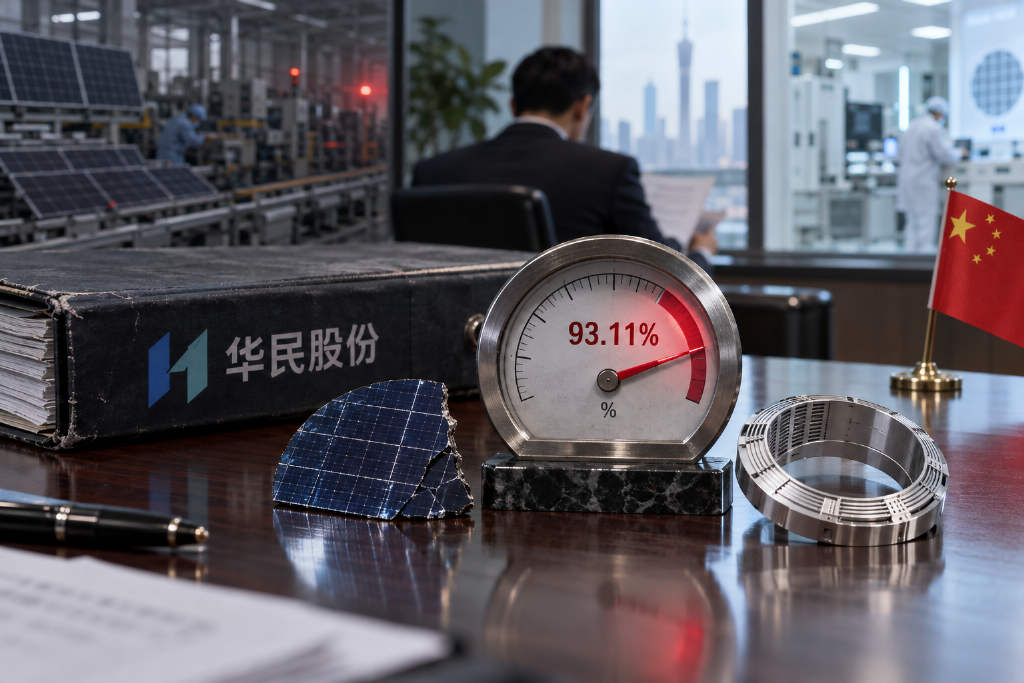
Huamin Shares is trying to open a second growth track in semiconductors while its solar business keeps deteriorating, and the gap between the two is now visible in its financials.
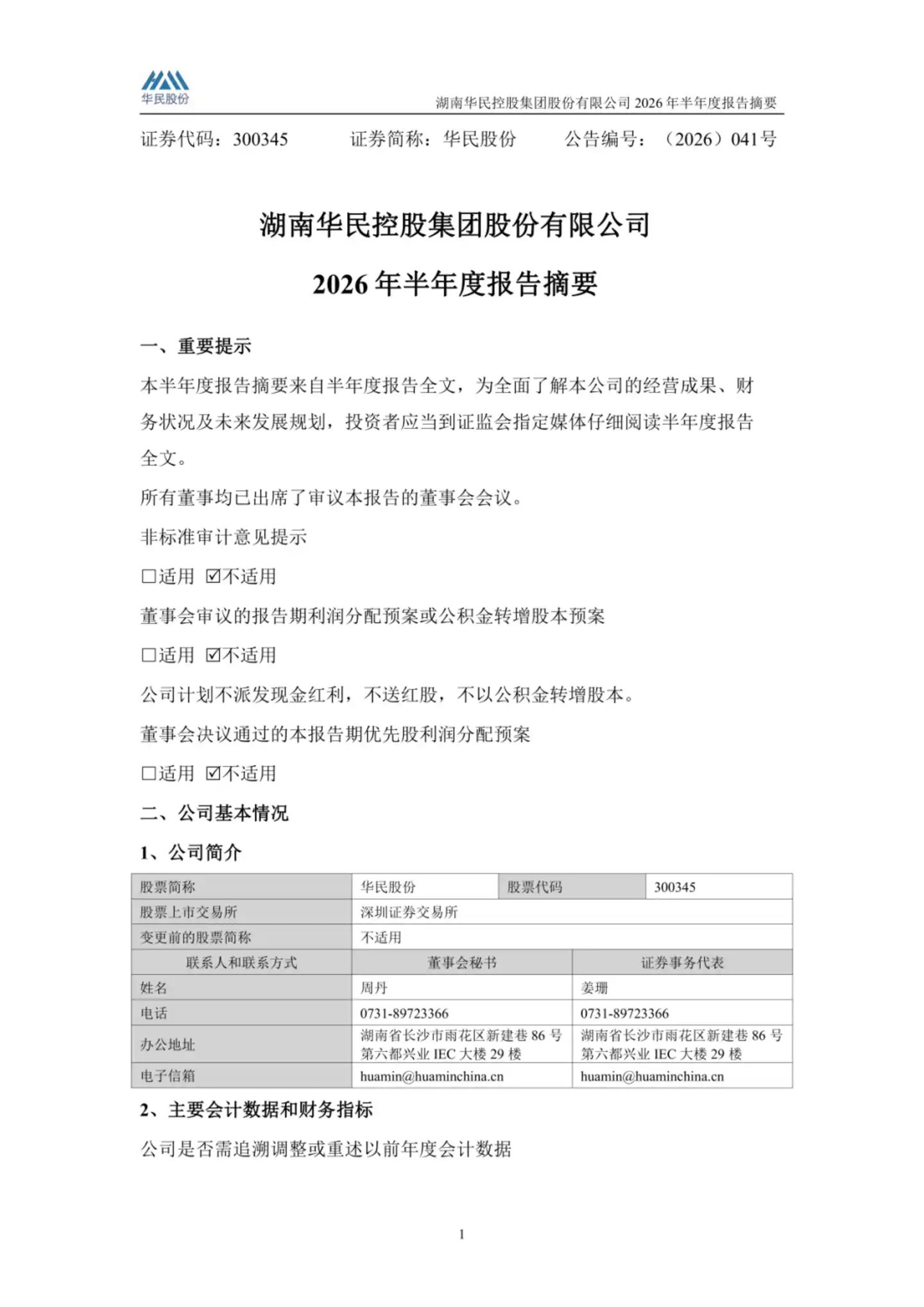
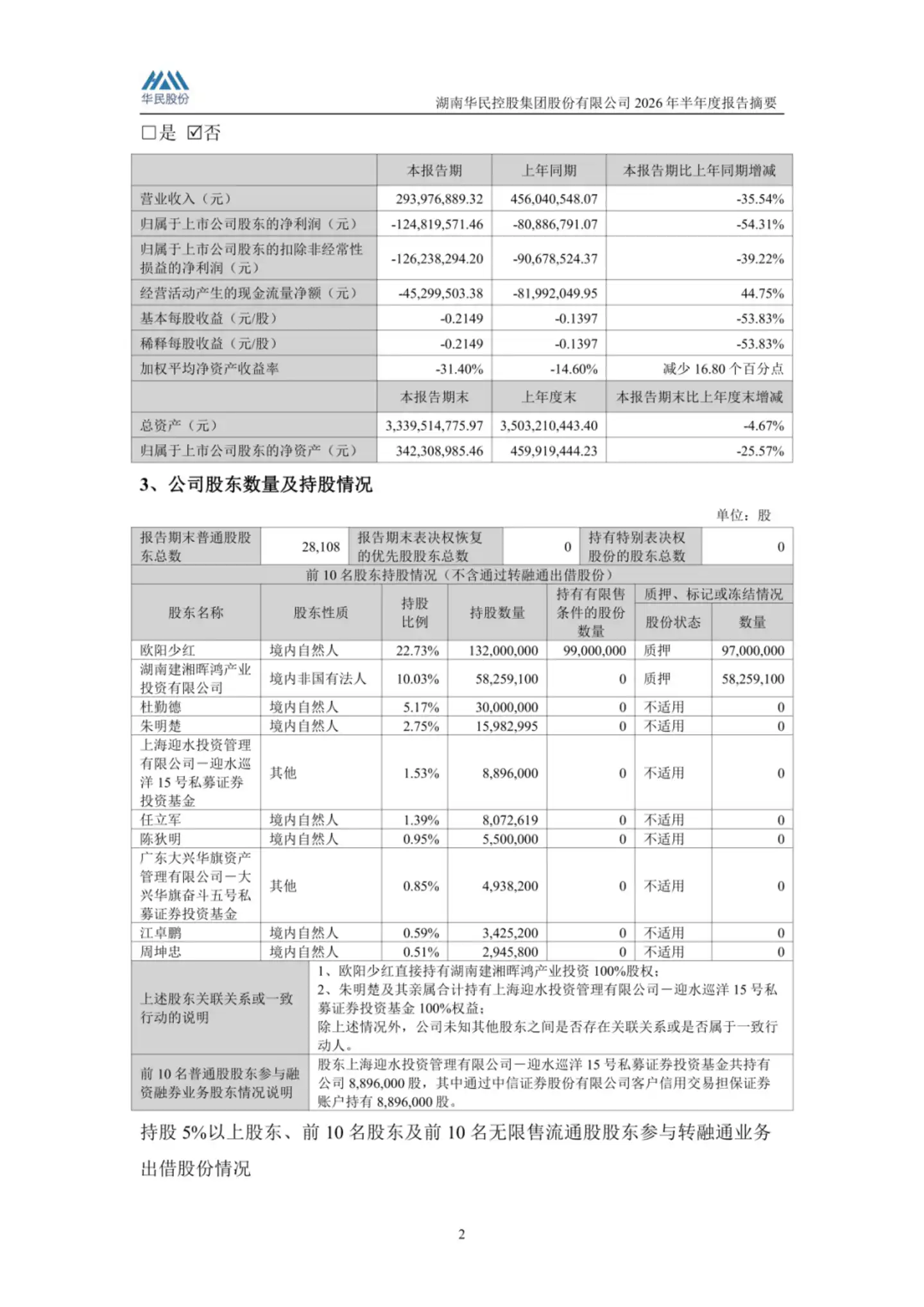
According to Yujian Energy, the company reported first-half revenue of 294 million yuan, down 35.54% from a year earlier. Net profit attributable to shareholders was negative 125 million yuan, and its asset-liability ratio rose to 93.11%. Total debt stood at 885 million yuan, with 95.03% classified as short-term.
Its new semiconductor business generated 2.91 million yuan in revenue in the first half and posted a gross margin of 62.14%. The solar segment, still the main business, brought in 250 million yuan in revenue but recorded a gross margin of -25.78%.
Solar losses are still widening
The report says Huamin’s results can no longer be explained by the industry cycle alone.
For the first half, overall gross margin was -18.84%, net margin was -54.49%, and return on equity came in at -31.4%. Solar products accounted for 85.11% of total revenue, yet their gross margin fell to -25.78%. On a non-recurring-items-adjusted basis, the company has posted losses for eight consecutive years since 2017.
Its debt profile adds another layer of pressure. Of the 885 million yuan in total debt, 95.03% was short-term, and short-term borrowings alone reached 384 million yuan. At the end of the reporting period, net assets attributable to shareholders of the listed company were only 342 million yuan, down 25.57% from the end of the previous year.
That leaves Huamin with little room. It needs to deal with most of its liabilities in a short period of time, while the cash-generation capacity of its solar business continues to weaken. Net cash inflow from operating activities was negative 45.2995 million yuan, and cash on hand fell 40.80% from the beginning of the year. The company said this was due to increased demand for debt repayment and operating funds.
Wafer manufacturing remains one of the most loss-making parts of the photovoltaic supply chain. In the first half of 2026, the price of mainstream monocrystalline N-type wafers fell from 1.40 yuan per piece to 0.88 yuan per piece, a decline of 37.14%. Estimates from the China Photovoltaic Industry Association put the fully tax-inclusive production cost of an N-type G12R wafer at 1.945 yuan per piece, while actual transaction prices were only 1.2 to 1.3 yuan per piece.
Huamin is not alone in facing these market conditions. The report notes that Hongyuan Green Energy expects a first-half loss of 590 million yuan to 690 million yuan, while Tongwei and LONGi have each posted losses for 10 consecutive quarters. Huamin’s balance sheet, though, is described as weaker than that of many peers, with leverage well above the industry average.
The current industry view, according to the article, is that solar capacity clearing is far from over. For Huamin, that means the revenue base it still depends on may not stabilize anytime soon.
Shared process roots do not mean equal barriers to entry
Huamin’s move into semiconductor silicon components is not detached from its existing manufacturing base.
Monocrystalline silicon used in photovoltaics and semiconductors shares key processes such as crystal pulling, doping and slicing. The difference lies in precision. The report says photovoltaic-grade monocrystalline silicon generally requires purity of six nines, while semiconductor-grade material usually requires 10 to 11 nines.
Huamin says it has developed the capability to research and pull large-diameter semiconductor silicon rods up to 450 mm, and that it has mastered a mass-production process for low-oxygen, low-defect monocrystals under non-magnetic-field conditions.
Other companies are moving in the same direction. The article names TCL Zhonghuan, Linton CNC and JSG as examples. It says TCL Zhonghuan plans to invest 11.96 billion yuan in a Shenzhen semiconductor large-wafer project, lifting planned 12-inch wafer capacity to 2.1 million pieces per month. Linton CNC, which holds about 18% market share in photovoltaic monocrystal furnaces, is also extending that technology into semiconductor-grade equipment.
The common industry thesis is that equipment and process know-how built around silicon materials can be reused, while semiconductor customers typically offer higher margins and stronger stickiness than solar buyers.
But the barriers are not comparable. Silicon parts used in etching chambers have long been dominated by overseas suppliers, and the report says mainland China’s localization rate remains below 10%. In the global silicon components market, U.S.-based Silfex, a subsidiary of LAM, holds about 55.3%, Korea’s Hana about 13.3%, and Japan’s Mitsubishi Materials about 8.4%.
That leaves room for import substitution, but not an easy opening. An industry forecast cited in the report says the localization rate of China’s silicon component market could rise from the current 5% to above 50% over the next three to five years, and that the global market for silicon components used in etching could reach 20.7 billion yuan by 2027. The harder question is how much of that market Huamin can actually access, and when.
Certification timelines are now as important as product strategy
On Aug. 6, Huamin said it had signed a strategic cooperation agreement with Huachuan Semiconductor, a China-Korea joint venture, to enter the market for core silicon components used in semiconductor etching equipment. The report says Huachuan has supplied SK hynix for years, and after the announcement Huamin’s stock recorded cumulative abnormal gains of more than 30% across three trading days.
Semiconductor silicon components are critical process consumables for equipment makers, and the customer qualification process is lengthy. It usually includes sample validation, pilot installation, long-run wafer testing, stability checks and mass-production qualification. The full process often takes several months to more than a year. For overseas top-tier memory manufacturers, the span from factory audit to product certification and mass production can extend to 18 to 36 months.
Shengong Co., cited in investor communication, also said its downstream customers impose strict and complicated supplier qualification procedures with long timelines.
Huamin’s response is to rely on Huachuan’s channels. According to the report, Huachuan Semiconductor is a China-Korea joint venture whose Korean shareholder, SeongHyun Technology, has worked in silicon parts for semiconductor etching processes for many years and has long supplied Samsung and SK hynix. Its flagship CSR high-end silicon ring is a core component in etching equipment for 3D NAND flash production.
The article adds that Huamin’s semiconductor silicon rod products have already entered the Korean industrial chain and currently have about four customers.
Time remains the key constraint. Under its equity incentive plan, Huamin set revenue targets for semiconductor-specific silicon rods and silicon components at no less than 6 million yuan in 2026, 30 million yuan in 2027 and 80 million yuan in 2028.
From 2.91 million yuan in the first half of this year to a full-year target of 6 million yuan, the second half would need to add roughly 3.09 million yuan in revenue. The report says that goal is not especially aggressive. The 30 million yuan target for 2027 is another matter. That would require multi-fold growth and appears to depend on whether customer qualification can be completed and introduced in the first half of next year.
High margins do not yet translate into meaningful earnings support
Debt obligations, unlike qualification cycles, do not wait.
The report says Huamin’s cash balance is still falling. The company is trying to reduce leverage by replacing capital expenditures with operating leases, converting debt into equity, and revitalizing existing assets. But debt-to-equity swaps require negotiation with creditors, and the pace of asset disposal is not entirely under the company’s control.
Even if the semiconductor business develops according to plan, the mismatch in scale remains severe. First-half semiconductor revenue was only 2.91 million yuan. At a gross margin of 62.14%, that translates into gross profit contribution of roughly 1.8 million yuan. Its solar business, by contrast, produced 250 million yuan in revenue. Applying the -25.78% gross margin implies gross losses of more than 64 million yuan from solar products alone.
Yujian Energy argues that even if Huamin reaches 30 million yuan in semiconductor revenue by 2027 and maintains a 60% gross margin, gross profit contribution would be about 18 million yuan, still not enough to offset ongoing losses in the solar segment.
On that basis, the financial significance of semiconductors as a second curve may lie more in valuation logic than in near-term income statement repair.
The sector has precedents, but Huamin enters from a weaker position
The shift from photovoltaic equipment into semiconductors is not new. The report says Maxwell Technologies generated 662 million yuan in revenue from the semiconductor and display industries in 2025, Laplace raised an additional 2.2 billion yuan to increase investment in semiconductors, and JINCHEN plans to invest 1 billion yuan in a semiconductor equipment project.
Those companies share two features: they already have some semiconductor revenue, and while their photovoltaic businesses are under pressure, they are not yet on the edge of balance-sheet distress.
Huamin’s situation is more stretched. It has posted eight consecutive years of losses on an adjusted basis, its leverage ratio is 93%, and its semiconductor business is only beginning. The report says the transformation makes sense at the technical level. Its 450 mm silicon rod capability, its cooperation with Huachuan Semiconductor and the revenue targets embedded in its equity incentive plan all point to a strategy that is being pursued in earnest.
Still, the outcome depends not only on direction but on timing. Semiconductor valuation upside sits farther out. Short-term debt pressure exists now. Based on the information currently available, the report says there is not enough evidence yet to tell where that balance point will be.
It argues that the indicators worth tracking are not simply semiconductor revenue growth, but two earlier signals: whether short-term loans can be extended or refinanced, and whether customer qualification in semiconductors can make substantive progress before the fourth quarter of 2026.
Those two variables, the report concludes, will decide whether Huamin’s story is one of painful transition or rising liquidity strain.