
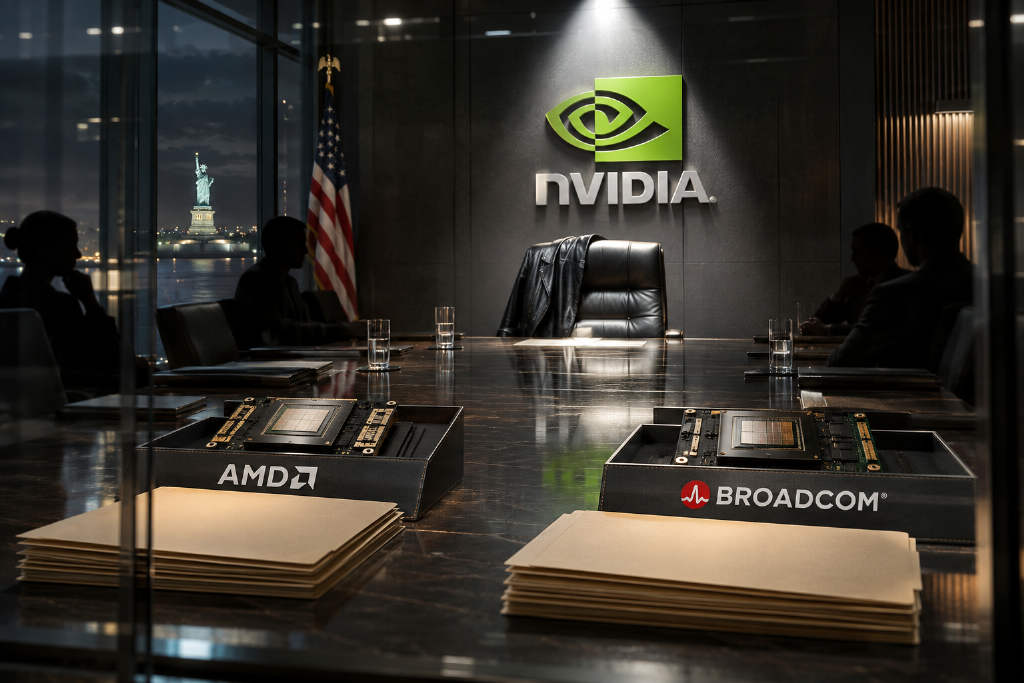
The AI rebound ran into a fresh Nvidia leadership crisis after reports said the company’s board could discuss removing CEO Jensen Huang. Nvidia futures fell more than 1.1% after hours, while AMD and Broadcom rose about 3% as investors began positioning for a possible shift in AI-chip orders.
AI stocks rebound, but liquidity remains thin
The S&P 500 gained 1.31%, returning to its 100-day moving average. The Nasdaq Composite rose 1.6%, while the Nasdaq 100 jumped 2.3% and moved above its 200-day moving average, marking its best weekly performance since May. The Dow Jones Industrial Average added 0.49%.
Goldman Sachs’ trading desk said the Veterans Day holiday reduced market liquidity by 20%. Hedge funds and retail investors crowded into the same trades, amplifying a short squeeze; only three stocks accounted for 32% of total market turnover. Bloomberg strategist Frank Monkam warned that cross-asset volatility remained elevated and that the rally was fragile under the pressure of monetary tightening.
Several AI-related developments brought money back into hardware and infrastructure. CoreWeave reported stronger-than-expected results and raised its outlook, Anthropic’s planned initial public offering drew several times more demand than the shares available, OpenAI’s quarterly revenue topped $10 billion for the first time, and IBM released a new quantum chip. The Goldman Sachs AI basket rose 5%, while the Philadelphia Semiconductor Index surged 5.66% and nearly returned to its 200-day moving average. Computing-rental, storage and optical-communications stocks advanced, and the new-cloud segment rose more than 12% in one session.
Goldman Sachs described the current phase as an AI “trough of disillusionment.” It estimated that six major cloud companies would need to generate $1.42 trillion in revenue between 2028 and 2030 to achieve a 15% return. Five of the companies have issued $296 billion of debt this year, while the high-yield AI debt market has been nearly frozen for the past month.
Michael Burry warned that a large portion of the more than $3 trillion in procurement commitments made by technology giants could involve GPUs that depreciate in warehouses before being switched on. Sixth Street chief Alan Waxman said about $200 billion of chips were sitting in warehouses because data centers were not ready, leaving unit economics highly unstable. ING has started selling $500 million of data-center loans, including loans linked to Stargate.
Chamath Palihapitiya, founder of Social Capital, said the next 18 months would be a severe selection period and that projects would need utilization of 70% to 75% to break even. JPMorgan also said it would take time to monetize AI efficiency, while high interest rates could weigh on highly leveraged operators.
Reports put Huang’s position under pressure
The New York Times reported that Huang was involved in a second extramarital affair with Powell, a medical vice president who reported directly to him. The report said the two were photographed in an intimate situation at a hotel during the March GTC conference, after which security personnel allegedly asked witnesses to sign confidentiality agreements.
Nvidia’s board could discuss removing Huang as soon as the day of the report and has reportedly identified an interim chief executive. Polymarket data showed that the probability of Huang resigning or being removed by December 31 had climbed from 13% to 84%.
The episode has also drawn political pressure in Washington. Senator Kevin Cramer and the chairmen of three House committees jointly pressed the company. Axios reported that an argument took place in the White House Oval Office, where Elon Musk, Marco Rubio and Scott Bessent supported expanding sanctions on the improper transport of Nvidia chips. The report said President Donald Trump also shifted against Huang, leaving Commerce Secretary Howard Lutnick isolated in his attempt to block the measures.
As many as 60 Nvidia employees report directly to Huang, and the company has no clear successor. The report said a leadership change could shock the global AI sector. Baird and Bernstein cut Nvidia to neutral and halved their price target to $200. Morgan Stanley removed the company from its preferred list, while Citigroup, Wells Fargo and Mizuho also lowered their targets. Strategists O’Rourke and Mullarkey warned that Nvidia’s aggressive supplier financing could leave a successor dealing with a major cleanup and struggling to restore customer trust. Burry called the selloff an “excellent short-term trade,” but said Nvidia’s advantage would narrow over the next five years.
Company moves and sector performance
CoreWeave closed 24.71% higher but fell more than 6% after hours. Third-quarter revenue jumped 167% year on year to $3.66 billion, its backlog reached $132.5 billion and the company raised its full-year guidance. Its CEO said computing capacity was sold out through 2027 and that prices would rise sharply. Goldman Sachs expects positive cash flow by 2030, while short sellers warned of a $33 billion financing gap next year. CoreWeave’s credit-default-swap spread had previously exceeded 1,289 basis points.
After hours, the market learned that Morgan Stanley and Mitsubishi UFJ could lead a $4 billion loan backed by chip contracts, with a yield of 7% to 7.5%. The Nvidia news also erased part of CoreWeave’s earlier gain. Nebius rose 15.44%, and Oracle gained 8.82% after Bernstein highlighted the combined strength of its data-center and database businesses. GoPro fell 18.34% after an accounting issue delayed its third-quarter filing, the company sought debt waivers and projected quarterly revenue of only $96 million, roughly half the year-earlier level.
Chip and optical-communications stocks advanced broadly. Arm rose 12.05%, Intel 7.46%, AMD 7.32%, Taiwan Semiconductor Manufacturing Co. 4.25%, Broadcom 3.99%, Marvell Technology 9.33%, ASML 1.76% and Qualcomm 1.75%. Super Micro Computer benefited from the start of deliveries of H15 servers using AMD processors. AAOI gained 15.6% and Lumentum 10.67%. Nuclear-energy company Oklo rose after the Energy Department lifted operating restrictions on its test reactor in Texas.
Storage shares also rallied. Consumer NAND momentum slowed, but AI-storage production slots were booked through 2029. SK Hynix said its DRAM and HBM capacity was sold out and that demand was twice supply. Samsung’s 2027 HBM capacity was also fully sold. Micron rose 11.89%, SanDisk 13.69%, SK Hynix 9.71% and Seagate Technology 9.99%.
Dollar reaches 103 as Fed politics intensify
Expectations for a 50-basis-point rate increase and a return of Treasury yields to 5% pushed the dollar index to 103, its highest level since April 2025. The euro fell 0.7% and the yen declined 0.7%, approaching the 160 level. Japan’s corporate-goods prices rose 7.1% in October, pushing Japanese government bond yields to 2.785%, but the wide US-Japan rate gap continued to pressure the yen.
The Dai-ichi Life Research Institute said expectations for a 50-basis-point Fed hike were excessive. Mitsubishi UFJ warned that cautious comments from dovish Bank of Japan policymaker Tomoaki Asada could trigger another “buy dollars, sell yen” wave.
Personnel disputes inside the Federal Reserve are also intensifying. Chair Wash is expected to face questioning from both chambers of Congress in January, which will be controlled by Democrats. Senator Elizabeth Warren, one of his strongest critics, is expected to take control of the Senate Banking Committee. The retirement timing of New York Fed President John Williams, who has a permanent vote, has become another point of contention: he could retire upon turning 65 next year or serve 10 years and remain until 2028.
Analyst Derek Tang said that if Williams were forced to leave next year, Wash would gain appointment authority over the key regulatory position a year earlier. University of Pennsylvania professor Conti-Brown warned that forcing a change could be viewed as political interference.
Gold, aluminum and oil
Spot gold dropped 1.2%, breaking below the psychological $4,000 level for the first time in four sessions. The LME cash aluminum premium reached its highest level in more than 30 years, while inventories fell to their lowest level since 1990, indicating severe physical tightness.
Brent crude briefly moved above $94 a barrel before retreating to $92.80 as October output from Saudi Arabia and Iraq reached its highest level since the war. West Texas Intermediate gained 0.4% to $86.41 a barrel.
The Trump administration authorized Vice President JD Vance to explore talks with Iranian officials to ease shipping pressure. Envoys Jared Kushner and Steve Witkoff traveled to Moscow to meet President Vladimir Putin and request a new European security proposal containing reciprocal de-escalation measures. The Interior Department also plans to sell some federal public land to unlock what Interior Secretary Doug Burgum described as trillions of dollars in oil and gas assets. Democrats strongly opposed the plan.
Software competition and the Magnificent Seven
New AI office products are challenging traditional software. United Airlines and Amazon have blocked access by third-party AI agents, while travel shares including Booking and Expedia turned higher after being pressured by concerns over AI disruption. NBCUniversal’s Peacock is taking a different approach, adding more vertical short dramas with individual viewing times of up to 30 minutes to compete for mobile users.
Nvidia closed 2.87% higher but plunged more than 8% after hours. Microsoft fell 2.26%, its second straight decline. Anthropic is scheduled to list on November 19 after receiving several times more demand than the shares offered. It plans to raise the issue price and target a $1.5 trillion valuation and $90.4 billion in proceeds, which would be the largest IPO on record and exceed the previous figure associated with SpaceX.
Microsoft has committed $1 billion to Anthropic and plans to spend $117 billion on computing capacity this year. It is also building a Texas power project with Chevron and will bear the electricity costs. Anthropic’s new workplace products, including Claude Sheets, directly challenge Excel.
Tesla rose 2.91% after Musk said production of the Cybertruck at the Texas plant would be extended by two to three months into late summer 2027 to clear its backlog. The delay pushes back the time available to free capacity for Cybercab. Tesla also adjusted prices and suspended new orders for the base dual-motor version.
Alphabet rose 2.11%. It is internally testing a Gemini 4 model series codenamed Hydrogen, positioned like the Flash series and focused on speed, efficiency and low cost. Apple gained 2.04%. Its AI capital expenditure is below 5% of sales, compared with more than 50% at Meta and nearly 45% at Microsoft, making it a defensive beneficiary of investor preference for controlled spending.
Amazon fell 1.74% under the pressure of high capital expenditure and after blocking Meta’s Muse AI agent from automated shopping activity on its platform. Meta fell 1.97% as investors weighed capital expenditure above 50% of sales and the blocking of Muse by several companies. Santosh Janardhan, Meta’s infrastructure chief, will leave early next year. Dave Brown, a former AWS executive, will take over the company’s AI-computing infrastructure.
Events to watch
- On November 12, the United States will auction $25 billion of 30-year Treasury bonds. The sale concludes the week’s quarterly refinancing of $125 billion and will test demand for long-dated US debt.
- Federal Reserve officials will speak in succession: Cleveland Fed President Beth Hammack at 22:00, Chicago Fed President Austan Goolsbee at 00:30 the following day, San Francisco Fed President Mary Daly at 02:10, and New York Fed President John Williams at 07:30.
- Nvidia’s board meeting could determine whether Huang remains in charge. Markets will also follow the US envoy’s meeting with Putin in Moscow and meeting with Volodymyr Zelenskyy in Dublin, along with the impact of prisoner exchanges and security proposals on whether oil can hold $94.
- Before the US open, investors will watch Nebius, Ondas, Nu Holdings and Brookfield. After the close, attention will turn to Applied Materials, Cerebras Systems, Cisco and Virgin Galactic.
- On November 13, South Korea’s IPO cornerstone-investor rules will take effect. Institutions with lockups of at least six months will be allowed to receive allocations earlier, a system intended to curb IPO breaks and sharp declines. Anthropic’s CEO will appear in a livestream with JPMorgan CEO Jamie Dimon to promote the IPO’s $1.5 trillion valuation.



