
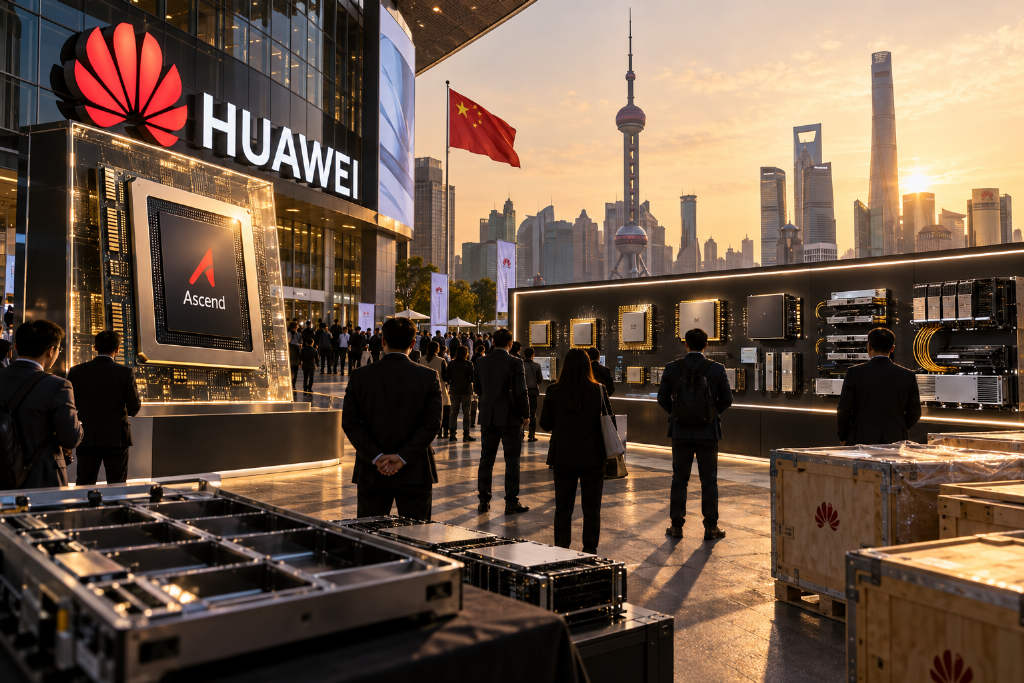
Huawei said at its annual Huawei Connect conference in Shanghai on Sept. 17 that its flagship AI chip, the Ascend 960DT, will be launched in the first quarter of 2027 instead of the originally planned fourth quarter of that year. The move brings the product forward by three quarters and stands as one of Huawei’s clearest responses to U.S. export controls in the AI computing race.

At the same time, reports said Huawei is still struggling to fulfill orders from its biggest domestic customers on schedule, leaving supply stability as a central question for the roadmap it just unveiled.
Ascend 960DT moved up to Q1 2027
According to Bloomberg and Nikkei Asia, Huawei rotating chairman Wang Tao told the conference that the Ascend 960DT will arrive in the first quarter of 2027, three quarters earlier than previously planned. A second variant, the Ascend 960PR, is expected to be delivered in the third quarter of the same year.
Wang said the 960DT offers twice the performance of the previous-generation Ascend 950. Huawei also laid out an annual iteration plan running through 2029: the Ascend 970 is expected in 2028, followed by the Ascend 980 in 2029.
Two 960-series variants, two deployment targets
On the specification side, the roadmap points to different positioning for the two chips. From the Ascend 960DT to the 960PR, FP4 computing power doubles, while memory capacity and bandwidth are reduced. That split suggests the products are aimed at different workloads rather than serving as a simple sequential upgrade.
The report said the 960DT is geared more toward training and large-model inference, while the 960PR is optimized for quantized inference.
Huawei is pushing a full AI system, not just a single chip
Huawei’s presentation went beyond the Ascend line. The company introduced 11 chips spanning AI computing, general computing, storage, and high-speed interconnect, with the stated goal of building a complete component stack capable of supporting an entire AI data center.
The strategy is built around system integration. Huawei is trying to offset the disadvantage of a single chip competing head-on with Nvidia by linking Ascend NPUs, Kunpeng CPUs, memory, and network interfaces through its own UnifiedBus technology. Those components form the base infrastructure, which is assembled into SuperPoD systems, and multiple SuperPoDs can then be aggregated into larger SuperCluster deployments.
Huawei said this cluster design allows large numbers of Ascend chips to work together, lifting total computing capacity beyond the limits of any single chip in theory. On the software side, the system supports mainstream frameworks including PyTorch, Triton, and vLLM. Wang said Huawei has shipped more than 1,000 SuperPoD systems to over 370 customers.

Supply shortages remain the main obstacle
Even as Huawei outlined a faster product schedule, executives acknowledged the supply bottleneck. Vice chairman Xu Zhijun told reporters that Huawei is facing shortages in optical components, storage, and memory. He estimated that global supply and demand may not reach balance until 2029 at the earliest, while China may have to wait until 2030.
Reports said DeepSeek had planned to build a data center in Inner Mongolia and needed at least 160,000 Ascend 950DT chips. Huawei said it could not fulfill an order of that scale. Tight supply has also shown up in pricing: the 950DT rose 60% this summer because of component shortages.
With the current flagship chip still not available in stable volume, whether Huawei can mass-produce the next-generation 960DT in the first quarter of 2027 remains uncertain.
Overseas expansion is not the priority
Xu also said Huawei is prioritizing demand in China and has no plan at present to enter international markets. That places domestic allocation ahead of any overseas push, even if the next generation launches on schedule.
China’s AI chip market is expected to grow, but Nvidia still leads in training
Morgan Stanley estimates that China’s AI chip market will reach $67 billion by 2030, with domestic suppliers’ share rising from below 50% in 2025 to 86% by 2030.
At the conference, Xu said, 「China is a country with a strong sense of crisis. We cannot let our fate be decided by whether others are willing to sell us chips.」
At the same time, Nvidia’s technical lead has not disappeared. The report said top AI labs in China still rely mainly on Nvidia GPUs for model training, while the Ascend line is used more often for inference workloads. That division shows the gap that remains between the two sides in both hardware capability and software ecosystem.