
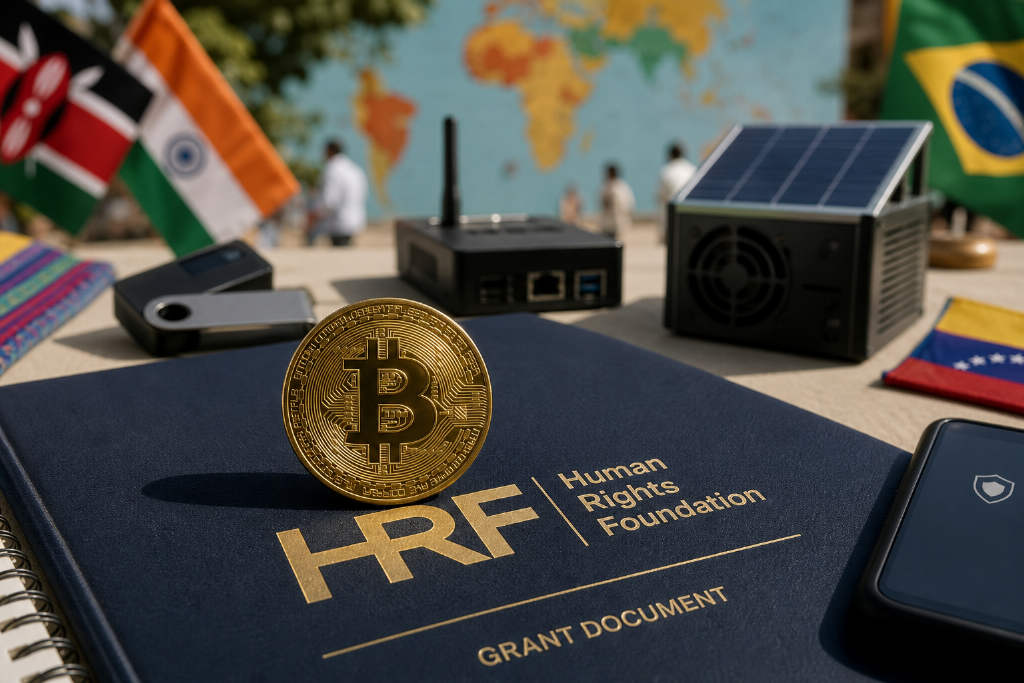
The Human Rights Foundation, or HRF, said it is awarding more than 600 million satoshis in grants to 16 projects across Africa, Asia, and Latin America through its Bitcoin Development Fund. At current prices, the organization valued the total at $472,807. HRF said the money will go toward strengthening the Bitcoin protocol, expanding practical access to Bitcoin, and supporting secure messaging and community infrastructure for dissidents.

This is HRF’s second funding round of 2026. In April, the NGO said it had backed 26 projects. HRF said the funding is intended to reinforce Bitcoin’s role as a tool for financial freedom, allowing journalists, nonprofit organizations, and activists to communicate, organize, and receive support more securely across borders.
Payments and access tools
BitSpenda
HRF said cross-border money transfers in many parts of Africa are often slow, expensive, and dependent on intermediaries. BitSpenda is a mobile money-to-bitcoin bridge built as a non-custodial, account-free tool. It lets users in Nigeria, Kenya, Cameroon, Uganda, and Ghana send bitcoin from a Lightning wallet directly to a mobile money account, where the funds are received in local currency.
With the new grant, BitSpenda plans to expand its payment tools to make cross-border payments faster, cheaper, and easier to access in the region.
Project Island Resilience
In parts of the Caribbean, HRF said power outages and authoritarian repression can block both communications and access to money. Project Island Resilience builds on Flash, a Bitcoin and Lightning wallet created by Jamaican developer Dread.
After Hurricane Melissa devastated Jamaica in late 2025, the app raised and distributed more than $10,000 in bitcoin within 72 hours, according to the report. The project now plans to add offline payments to Flash using Bluetooth, near-field communication, or NFC, and ecash. HRF said the next phase is meant to show how Bitcoin can keep working under adversarial conditions. Its grant will support practical infrastructure that can be used during protests and internet shutdowns.
Bitzed
In Zambia, mobile money is widely used, but buying bitcoin still usually requires banks or centralized exchanges that keep identity records and control user assets, HRF said. Bitzed, created by Bitcoin educator Humphrey, is an account-free platform connecting mobile money networks directly to Bitcoin in Zambia.
Users can buy bitcoin through existing mobile money accounts and receive it straight into their own Lightning wallet. HRF said the funding will help expand a self-custodial route into Bitcoin for Zambians who are excluded from traditional banking and face financial repression.
Bitcoin development and wallet infrastructure
Libbitcoinkernel
HRF said many Bitcoin applications still have to rebuild the protocol’s most complex security rules from scratch, raising the risk of major errors. Libbitcoinkernel is a software project that extracts core security and transaction rules directly from Bitcoin’s original code and turns them into reusable software modules.
That approach is meant to let freedom-tech developers build more secure and independent wallets, services, and infrastructure without duplicating Bitcoin’s critical code. HRF said its support will help developer yuvicc continue the work.
A Node in Every Wallet: Utreexo Wallet Integrations
Most Bitcoin wallets still depend on centralized servers for balances and transaction history, which weakens user privacy, HRF said. Floresta is a lightweight Bitcoin node implementation that can be embedded directly into wallet apps. It reduces the storage required to verify Bitcoin transactions, allowing wallets to check data locally and privately.
The grant will support developer Luis Schwab as he works to help wallets remove intermediaries and connect directly to the Bitcoin network.
BDK-Dart
In many authoritarian countries, mobile wallets are the most practical way to access Bitcoin. HRF said it remains difficult to build apps that give users full control of their funds without leaning on a central authority. BDK-Dart is a toolkit that provides developers with ready-made Bitcoin wallet building blocks for Flutter, a widely used framework for building apps across devices.
The toolkit is designed to make it easier to build secure custodial Bitcoin wallets from a single shared codebase across platforms. HRF said software developer John Osezele will use the support to ship a major release of the software and a reference wallet, lowering barriers for developers building self-custodial Bitcoin apps worldwide.
WalletScrutiny
HRF said most Bitcoin users have no practical way to confirm whether a wallet app matches the open-source code it claims to run. WalletScrutiny audits Bitcoin wallets for transparency and verifies whether distributed software matches its source code.
The grant will fund broader review of wallet dependencies and third-party frameworks. HRF said that work can help activists, journalists, and changemakers choose more trustworthy Bitcoin applications in authoritarian settings. The organization has supported WalletScrutiny before, and said this grant extends that effort. The report also pointed to the recent Coldcard hack as a reminder that users need confidence that the software on a wallet is the software they expect.
Nostr communications and privacy projects
Vector Privacy: Privacy by Principle
Private messaging in high-risk environments requires more than encryption, HRF said. It also means avoiding account creation, reducing metadata trails, and resisting censorship. Vector is an open-source messenger built on Nostr, the decentralized communications protocol. It is permissionless and uses end-to-end encryption.
HRF said the funding will help Vector launch on iOS and desktop, add encrypted voice and video calls, and provide journalists, activists, and whistleblowers with a more stable, censorship-resistant communications tool.
Flotilla Chat
Civil society groups and communities often rely on centralized communications platforms that can delete forums, remove users, or shut down networks with little warning, HRF said. Flotilla Chat, built by the Nostr client Coracle, is a Discord-style platform on Nostr that separates a user’s identity from the hosting provider.
Organizers control their own infrastructure, while members retain portable identities across the network. HRF said the funding will support features including role-based access control, voice chat, and Bitcoin-native funding tools to make online assembly more resilient under autocratic regimes.
OpenAlert: Decentralized Critical Alerts for Nostr
Critical emergency alerts often rely on centralized push notification services such as those run by Apple or Google, and those systems can be blocked, monitored, or fail during a crisis, HRF said. OpenAlert, created by software developers Fernando Diego Pergolini and Jorge Carlos Franco, is an alternative notification platform for urgent alerts.
Its main layer uses the decentralized Nostr network to issue alerts through anonymous text and audio messages, with end-to-end encryption and programmed self-destruction. HRF said the grant will cover hardware and personnel costs to keep developing the tool for human rights defenders who need urgent information about what is happening around them.
0xchat
Activists and journalists need private, reliable communications tools, but many apps still expose users to surveillance and censorship, HRF said. 0xchat, created by software developer water783, is a Nostr-based messaging app with fully encrypted chat, file transfer, voice calls, and video calls.
The app integrates Tor to mask internet traffic and protect a user’s physical location and identity. It also includes a built-in Cashu wallet for private bitcoin payments. HRF said the support will help advance the tool so users can coordinate more safely without relying on platforms that are vulnerable to authoritarian intervention.
Mining, education, and civic infrastructure
256 Foundation
Bitcoin mining hardware is still dominated by a small number of manufacturers using proprietary technology, HRF said, and that can limit participation in securing the network. The 256 Foundation is a nonprofit working to break that concentration by open-sourcing every part of a Bitcoin miner, from the hardware to the software that runs it.
HRF said making mining tools more accessible and transparent reduces reliance on centralized manufacturers. The grant is also tied to support for one of the more private ways to acquire bitcoin under a dictatorship.
My First Bitcoin
Financial education is often shaped by state institutions, leaving little room to question how monetary systems work or to explore alternatives, HRF said. My First Bitcoin is an education initiative that provides free, open-source educational resources through a global education node network made up of independent educators in more than 40 countries, including India, Uganda, and Indonesia.
HRF said its support will help expand the number of educators trained through the Educator Training Program from roughly 60 to 120, with an emphasis on communities living under authoritarian rule.
Agora: Bitcoin Lightning Activation & Civic Infrastructure Pilot
In Venezuela, activists, independent journalists, and civic organizers face blocked platforms, surveillance, and difficulty receiving international support, HRF said. Agora is a decentralized activist platform built on Nostr and Bitcoin. It is designed for coordination, censorship-resistant communications, and peer-to-peer financial support for communities living under authoritarianism.
Agora includes a non-custodial bitcoin fundraising component that lets people anywhere send support directly to individuals and causes, with funds going straight to recipients’ wallets. The report said the project was developed in part through an HRF-backed hackathon. This grant will support a nine-month pilot deployment in Venezuela.
HODL: Hands On Design Lab
Many Bitcoin tools remain hard to use because their interfaces do not clearly guide users through self-custody, privacy, and security, HRF said. HODL: Hands On Design Lab is an education initiative in India that runs structured cohorts for early-career designers.
The program is intended to prepare them to contribute to Bitcoin apps, projects, and tools, and to close a usability gap in Bitcoin by training user interface and user experience designers. HRF said the funding will support personnel and three cohorts over 12 months.
Hack4Freedom
Women in Africa and Latin America are often excluded from the education and technical training needed to contribute to freedom tech, HRF said. Hack4Freedom, created by Evento founder Brianna Honkawa d Estries, is a two-week developer education program that trains women in Africa and Brazil to build on Bitcoin and other open-source freedom-tech projects.
With cohorts planned in cities including Lagos, Nairobi, and São Paulo, the grant will cover event and travel costs. HRF said the goal is to create more opportunities for women to participate in building tools for financial and digital freedom.
This report first appeared in Bitcoin Magazine and was written by Mathew Di Salvo.