

BitMEX co-founder Arthur Hayes publicly called at the end of May that HYPE should at least surpass SOL before this bull cycle concludes, having previously predicted a $150 target. The clash began when former Multicoin Capital co-founder Kyle Samani fired at Hyperliquid, escalating into a $100,000 wager that HYPE would outperform all top-10 coins for the remainder of 2025. As HYPE surged to a fresh all-time high of $75 in recent days, investors are gripped by both excitement and fear of heights, with some even attempting to short the token.
Two HYPE spot ETFs are currently trading: 21Shares launched the first Hyperliquid ETF (THYP) on Nasdaq on May 12, and Bitwise followed with BHYP on the NYSE on May 15. By June 2, these ETFs had attracted net inflows for 14 consecutive days, totaling over $136 million and absorbing roughly 0.9% of HYPE's market cap. BHYP alone contributed $82.96 million, making it the largest HYPE ETF. This demonstrates robust demand from traditional capital. Among 12 U.S. crypto spot ETFs, HYPE ETFs now rank fifth by cumulative net inflows, trailing only BTC, ETH, XRP, and SOL ETFs, and far surpassing earlier-launched competitors.
The divergence between HYPE and major asset ETFs has become pronounced. Since May 15, BTC spot ETFs have seen 12 consecutive days of net outflows, totaling over $2.43 billion in May and breaking the previous record of 8 straight outflow days set in early 2025. ETH spot ETFs have posted 16 straight outflow days since May 11, losing over $540 million. Even VanEck’s BNB ETF (VBNB), launched on May 28, recorded zero net inflows for four days. Institutional demand for BTC and ETH exposure has cooled markedly, while HYPE’s appeal is intensifying, with FOMO metrics surpassing those seen at the BTC and ETH ETF launches.
On a market-cap-adjusted basis, HYPE ETFs absorbed nearly 1% of HYPE’s market cap within two weeks—outstripping the debut performances of BTC, ETH, and SOL ETFs. According to SoSoValue, BTC spot ETFs attracted $1.46 billion in net inflows during their first two weeks, representing just 0.2% of BTC’s then-market cap; ETH spot ETFs saw net outflows of about $400 million; and SOL spot ETFs drew roughly $380 million, accounting for 0.47% of SOL’s market cap. The sustained HYPE ETF inflows are providing solid price support.

Hyperliquid Protocol Revenue and Assistance Fund Provide Ongoing Backing
Beyond ETFs, Hyperliquid’s own protocol revenue is a crucial pillar for HYPE demand. In early 2025, Hyperliquid introduced the Assistance Fund (AF) mechanism, automatically allocating 97% of protocol trading fees (perps + spot) to the AF address for continuous HYPE buybacks; the fee allocation was subsequently raised to 99%. This enables HYPE to effectively capture the protocol’s value and serves as a significant price support. Hyperliquid’s daily protocol revenue ranges between $1 million and $3 million, and cumulative AF buybacks have exceeded $1.1 billion. While aggregate ETF inflows are still lower than the AF’s buyback volume, their pace is remarkable: in just half a month, ETF inflows have reached one-tenth of the AF total, peaking at $31.62 million on May 29. Together, ETFs and the AF create dual support that offsets selling pressure from team token unlocks.

Team Token Unlocks: Monthly One-Off Release, Manageable Impact
Since January 2026, the Hyperliquid team’s tokens are unlocked once a month on the 6th. On June 6, $38.7 million worth of tokens will be unlocked. ETF investors often lack in-depth knowledge of tokenomics and may never have directly engaged with DeFi protocols; they simply seek HYPE exposure. Consequently, such investors are less sensitive to unlocks, and as long as the project’s fundamentals remain stable, unlocks are unlikely to dampen buying pressure.
More Spot ETFs on the Horizon; Grayscale Launches Staking ETF
More HYPE spot ETFs are coming. On June 2, Grayscale submitted an S-1 amendment for a Hyperliquid Staking ETF (ticker HYPG), seeding it with approximately 2 million HYPE, with trading set to begin on June 4. This signals deeper liquidity, stronger institutional participation, and sustained incremental buying power for HYPE.

Institutions Quietly Accumulate HYPE on a Large Scale
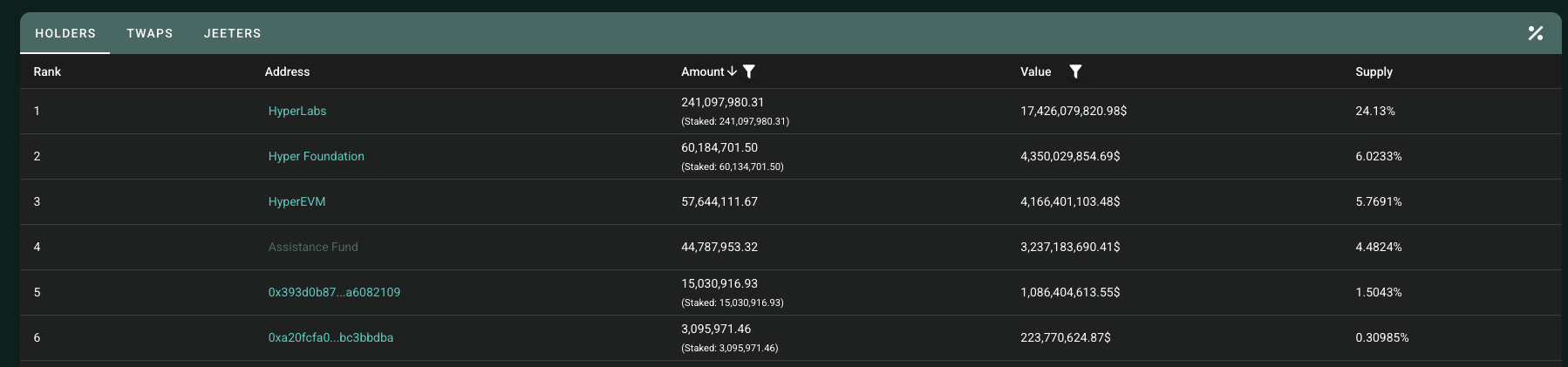
Institutional FOMO is no less intense than retail. Since August 2025, a16z has been building substantial positions. According to crypto analyst @ai_9684xtpa, a16z may now be the sixth-largest on-chain holder of HYPE and the largest external holder. The top five addresses belong to Hyperliquid’s own ecosystem projects; the sixth, held by a16z, contains 3,095,000 HYPE valued at over $223 million. On-chain data reveals that a16z continues to accumulate through multiple affiliated wallets. On May 28, an address starting with 0x4c6 associated with a16z withdrew 253,947.43 HYPE from exchanges and market makers at an average price of about $59.2. On May 30, Lookonchain flagged another a16z-linked address (0xb5E) buying 226,121 HYPE, bringing its cumulative purchases since April 14 to 3.9 million HYPE at an average price of $49.4.

Galaxy Digital is also adding to its HYPE stack. On June 3, Lookonchain reported that Galaxy Digital withdrew 179,000 HYPE (approximately $12.62 million) from Coinbase, following a 158,100 HYPE purchase (~$8.8 million) via another wallet on May 21.
Institutions no longer view HYPE as an ordinary altcoin. Bitwise CIO Matt Hougan described HYPE as a “second-generation” cryptocurrency, citing its real value capture, buybacks, and institutional demand. Grayscale’s research positions Hyperliquid as a blockchain-based financial infrastructure platform, suggesting it could eventually challenge traditional derivatives trading and exchanges, evolving into a “financial services giant”.

PURR Poised for Russell 3000 Inclusion, Adding Fuel to the DAT Narrative
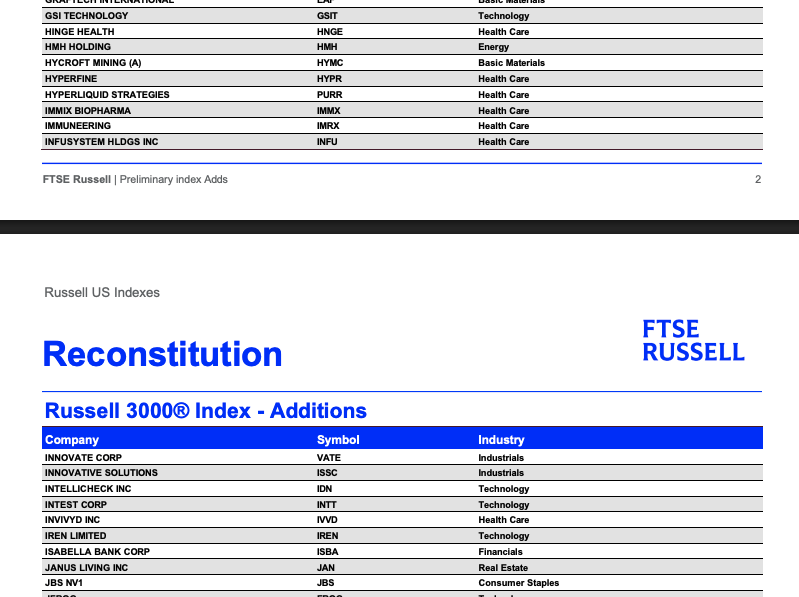
As the DAT (digital asset treasury) theme cools in equities and sector bellwether Strategy begins selling coins, HYPE-exposed DAT company PURR is still sitting on substantial unrealized gains. On May 22, FTSE Russell released its preliminary list for the 2026 Russell 3000 reconstitution, with PURR appearing in the additions list, effective June 26. The Russell 3000 is one of the broadest U.S. stock indices, encompassing roughly 3,000 companies and serving as a benchmark for approximately $10.6 trillion in assets. If PURR is included, it will attract passive fund allocations and heightened visibility. To broaden investors’ HYPE exposure, the company may in the future emulate Strategy’s “fundraising-to-buy-crypto” model, providing yet another solid source of buy-side support for HYPE.