
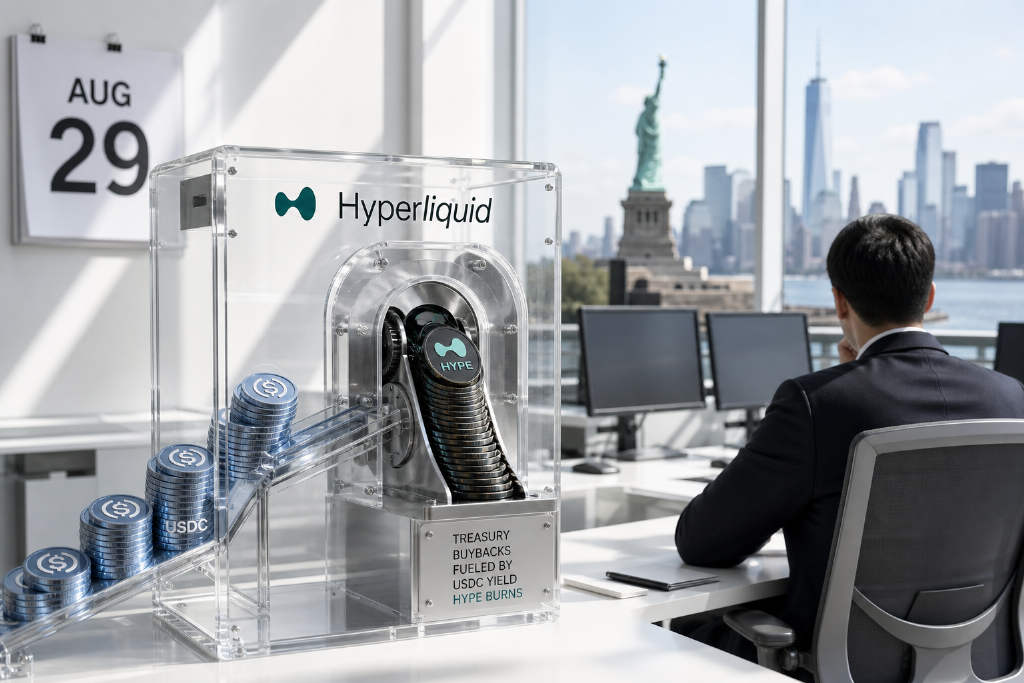
HYPE surged to a new all-time high in late August, reaching about $83.5 and trading near $82 at the time referenced in the source. The token was up 37.5% over the past seven days and more than 220% year to date. The move has put the focus on three questions at once: how much support buybacks can provide, how much pressure the next unlock may create, and whether Hyperliquid’s revenue base is strong enough to justify the rally.
Supply: fee buybacks are growing, but the next unlock is large
According to hl.eco, Hyperliquid has generated about $1.27 billion in cumulative net revenue so far, corresponding to roughly 48.17 million HYPE burned on-chain. That equals 4.82% of the token’s 1 billion cap. At the current price referenced in the source, those burned tokens are worth about $3.9 billion.
Hyperliquid routes about 99% of trading fees into automatic HYPE purchases. The tokens are sent to the Assistance Fund, an address with no private key and no way for anyone to move the assets, which makes the effect equivalent to permanent lockup. In December 2025, validators approved by an 85% vote that those tokens should be treated as burned.
The pace of buybacks has been rising because protocol revenue has expanded. Blockworks data cited in the source shows Hyperliquid generated about $16.93 million in revenue last week, up 196% from the previous week. Higher revenue means more capital flowing into the buyback engine.
Hyperliquid has also opened a second buyback channel beyond fee income. Perpetual traders on the platform post margin mostly in USDC, and more than $5 billion in USDC deposits are now sitting on the venue. Those reserves are backed by yield-bearing assets such as U.S. Treasurys, creating an additional stream of income.
On Aug. 26, Hyperliquid launched AQAv2, short for Aligned Quote Asset v2. The mechanism directs part of the income generated by platform USDC reserves into a pool of funds that will ultimately be transferred to the Assistance Fund to repurchase and burn HYPE on the secondary market, cutting circulating supply.
Under the arrangement described in the source, Circle handles the USDC technical deployment and Coinbase manages the reserves. The stablecoin issuer is expected to share about 90% of the related reserve income with the protocol after operating costs. The first transfer, roughly $20 million, is expected to arrive on Oct. 3. Estimated incremental buybacks are projected at $135 million to $160 million a year.
That changes the structure of HYPE support. Buybacks are no longer tied only to trading fees. Each dollar of USDC parked on the platform can now contribute, indirectly, to HYPE demand.
The other side of the supply equation is unlocks. HYPE unlocks on a monthly schedule. Since March 2026, the size of each unlock relative to market value has fallen from about 3.3% to about 2.7%. The next event is scheduled for Aug. 29, when about 14.18 million HYPE worth roughly $1.1 billion is set to unlock. That equals about 1.4% of total supply and around 6% of the current circulating float. Of that amount, about 46.6% goes to early insiders, 46.3% to the community, and 7% to the foundation.
Tokenomics data cited in the source shows HYPE fell an average of about 8.6% over the seven days following previous unlocks. In some months, the maximum drawdown within two weeks reached 20% to 30%. The source also notes that many of those deeper declines coincided with broader market weakness rather than being caused by unlocks alone.
A rough estimate in the source suggests current monthly buybacks of about $60 million to $80 million would offset only around 6% to 7% of this upcoming tranche, even if all unlocked tokens were sold in the short term. That leaves the month-end unlock as the main near-term supply overhang, while fee-funded repurchases and the Oct. 3 AQAv2 transfer form the medium-term support line.
Demand: U.S. compliance hopes, distribution channels, and institutional access
With HYPE already at a record high, the next question is whether new users and fresh capital still have reasons to enter.
The largest upside narrative remains a compliant path into the U.S. On Aug. 19, Trump said at the White House that CFTC Chair Selig was pushing Hyperliquid to enter the United States in a "fully compliant" and legal way. Hyperliquid does not currently serve U.S. users. If that message turns into an executable route, it would open the door to incremental retail and institutional demand from the U.S. market.
Hyperliquid Policy Center has been active on that front. During August, it submitted comment letters to the U.S. Securities and Exchange Commission and the Commodity Futures Trading Commission covering pre-IPO perpetuals, equity perpetuals, and energy perpetuals. The core request is to regulate cash-settled contracts with futures-like characteristics under the framework for security futures.
Binance founder Changpeng Zhao also voiced support at the Wyoming Blockchain Symposium, according to the source. He said a compliant U.S. entry by Hyperliquid could create room for more decentralized products and would be positive for the broader industry.
Still, those developments remain at the level of comment letters and public statements. Trump mentioning the platform does not mean the CFTC has approved it. The source says a more likely implementation path would involve licensed institutions accessing HyperCore through a permissioned version of HIP-3. That also means this part of the premium may be the fastest to rise and the easiest to give back.
Distribution is another part of the demand story. Coinbase is the official deployment partner for the platform’s USDC reserves and has also increased staked HYPE holdings. Base App has integrated Hyperliquid and offers eligible users access to more than 200 perpetual markets with leverage of up to 50x. Coinbase does not buy HYPE directly, but larger trading volume becomes fee revenue, and those fees feed the buyback mechanism.
Further up the stack sits HIP-3. The framework opens market listing rights to outside deployers. Teams can launch a new contract market by staking about 500,000 HYPE. Aggregate notional volume has already exceeded $480 billion, with more than 90% of that activity concentrated in trade.xyz.
HIP-3 recently picked up a high-profile new entrant in EntropyIO. The project raised $14 million in a round led by Ribbit Capital, staked $40 million worth of HYPE, and includes team members from Citadel Securities, Optiver, Millennium, and Polymarket. On its first day, it launched a pre-IPO market for Anthropic and generated more than $40 million in volume within half a day.
The source says Blockworksres analysts see EntropyIO as the first serious threat to TradeXYZ’s dominance. Other analysis cited there argues that HIP-3 could trigger intense liquidity competition among deployers, making life difficult for later entrants. At the same time, more competition could improve products for users and broaden the Hyperliquid ecosystem overall.
There are signs Kraken is also testing a compliant HIP-3 setup on testnet. CME, the traditional futures exchange, has also begun publicly discussing the impact of trade.xyz and Hyperliquid, according to the source.
HIP-4 remains much earlier in development. It is positioned against the on-chain prediction market Polymarket and has generated about $310 million in lifetime volume, with roughly 1,000 daily active traders. On Aug. 25, founder Jeff updated three functions including sub-deployer authorization, but the overall trading base is still small.
Institutional capital is also coming through regulated channels. Spot HYPE ETFs have recorded about $301 million in cumulative net inflows since launch, with net assets of about $409 million. After Trump’s comments, the products saw about $5.8 million of net inflows on Aug. 20 and another roughly $14.7 million on Aug. 26.
Meanwhile, Nasdaq-listed treasury company PURR holds about 29.35 million HYPE, equivalent to around 2.94% of total supply. Based on net asset value calculations cited in the source, the position is sitting on more than $1 billion in unrealized profit, and PURR is still adding in the open market.
Fundamentals: strong revenue and market share, but concentration remains an issue
Hyperliquid’s operating metrics remain a major part of the bull case. ASXN data cited in the source shows the platform has processed about $5.27 trillion in cumulative trading volume, attracted roughly 1.71 million registered users, and now carries around $13.4 billion in open interest, up about 24% over the past month.
In the perpetual DEX segment, Hyperliquid holds about 40% market share and remains the clear leader. The source notes that Lighter and Aster, the next platforms in line, each generate less than one-quarter of Hyperliquid’s daily volume.
The asset mix is also shifting. ARK Invest data cited in the article shows RWA trading on Hyperliquid briefly reached 54% in July, the first time it exceeded crypto assets. At present, about 29.8% of perpetual volume on the platform comes from RWAs, with roughly $2.9 billion in 24-hour volume.
Revenue is another core support point. Hyperliquid’s annualized revenue is about $748 million, making it one of the rarer cash-generating businesses in crypto. Ecosystem usage is broadening as well. HyperEVM at one point recorded $538,100 in daily fee revenue, and all of it was burned.
There are, however, structural questions beneath those numbers. HIP-3 activity remains highly concentrated, with the vast majority of volume still coming from trade.xyz. Deployers can take about 50% of fees from the markets they operate. That means even if total volume keeps hitting records, protocol-retained revenue may not scale at the same rate. Whether EntropyIO, Kraken, or other entrants can weaken trade.xyz’s grip is an important next variable.
The ecosystem also has internal debates. Kinetiq recently proposed a Layer 2 called Elysium, which briefly drew market enthusiasm. Analysts including y_cryptoanalyst argued that Elysium is a Kinetiq initiative rather than an official Hyperliquid project, and described it more as a narrative built around HyperEVM momentum.
The source adds that HyperEVM’s application layer has remained relatively weak, with trading heavily concentrated in the official HyperCore and limited room for third-party apps. On that reading, the probability of the official team launching its own Layer 2 is not high.
What is supporting the breakout, and where the risk sits
Put together, the latest HYPE rally rests on a fairly clear three-part structure. Policy expectations add valuation upside. Buybacks support the supply-demand balance. Revenue, volume, and market share provide the fundamental base underneath the price.
The source notes that research house GLC Research described current HYPE buying pressure as unusually strong and said the token could soon move into three-digit territory. It also points out that Fortune and Bloomberg have been publishing frequent coverage of Hyperliquid, a sign that the platform is drawing attention from traditional finance.
At the same time, the source includes a counterpoint. Greater regulatory acceptance in the U.S. may help Hyperliquid in the short term, but if regulation moves deeper into the product, some of the platform’s original advantages, including no account opening, no KYC, and direct wallet connectivity, could be gradually weakened.