
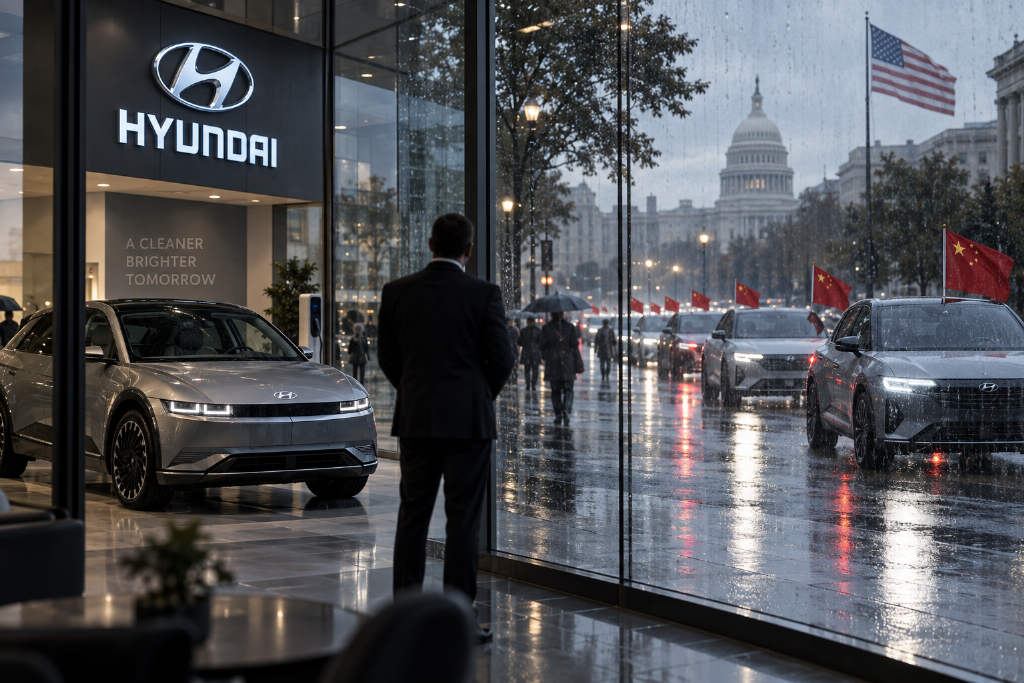
Hyundai Motor CEO José Muñoz warned that Chinese carmakers could become a major threat to the US market if current protections are weakened, saying Chinese vehicles in Italy, Spain, and France are already priced 30% to 40% below comparable rivals.
Speaking to Reuters, Muñoz said the US could be the next market hit by a wave of lower-priced Chinese vehicles if it does not maintain sufficient safeguards.
He also pointed to the UK, once what he described as a 「very profitable, very robust」 market, as a case study in how quickly conditions can change. In his words, 「the best sellers are all Chinese cars, because there are no barriers there.」
The UK market has become a reference point
According to August data from the Society of Motor Manufacturers and Traders, electric vehicles accounted for 29.8% of new car registrations in the UK, the second-highest monthly reading this year. Over the first eight months, 355,746 EVs were registered, compared with 598,842 gasoline vehicles. Gasoline car sales fell 3%, while EV sales jumped 28.6%.
Chinese brands were the biggest winners in that shift. BYD registered 48,265 vehicles in the UK in the first eight months of the year, up from 24,333 a year earlier, nearly doubling its volume. Its market share rose from 1.92% to 3.48% over the same period. BYD’s lowest-priced EV, the Dolphin Surf, carries an on-road price of 18,675 pounds in the UK, or about $25,000. Chinese brands as a group now account for more than 15% of new car registrations in the UK.
EU tariffs have not stopped share gains
The report said tariffs and minimum price thresholds in the European Union have not been enough to stop Chinese brands from gaining share. Data from the European Automobile Manufacturers’ Association showed Chinese brands accounted for more than 9% of EU new-car sales in the first half of 2026.
Even after tariffs, Chinese-made EVs in Italy, Spain, and France remain 30% to 40% cheaper than comparable local models. The UK, by contrast, did not adopt the EU’s tariff and pricing thresholds after Brexit in 2020, giving Chinese automakers a much easier path into the market.
The US still has a tariff wall, but the stance may be shifting
The US currently imposes a 100% tariff on imported Chinese EVs. It also restricts Chinese connected-car software, batteries, and critical minerals. Muñoz said the US will need to impose conditions on Chinese automakers if it wants to reduce the impact, adding that the pressure 「will definitely come.」
That policy line may no longer be fixed. In an interview with Fox News last week, Donald Trump said he would be open to Chinese automakers if the vehicles were produced in the US. That would move the debate away from a simple tariff barrier and toward conditional market access tied to local manufacturing.
Legacy automakers are also warning about price and capacity pressure
Ford CEO Jim Farley made a similar argument in April on Fox & Friends. He said China has more than 50 million units of production capacity, enough to 「cover all of US manufacturing, all of US auto sales.」 He called manufacturing the 「core and soul」 of the US and said the impact would be 「devastating,」 adding, 「we should not let them into our country.」
Price gaps remain central to the concern. Ford’s Fathom electric pickup, expected in 2027, is set to start at $30,000. Kia’s EV3 starts at $29,890 in the US, while Hyundai’s IONIQ 5 starts at $35,000. All three are priced above the roughly $25,000 on-road price of BYD’s Dolphin Surf in the UK.
Hyundai’s answer is more local production
The report said tariffs and restrictions on software and batteries have bought US automakers time, but the UK and EU markets show how quickly market share can shift once protections loosen and price differences are allowed to work through the system.
Hyundai’s own response is to expand localization. The company plans to add 500,000 units of capacity in North America by 2030 and raise the share of locally sourced parts in the US from about 60% to more than 80%. The Santa Fe built in Alabama was cited as one example.
The report said that approach resembles the strategy Japanese automakers once used to enter the US market: local manufacturing in exchange for political tolerance.