
IBM's Acknowledgment Ignites the Rally: three Token Rockets 53x
Over the night of June 1 to June 2, IBM's official X account twice responded to collaboration-related posts by three.ws, directly catalyzing a massive surge in the three token. According to GMGN, three's market cap leaped from around $300,000 prior to IBM's response to an intraday peak of $16.38 million on June 4—a more than 53-fold increase—before settling around $13 million. Notably, the token had been live on Solana since late April, but the explosive gains were almost entirely concentrated around the period of IBM's public engagement, not a gradual build-up from launch.
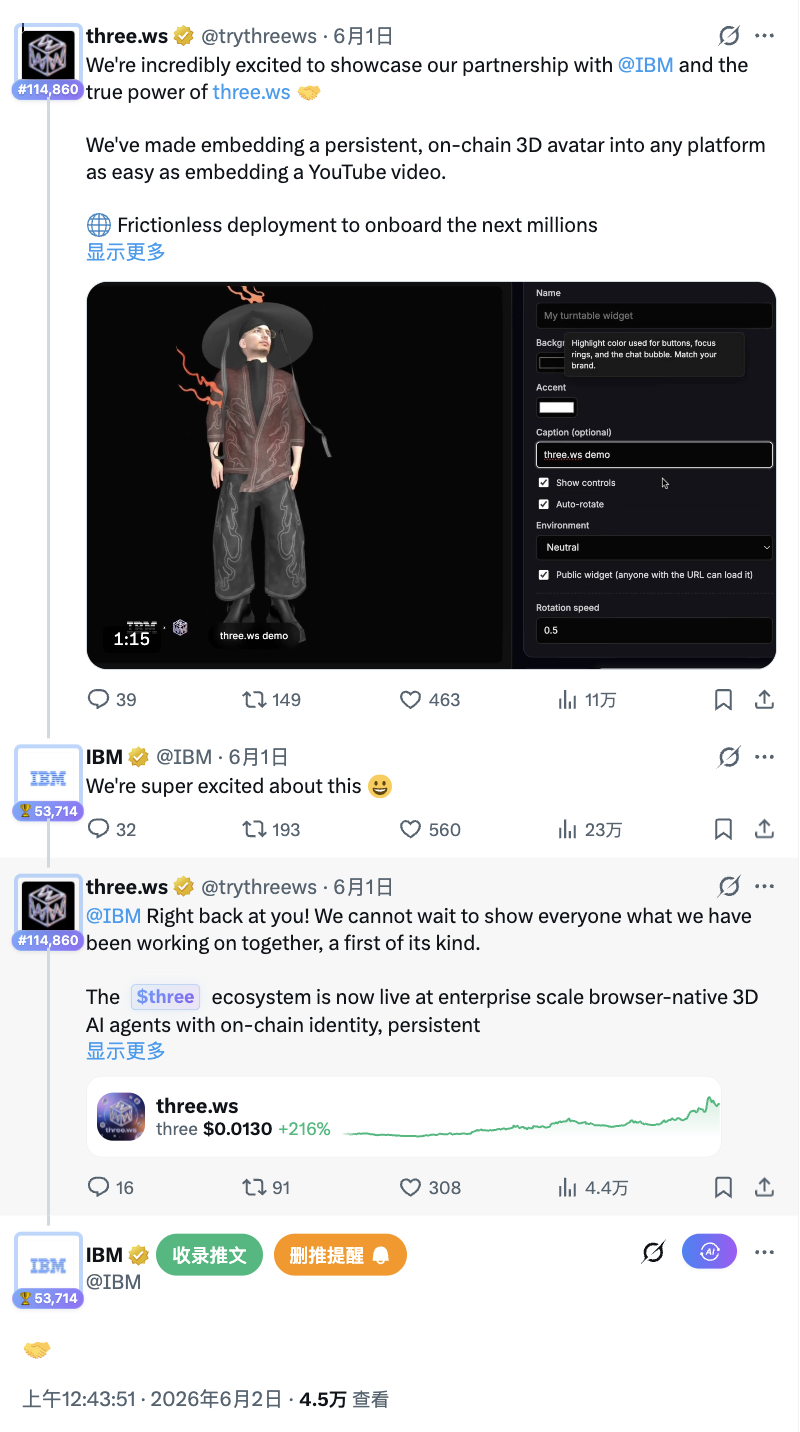
From Chatbox to Web Frontend: Making AI Agents Visible
If one merely sees three.ws as a Solana AI project blessed by IBM, they would miss the core dilemma it addresses: most AI agents today are still confined to chat interfaces and backend processes, invisible across websites, devices, and chains. three.ws positions itself as the "3D Agent Layer" for the internet, aiming to equip agents with a body, memory, identity, wallet, and distribution channels, turning them into 3D digital characters that can appear on web pages, perform actions, and transact. Founder @nichxbt has over 20,000 followers and a verified account. The project is already listed on AWS Marketplace and Alibaba Cloud International, has joined the Google Cloud for Web3 Startups program, is included on Anthropic's official MCP Registry, stands as a W3C contributor, and was a participant in the Solana Frontier Hackathon.
A Four-Piece Swappable Architecture: Rendering, Cognition, Identity, and Distribution
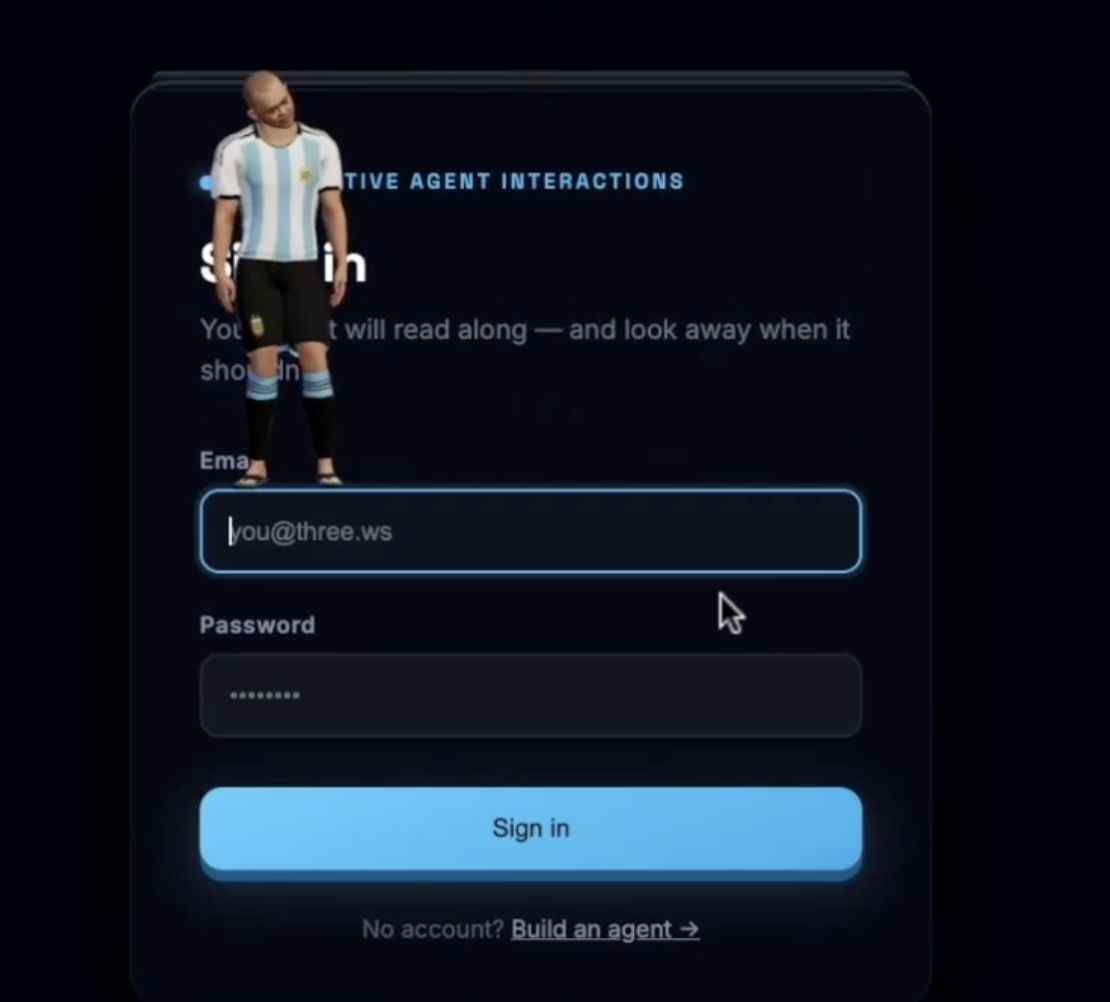
Based on existing code and documentation, three.ws's fundamental capabilities start with browser-side 3D model loading and display, then integrate large language models, memory, voice, skills, on-chain identity, and payments. A developer can create a 3D character, connect it to an LLM, memory, voice, and skills, and embed it into a website using a single <agent-3d> web component—similar to embedding a YouTube video—without building complex 3D scenes from scratch. Character creation is flexible: users can upload a selfie and generate an animatable 3D avatar in about 60 seconds, use text or image generation, upload custom GLB or glTF files, or work through a character editor.
The agent's on-chain capabilities include owning a Solana wallet, paying USDC for paid interfaces via the x402 protocol, and registering its identity as a Metaplex Core asset on Solana or via ERC-8004 on EVM chains. The identity layer is separate from the wallet: on-chain identity proves ownership and points to metadata, while the wallet handles payments and transaction execution.

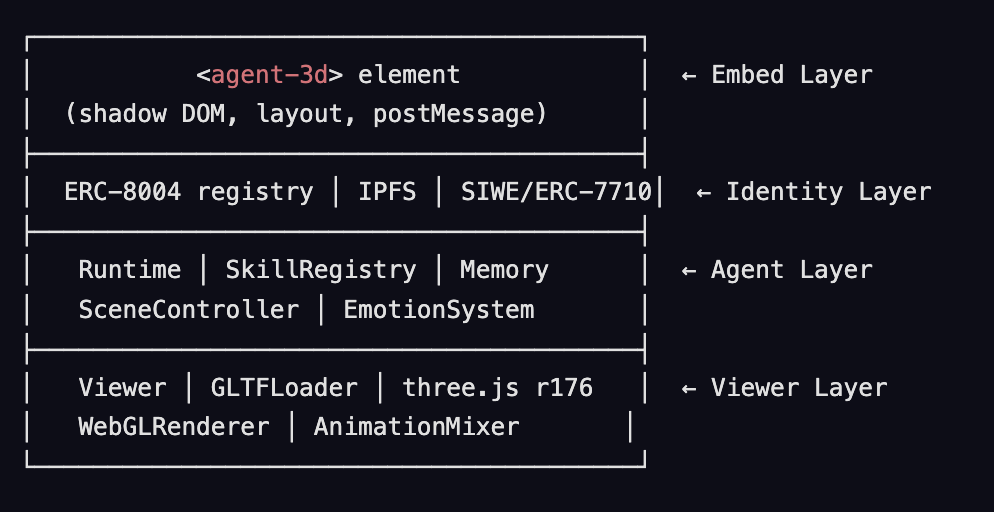
The overall architecture consists of four independently swappable layers. The Viewer layer, built on three.js, handles 3D rendering—lighting, camera, materials, animations—and can even operate as a standalone 3D model viewer without any AI. The Agent Layer processes user input through an LLM, combining the character's role settings, history, and installed skills to decide what to do; it also includes an emotion system that changes facial expressions, gaze, and gestures. The Identity Layer stores manifest files on IPFS or platform servers to preserve an agent's identity across sites and sessions; it already supports Metaplex Core on Solana, while ERC-8004 on EVM is still in testnet. The Embedding and Distribution Layer brings the agent to users via web components, iframes, widgets, or SDKs.

Enterprise Onboarding: AWS Marketplace and IBM Ecosystem Integration
For a 3D AI agent project, building a compelling demo is relatively easy; the real hurdle is fitting into enterprise procurement processes while meeting billing, deployment, identity verification, and AI governance standards. On May 27, three.ws joined the AWS Partner Network and listed on AWS Marketplace, enabling enterprise customers to purchase its services through their existing AWS accounts. The IBM collaboration envisions combining three.ws's 3D Agent technology with IBM's enterprise AI, hybrid cloud, and market channels, tapping into IBM Granite models for conversational AI, image understanding, semantic matching, market forecasting, and governance scenarios. AWS Marketplace solves procurement and billing; IBM contributes enterprise AI technology and commercial channels. Together, they aim to transform the browser-based 3D AI agent from a catchy demo into a service that businesses can buy, deploy, and manage.

Questions That Remain After the Hype
In a bear market, IBM's public acknowledgment has given three.ws scarce attention, but after the fever passes, the project must answer more practical questions: Do enterprises and developers actually need an AI agent with a physical body, skills, and a digital identity? And what precise role will the three token play inside this ecosystem? The short-term token surge is just the opening act.