
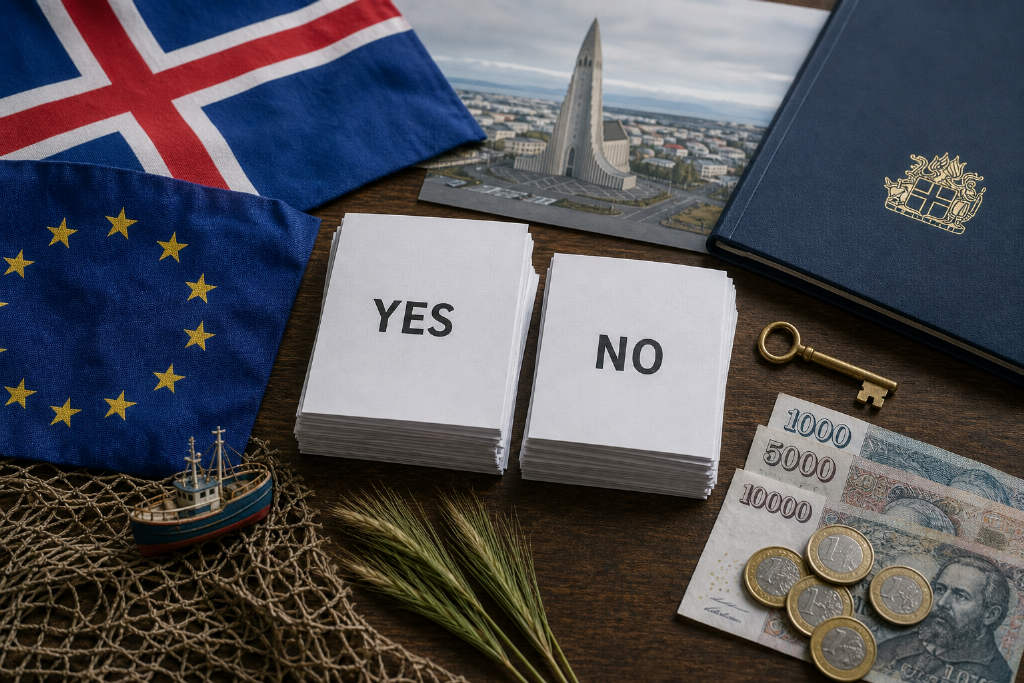
Iceland’s referendum on whether to restart European Union accession talks that were halted 13 years ago remained on a knife edge late in the count on Aug. 29, with the Yes camp ahead on 51.17% and No on 48.83%. A total of 104,731 valid ballots had been counted, and a clear result was not expected until midday Sunday local time.
For the island nation of fewer than 400,000 people, the vote reaches into several core questions at once: whether the krona could eventually give way to the euro, whether interest rates now sitting at 7.5% to 8% might fall, and whether decision-making over fisheries would move toward Brussels.
Polling and the ballot question both pointed to a close race
Pre-vote surveys had already shown a contest within the margin of error. A Maskína poll found 51.3% support and 48.7% opposition, while another poll released Friday put Yes at 50.4%.
The referendum question was direct: whether Iceland should resume EU accession negotiations. The vote is advisory, so a Yes result would not mean Iceland is joining the bloc. A second referendum, parliamentary approval, constitutional amendments and signatures from all 27 EU member states would still be needed.
Talks launched in 2009 and stopped in 2013 are back in focus
Iceland’s EU story traces back to the 2008 financial crisis. After the banking system collapsed, Reykjavik opened accession talks in 2009, then stopped them in 2013.
Before the process was halted, 27 of 35 chapters had been opened and 11 were provisionally closed. European Council records cited in the report said European Commission officials assessed the remaining work could be completed within one to two years. Iceland is already part of the single market through the European Economic Area and is in the Schengen area. Full EU membership would take it one step further into the customs union and, ultimately, toward the euro.
Fisheries sovereignty remains the central obstacle
For the No camp, the main concern is not security but livelihoods. Fisheries and marine industries account for nearly 40% of Iceland’s exports. Opposition leader Guðrún Hafsteinsdóttir said the question was not whether Iceland should cooperate with Europe, but whether Icelanders were willing to hand decision-making over fisheries, agriculture and natural resources to Brussels.
The EU’s Common Fisheries Policy remains the issue opponents find hardest to accept, and the No side has vowed not to share Icelandic waters. Brussels has hinted that exemptions might be possible, but the issue is still seen as the biggest barrier. Memories of the Cod Wars with the U.K. in the 1970s continue to shape the debate.
Eirikur Bergmann, a professor at Bifröst University, told the BBC that Iceland is one of Europe’s wealthiest countries and that “many attribute that to independence.”
The krona and the euro form a second line of argument
Currency policy runs through the vote as well. An independent krona lets Iceland set its own interest rates and use the exchange rate to absorb shocks. The report said that value was demonstrated after the 2008 collapse and during swings in tourism and fisheries income.
There is a cost. Interest rates remain between 7.5% and 8%, inflation stands at 5.6%, and an Icelandic labor union survey described Iceland as the most expensive country in the world. The Yes camp argues that moving closer to the EU could help bring rates down.
Prime Minister Kristrún Frostadóttir said after voting that the race was extremely close and “very exciting.” She also said a Yes result would not equal EU membership, and that a No win would be respected.
Each outcome comes with a different timetable
If Yes wins, negotiations could restart as early as the end of 2026 and take 18 to 24 months. Even then, another referendum would still be required.
If No wins, the government has pledged not to restart talks before 2028. Whether Iceland withdraws its application would be left to parliament.
Security tensions and Greenland added weight to the referendum
Geopolitics helped drive the vote. Iceland is a founding member of NATO but has no military of its own, relying on allies for defense. It has had a bilateral defense agreement with the United States since 1951. The No camp argues that security depends on NATO and the U.S., and that EU membership cannot replace the alliance.
The war in Ukraine has also sharpened Iceland’s attention to Russian activity in nearby waters. At the same time, concern has grown over Donald Trump’s stated interest in taking over Greenland; the report noted that he has even mixed up Greenland and Iceland. Earlier this year, the EU and Iceland signed a security and defense partnership agreement, which officials called an “anchor” for a community of values, prosperity and security.