
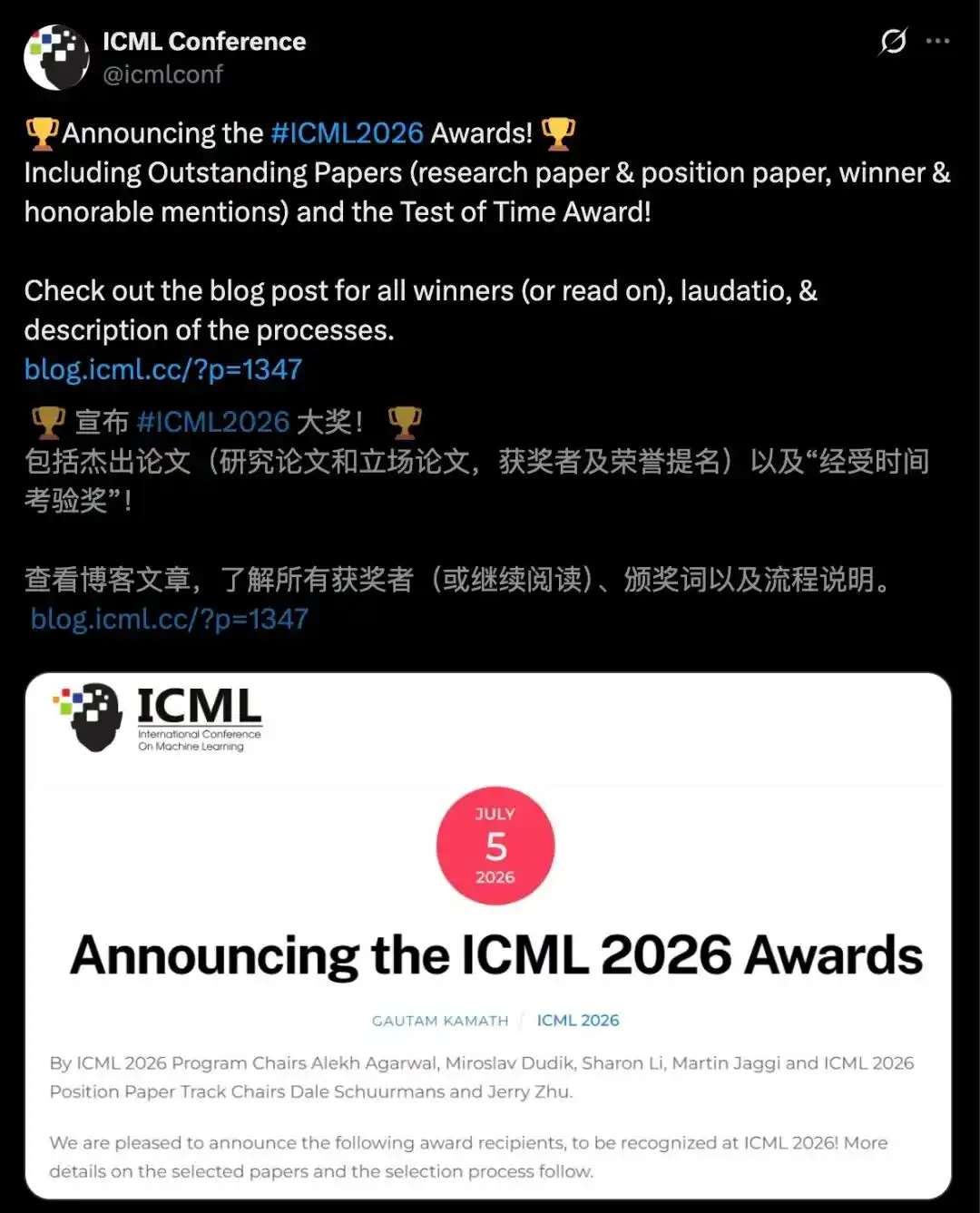
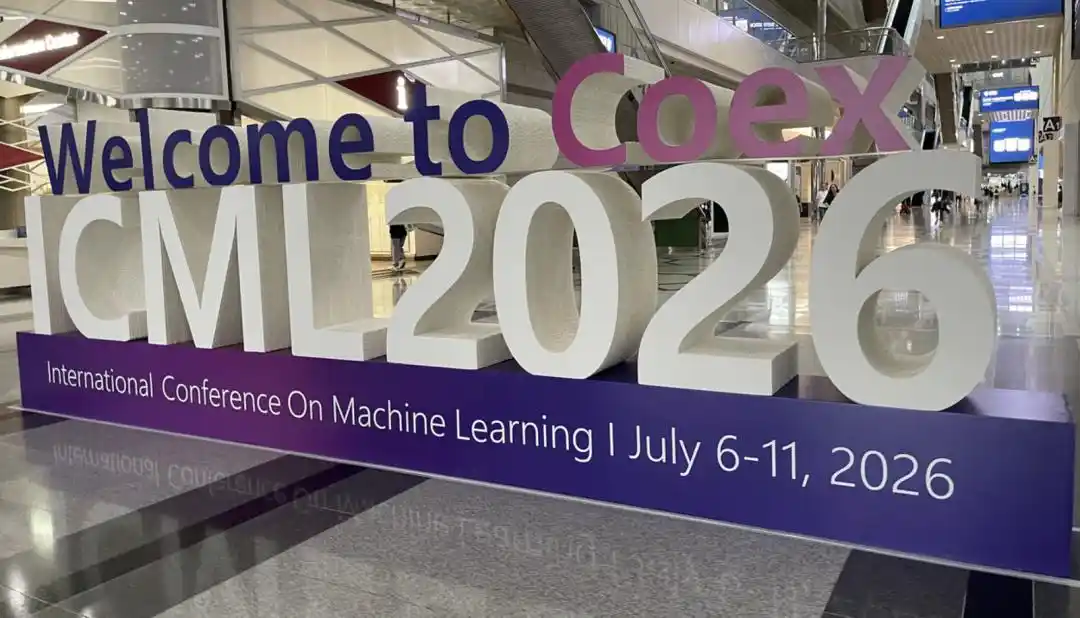
ICML 2026 has released its annual award list, highlighting a set of papers that reflect where machine learning research is heading next. As one of the three most influential conferences in the field alongside NeurIPS and ICLR, ICML 2026 is being held from July 6 to July 11 at COEX in Seoul, South Korea. This year’s distinguished paper selection included 9 finalists in total, made up of 7 research papers and 2 position papers, with 3 top winners and 6 honorable mentions ultimately announced. The conference’s Test-of-Time Award went to DeepMind’s landmark 2016 reinforcement learning paper, “Asynchronous Methods for Deep Reinforcement Learning.”
Diffusion-model papers dominated the top awards
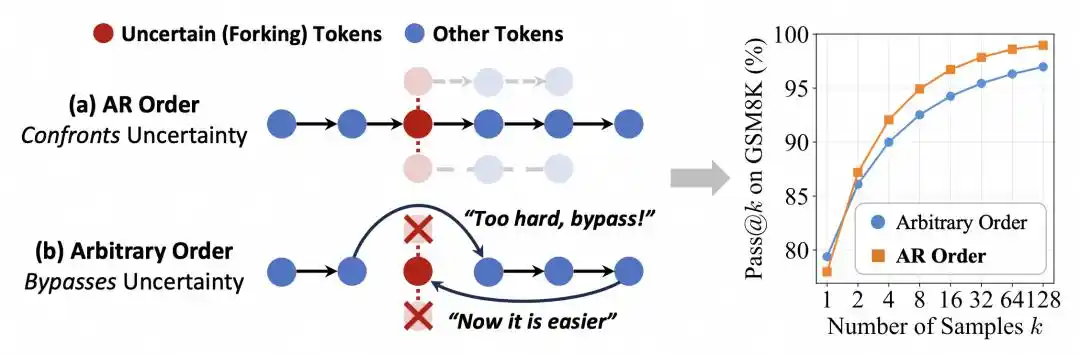
The most notable outcome this year was the prominence of diffusion-model research. Two papers in that area received distinguished paper honors, a rare result that signals unusually strong consensus from the ICML program committee. The first, “The Flexibility Trap: Rethinking the Value of Arbitrary Order in Diffusion Language Models,” by researchers including Zanlin Ni and collaborators from Tsinghua University, directly challenges one of the most widely cited advantages of diffusion language models: their ability to generate text in arbitrary order.
According to the paper, supporting every possible generation order may not provide the practical benefit that many researchers had assumed. Instead, the authors argue that this flexibility can dilute performance on specific generation orders, turning a supposed advantage into a tradeoff. That conclusion matters because arbitrary-order generation has often been presented as a key reason diffusion-based language models might outperform autoregressive systems in future architectures.
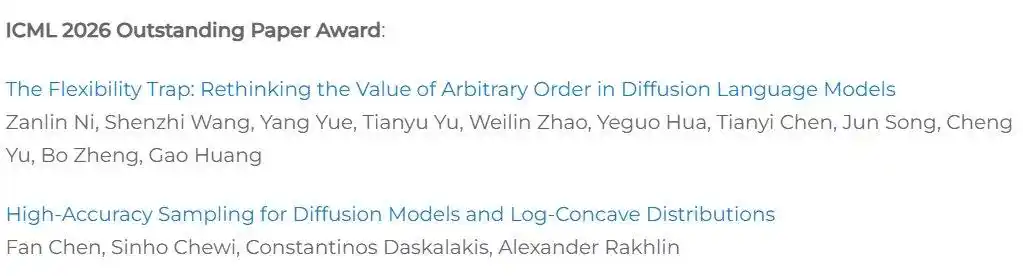
The second winning paper, “High-accuracy sampling for diffusion models and log-concave distributions,” by Fan Chen and coauthors, focused on sampling precision. Rather than challenging an assumption, this work pushed forward the algorithmic foundations of diffusion systems by improving high-accuracy sampling for both diffusion models and log-concave distributions. In practical terms, the paper addresses a lower-level bottleneck that affects generation quality and theoretical guarantees in deployment settings.
Taken together, the two winning papers sent a clear message. One dismantles a central narrative around diffusion language models, while the other strengthens the underlying mathematical and algorithmic toolkit. ICML’s decision to recognize both suggests the field is moving beyond novelty and into a phase centered on correction, rigor, and infrastructure.

Position paper award focused on alignment and censorship risks
In the position paper category, Sarah Ball and Phil Hackemann won the distinguished position paper award for “Position: The Alignment Community is Unintentionally Building a Censor’s Toolkit.” The paper argues that techniques developed in AI safety and alignment, including RLHF, Constitutional AI, and broader value-alignment frameworks, may be repurposed as content-control infrastructure even if their original goal is to make models safer and more controllable.
The paper’s argument resonated with broader debates that have intensified over the past year. Complaints about model refusals, aggressive filtering, and so-called over-alignment have become a recurring issue across major consumer AI products. By recognizing this paper, ICML elevated that frustration from a product-level discussion into a research-level question: whether the design of alignment tools inherently creates structural risks when those tools are deployed in other contexts.
An honorable mention in the same position-paper track went to “Position: Deepfake Research in AI/ML is Misaligned with AIG-NCII” by Li Qiwei and coauthors. That paper argued that mainstream deepfake research often fails to match the real-world harms associated with AI-generated non-consensual intimate imagery, drawing attention to a gap between academic priorities and the most damaging abuse cases.
Honorable mentions spanned RLVR, video generation, memory, and theory
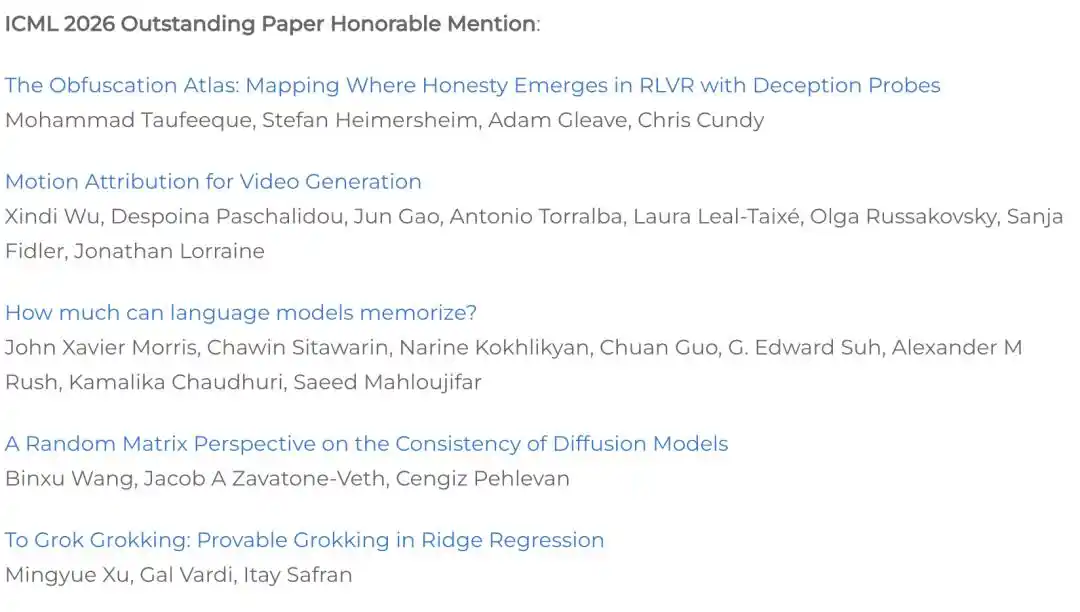
The five research-paper honorable mentions covered a broad range of active topics. “The Obfuscation Atlas: Mapping Where Honesty Emerges in RLVR with Deception Probes,” by Mohammad Taufeeque and coauthors, examined where honesty emerges in models trained with RLVR. The work is notable because locating honesty-related behavior inside model layers could eventually make alignment interventions more targeted rather than broadly heuristic.
Another selected paper, “Motion Attribution for Video Generation” by Xindi Wu and collaborators, addressed how motion is represented and attributed in video generation systems. This question is increasingly important as video models become more capable, because it bears directly on interpretability and whether generated motion reflects meaningful internal understanding or merely sophisticated pixel-level pattern replication.

John Xavier Morris and coauthors were recognized for “How much can language models memorize?” which tackles one of the most sensitive issues in large language models: how much training data they retain in a recoverable form. The topic has immediate implications for privacy, copyright, and the technical boundaries between learning, storage, and reproduction.
Diffusion theory also remained visible beyond the top winners. Binxu Wang and colleagues received an honorable mention for “A Random Matrix Perspective on the Consistency of Diffusion Models,” a paper that explores why diffusion models trained on different, non-overlapping subsets of data can still generate strikingly similar outputs when seeded with the same noise. The authors argue that part of this consistency can be traced to shared Gaussian statistics rather than simple memorization of identical examples.
Mingyue Xu and coauthors were honored for “To Grok Grokking: Provable Grokking in Ridge Regression.” Their contribution stands out because it provides a rigorous mathematical proof of grokking in ridge regression, a far simpler and more classical setting than the deep networks where the phenomenon is usually discussed. That makes the result significant for researchers trying to understand sudden jumps in generalization from a more principled perspective.

DeepMind’s A3C paper earned the Test-of-Time Award
The ICML 2026 Test-of-Time Award went to Volodymyr Mnih, David Silver, and other DeepMind researchers for “Asynchronous Methods for Deep Reinforcement Learning.” Published in 2016, the paper introduced A3C, or Asynchronous Advantage Actor-Critic, a reinforcement learning method that replaced a single monolithic training process with multiple parallel workers exploring policies asynchronously and aggregating gradients.
The appeal of A3C was its simplicity and effectiveness. It offered a practical training framework that helped define modern reinforcement learning at a crucial stage of the field’s development. A decade later, the paper is still recognized as foundational, with its design philosophy and core ideas influencing a wide range of RL systems, from game-playing agents and robotics to later large-scale optimization and alignment workflows.
What the ICML 2026 award list signals
Viewed as a whole, the ICML 2026 awards point to a noticeable shift in research priorities. First, diffusion models remain one of the most concentrated areas of machine learning activity, with both top awards and honorable mentions reinforcing their importance in the current architecture debate. Second, AI safety and alignment are no longer being discussed only in terms of capability control; the field is now grappling more openly with whether safety tools can become censorship tools in practice.
Third, many of the recognized papers focus less on scaling for its own sake and more on mechanism, theory, and evaluation. Whether the subject is diffusion consistency, model memorization, honesty emergence, or grokking, the common thread is a stronger emphasis on understanding systems rather than only extending them. In that sense, the ICML 2026 award list reads not just as a set of honors, but as a snapshot of a field entering a more reflective and foundational stage.