
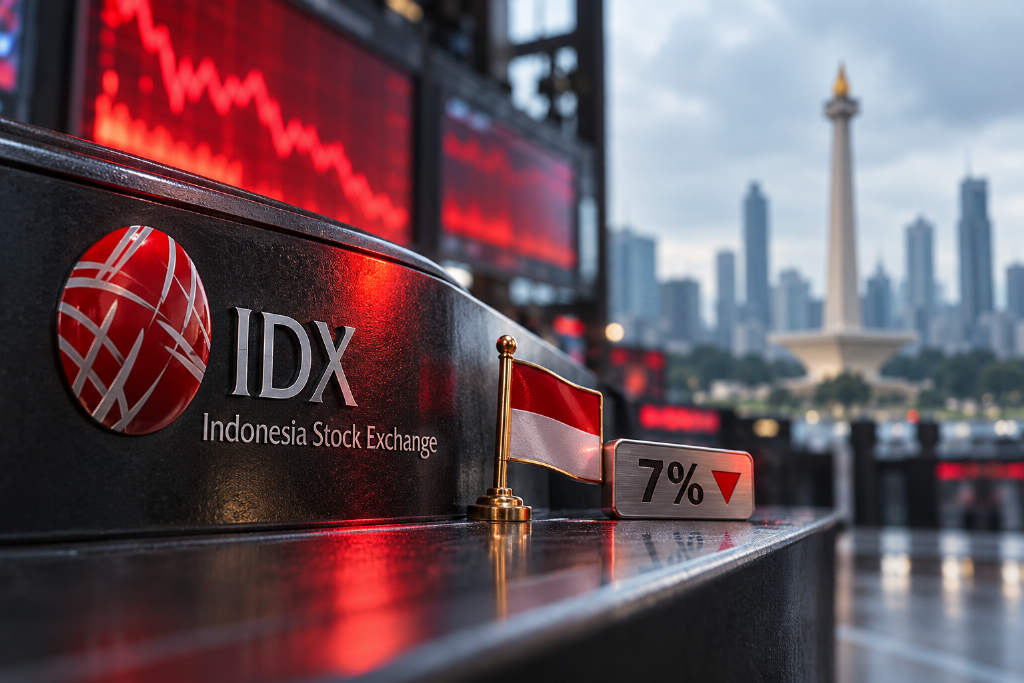
Indonesia’s stock exchange cut the daily downside limit for listed shares from 15% to 7%, effective Oct. 19 through year-end, after MSCI proposed stripping Indonesia of its emerging-market status and moving it to standalone-market status, while the benchmark index sank almost 15% in a single week.
The exchange said the point of the change was to give investors time to judge and process the information already out there. Then, on Oct. 20, it added one more rule for low-priced shares: stocks trading at 11 to 14 rupiah could fall by no more than 1 rupiah a day.
MSCI proposal triggered the latest shock
The spark was immediate. On Oct. 15, MSCI said it was proposing to shift Indonesia from the emerging-markets bucket to the standalone market category. MSCI splits markets into four levels: developed, emerging, frontier, and standalone. Reuters said that if Indonesia ends up classified as standalone, it would sit outside the major global indexes and be grouped with markets including Lebanon and Zimbabwe.
MSCI did not suggest dropping Indonesia to frontier first. It skipped that step and went straight to standalone. The reason was plain enough: market participants felt a frontier-market downgrade would still fail to capture how deep the market’s problems run.
MSCI pointed to murky ownership structures, suspected coordinated trading, and no visible enforcement to speak of. Indonesian authorities have already announced tighter disclosure rules for shareholders with stakes above 1%, and they also plan to lift the minimum free-float requirement to 15%. But MSCI said suspected coordinated trading is still going on, and it has not seen proof of meaningful enforcement. Unless the consultation period produces clear evidence of improvement, MSCI said it expects to move ahead with the proposal.
Index fell 14.91% in a week
The market’s response was instant. On Oct. 16, the Jakarta Composite Index opened down 8.01%, enough to trigger a 30-minute trading halt. After the market reopened, losses got worse, and the index finished down 11.6%—its sharpest one-day fall in 28 years. For the week, the drop reached 14.91%.
That same day, Indonesia’s Financial Services Authority, or OJK, fined parties tied to alleged manipulation involving the shares of three companies, with total penalties of 2.1 trillion rupiah. Angus Mackintosh, ASEAN specialist at Aletheia Capital, told Reuters the fines were a good step. But, he said, OJK still has to prove its authority by acting directly against "certain well-known individuals involved in market manipulation."
How the new limit works
Under the Oct. 19 rule, any stock priced at 11 rupiah or higher now faces the same 7% daily downside limit. Daily upside limits did not change; they still follow price bands of 35%, 25%, and 20%.
Sell orders entered below the lower limit are rejected automatically by the matching system. Sellers can only place orders at the limit-down price and wait for buyers. If no trade happens, that order does not magically clear. They have to come back and try again the next day.
The Oct. 20 tweak changed the treatment of shares priced at 11 to 14 rupiah, limiting daily declines to 1 rupiah, which is the same rule already used for stocks trading at 1 to 10 rupiah. The reason is mechanical. Simple math. Seven percent of that price range is less than 1 rupiah, while the minimum tick size is 1 rupiah. So a strict 7% cap would, in practice, mean those shares could not fall even one tick.
First day under the new rule still ended lower
Even on the first day of the tighter limit, the Jakarta Composite Index still dropped 3.64% to 4,996.60, its lowest level in six years. There were 656 decliners and 100 gainers. Exchange president Jeffrey Hendrik said on Oct. 19 that, "The market can fall, but it must fall through an orderly market mechanism, and investors must receive equal access to information," adding that the panic seen on Oct. 16 had eased.
By midday on Oct. 20, the index had bounced 4.16% to 5,204.63, with 633 stocks up and 124 down. Local media said the rebound was driven by corporate share buyback announcements, the exchange’s new rule, and plans to increase holdings in state-owned enterprise stocks. Even so, the index was still down about 40% for the year, and trading in Jakarta had not yet ended at the time of writing.
The cap changes speed, not the underlying problem
The report’s point is simple: the lower limit only changes how far prices can fall in one day. It does nothing to fix the issues MSCI actually cares about—who owns the shares, whether coordinated support or manipulation is happening, and whether enforcement has any real bite. Orders that cannot be sold do not vanish. They spill into the next session. The exchange wants investors to absorb information. MSCI wants proof that reform is real and already being carried out.
63 concentrated-ownership stocks to be removed from index calculation
After meeting with MSCI, Hendrik said the exchange would remove every stock it classified as having high ownership concentration from the composite index calculation. That is not delisting. Far from it. It simply means those shares will no longer move the benchmark index when their prices change.
There are 63 such stocks. As of September 2026, their combined market value stood at 3,076.5 trillion rupiah, or 28.8% of the entire market, yet they made up only about 5% of average daily turnover. Nearly 30% of market capitalization with just 5% of trading is a pretty direct sign of a market where a lot of stock sits in the hands of a small group of owners, while only a limited slice really circulates. That cuts straight to MSCI’s concerns about ownership structure and free float.
Decision due by June 30, 2027
MSCI’s consultation period runs until April 30, 2027, and the final decision is due no later than June 30, 2027. Until then, MSCI���s freeze on Indonesian constituents stays in force. It will neither raise foreign inclusion factors nor add new constituents.
Goldman Sachs strategists wrote that the burden of proof has now moved. If Indonesia wants to avoid reclassification, it has to show clear evidence that reforms are being applied consistently and are materially improving how the market functions. The burden now sits with Indonesia, not MSCI.
Outflow risk and pressure on the rupiah
Goldman Sachs estimates that a full removal from MSCI indexes could trigger $5.6 billion in passive outflows. Active funds hold more than $8 billion more, though whether those positions get sold will depend on portfolio managers. Foreign investors have already been net sellers of $4.88 billion in Indonesian equities this year—the biggest annual outflow in at least 16 years.
The rupiah has weakened to 18,040 per U.S. dollar, near the record low of 18,190 reached in June. Gary Tan, a portfolio manager at Allspring Global Investments, said, "We are more concerned not about the index-related selling itself, but about short-term spillover into the rupiah and domestic government bond yields, tightening financial conditions and causing a more visible hit to the real economy."
What the market is watching next
The report takes a cautious view of the rebound. It sees it as a pause after a brutal drop, not a turning point. The tighter limit buys time. That’s all. Two things matter most: whether OJK takes real action against well-known manipulators, and whether ownership and trading structures show verifiable improvement after the 63 concentrated-ownership stocks are removed from index calculation.
If those two conditions still are not in place by June 30, 2027, there is little reason to think MSCI’s expected decision changes direction. One more signal matters too: the rupiah. If it falls past the June record low of 18,190, the strain could jump from equities into the currency market and government bonds. The daily limit can slow stock-price declines. It cannot hold down the exchange rate.



