

Citrini has repeatedly appeared at the intersection of traditional finance and crypto markets this year. In February, its report The 2028 Global Intelligence Crisis triggered a selloff in U.S. software stocks and intensified anxiety around job losses in Silicon Valley. In April, Citrini’s Analyst#3 traveled to the Strait of Hormuz and wrote a field report that used firsthand observations to describe the actual operating details of this conflict-sensitive chokepoint. More recently, Citrini semiconductor analyst Jukan accurately highlighted the importance of copper foil in the AI and semiconductor supply chains, helping set off another wave of investment interest.
Behind the research firm is James van Geelen, a founder who did not come from a conventional finance background. Public information shows that he holds dual degrees in biology and psychology from UCLA, previously worked as an emergency medical technician and caregiver, and founded a healthcare company before entering the investment world. Today, he is described by some as a “god of investment research,” while his cross-disciplinary path has become inseparable from Citrini’s identity.
How Crypto Traders Came to Notice Citrini
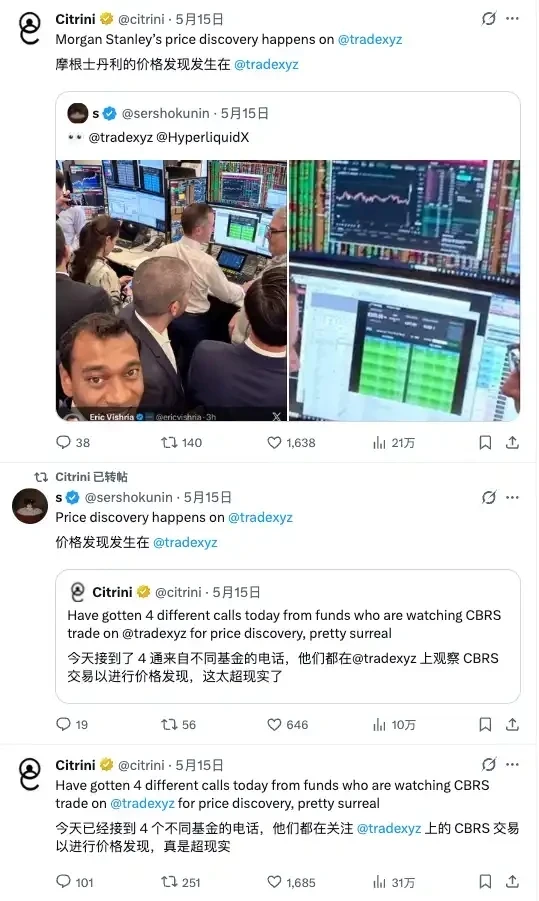
Crypto market participants began paying close attention to Citrini around the time of the Cerebras (CBRS) listing in May. Ahead of the listing, Citrini posted that fund managers were using Trade.xyz, a platform in the Hyperliquid ecosystem, to conduct early price discovery. The post was later reposted and confirmed by Trade.xyz founder Shokun. For a research account that had already influenced traditional finance through The 2028 Global Intelligence Crisis, this comment pushed RWA platforms, U.S. equity pre-market contract platforms, and on-chain U.S. stock trading platforms further into the public view of crypto investors. It also played a role in this year’s “U.S. stock RWA asset” wave.
In this sense, Citrini is not only producing macro and sector research for traditional finance audiences. It is also sending a warning signal to that market: crypto participants that were once seen as minor players are now aiming at the large opportunity set represented by traditional financial markets. This cross-market way of thinking is closely connected to Geelen’s belief in second-order thinking and long-termism.
From UCLA and Emergency Medicine to Entrepreneurship
Geelen, now 33, was not originally tied to AI, semiconductors, or macro trading. He graduated from UCLA with dual degrees in biology and psychology, and later worked in downtown Los Angeles as an emergency medical technician and caregiver. His academic training and emergency medical experience shaped a personality focused on efficiency and planning. As he once said, “If you don’t have a plan, you’re going to have a miserable time.” He has also described himself as a “genius musician,” although there are few widely recognized works that outsiders can use to judge that claim.

Under his original plan, Geelen would have become a doctor. Instead, his career turned toward entrepreneurship. He first founded a healthcare company and sold it to a private equity fund, allowing him to step away from the more standard path of elite university, employment, and professional management. He later founded Citrini. In a 2023 appearance on the Odd Lots podcast, he also said that he had co-founded one of the earliest medical marijuana dispensaries in Connecticut. That experience shows that he was never simply the orderly and rigid “proper doctor” that some might imagine.
The AI Report That Hit Multiple U.S. Equity Sectors
In 2018, after obtaining initial capital, Geelen began his personal investment career under the name Citrinitas Capital. He caught early opportunities in AI, including Nvidia, and in GLP-1 weight-loss drugs, including Ozempic/Wegovy. In December 2025, PitchBook information showed that Citrini completed a seed round of about $5.05 million. The firm had only around 10 employees and remained privately held. Then in February this year, Geelen and Alap Shah, who came from the traditional finance world, co-authored The 2028 Global Intelligence Crisis. Although they repeatedly emphasized that the report was a “thought experiment” and a hypothetical scenario rather than a forecast, its discussion of mass white-collar unemployment, falling consumer spending, and economic contraction, described as “Ghost GDP,” still caused concern in capital markets.

Delivery, payment, and software stocks then fell sharply. IBM recorded its largest single-day decline of 2025 on February 23. American Express and Blackstone both fell more than 8%. The broader software sector declined nearly 5%. Shares of DoorDash, Uber, Mastercard, Visa, Capital One, and Apollo Global Management Inc. were at one point down 3%. Several U.S. equity sectors were pulled into the selloff, while the Dow Jones Industrial Average was down more than 800 points at one stage. Alap Shah later publicly described his investment stance as “short the disruption, long the enablers”: shorting companies they believed would be disrupted by AI while holding semiconductor technology stocks that benefit from AI. The report wiped out hundreds of billions of dollars in U.S. market value in a short period and drew follow-up coverage from Bloomberg, The Wall Street Journal, and other overseas media.

Hormuz, Alchemy, and Second-Order Thinking
On April 6 this year, Citrini’s “Analyst#3” traveled to the Strait of Hormuz, a crucial chokepoint in the U.S.-Iran conflict, and disclosed a series of frontline observations. The report described how Iran’s “toll station” in the strait operates and presented several counterintuitive conclusions. It argued that shipping volume through the strait would gradually rise regardless of how the situation developed; that Iran did not want to close the Strait of Hormuz; that the actual traffic order in the strait was highly standardized; that even if ground operations began, shipping volume could still continue to increase; and that the conflict was not a simple confrontation between two sides, but a multi-party game and a reshaping of the regional structure. Geographic disputes within great-power competition are therefore also within Citrini’s research range.
When asked why the company was named “citrinitas,” Geelen explained that the inspiration came from George Soros’s The Alchemy of Finance. Citrinitas is a stage in alchemy. During this transitional stage, lead begins to turn into gold, but has not yet fully become gold. Geelen said this is the kind of moment he likes most: identifying the birth of “gold” before others have noticed that the lead is changing. Citrini’s research style reflects that idea. It focuses on long-term “supertrends” such as AI, robotics, energy demand, fiscal policy, geopolitics, and modern warfare. It also emphasizes executable “basket” investment references and tactical macro trading ideas, with a preference for long-term structural changes rather than short-term trades. On its Substack profile, Citrini stresses practicality by telling readers that they will no longer need to ask, “What is the trade?”

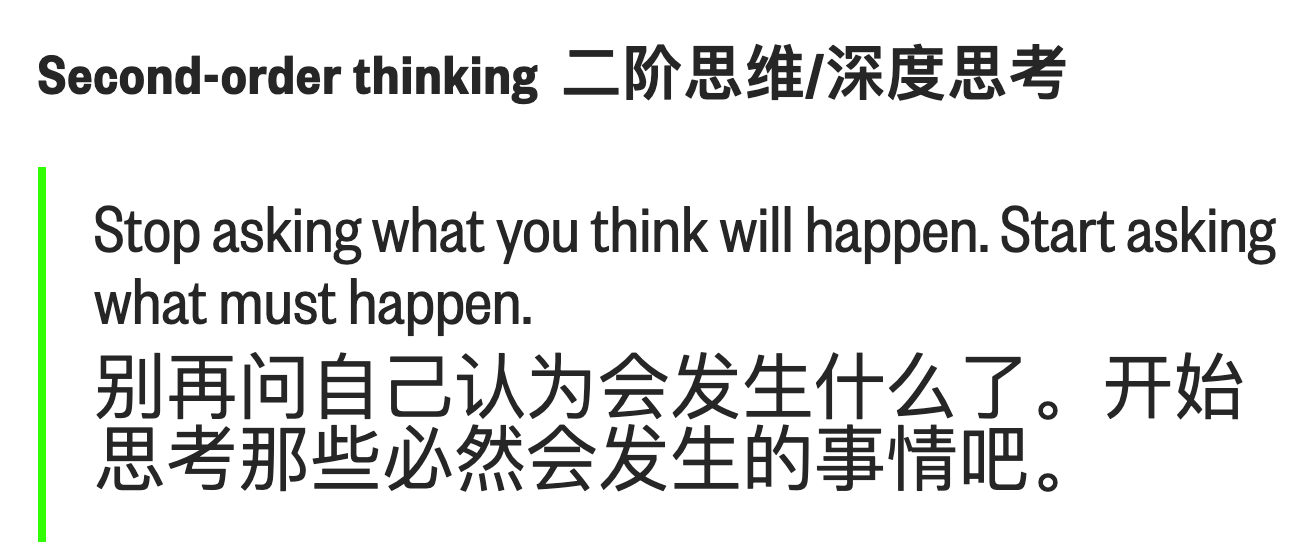
The core of Citrini’s method is to use scenarios to understand second- and third-order effects. Geelen once said: “Don’t always think about what you think will happen. Instead, think about the things that must happen. How will the market’s reaction change reality? What second-order effects will there be? What obstacles stand in the way of a trend continuing? And where will capital flow in order to overcome those obstacles?” This approach has appeared in earlier trades and research. In March 2023, when Silicon Valley Bank collapsed, he bought overnight financing rate call options and gained almost 50 times his money. Last December, before the United States launched military action in Venezuela, he also shared views on investment opportunities in Venezuelan sovereign bonds. Since the start of this year, Citrini has brought in multiple independent analysts, including macro analyst Nick Reece, Korean semiconductor industry analyst @jukan05, and AI chip industry analyst @zephyr_z9. These additions helped fill gaps in industrial detail, technical processes, and changes in sector direction. The firm still operates with a founder-driven model supported by an anonymous elite research team.