
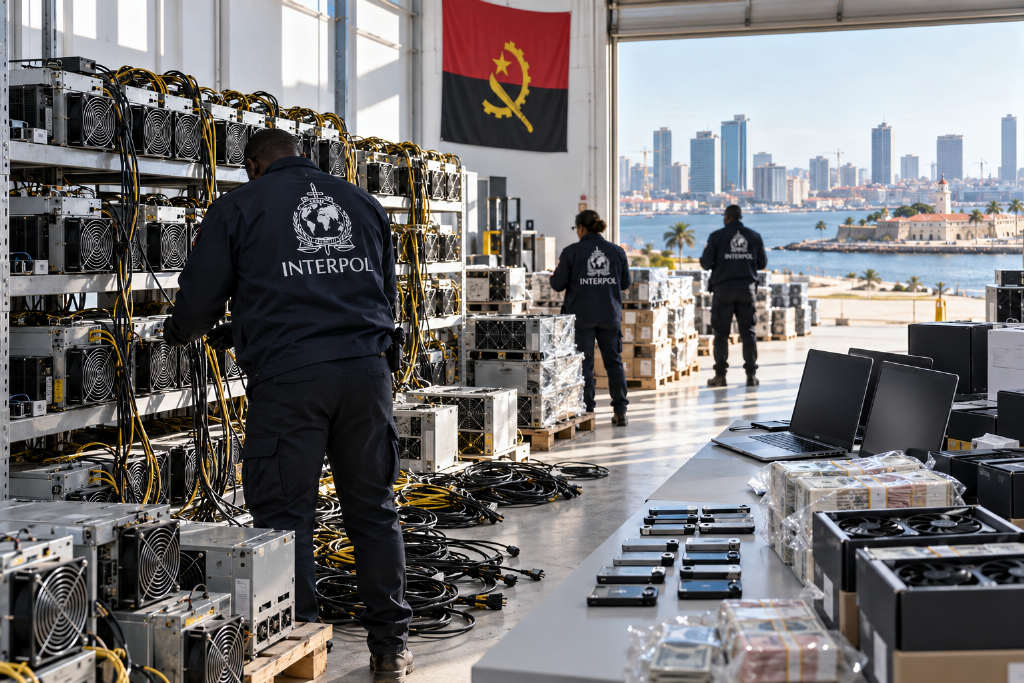
Law enforcement agencies across 21 African countries arrested 1,462 suspects, disrupted 10,909 malicious networks, and recovered more than $105 million in illicit funds in an Interpol-coordinated cybercrime operation, the international police organization said Thursday.
Operation Serengeti III ran from June 29 to August 31, 2026. It targeted ransomware, online scams, business email compromise, digital extortion, and other cyber-enabled fraud. Interpol said authorities identified 65,929 victims, and financial investigations linked the networks to losses of more than $385 million.
Illegal crypto mining sites dismantled in Angola
In Angola, investigators dismantled two illegal crypto mining centers, arrested nine people, and seized more than 2,000 mining devices along with six illegal power transformation stations. Interpol said the seized electrical equipment alone was worth more than $1 million.
Nigeria and Uganda cases involved crypto-linked fraud flows
In Nigeria, authorities arrested a suspect tied to an international investment fraud scheme promoted through messaging apps. Investigators traced more than $2.4 million in suspected criminal proceeds, much of it laundered through crypto transactions.
Ugandan authorities dismantled two transnational fraud rings and arrested 365 foreign nationals linked to online investment and pension scams targeting victims in Asia. According to Interpol, the rings operated a rotating call-center setup that used scripts, fake trading platforms, and fraudulent websites to persuade pensioners to put money into nonexistent opportunities.
Other arrests and network disruption details
Other arrests included a Nigerian suspect accused of running a phishing and business email compromise operation that collected around 2.1 million email addresses, as well as 30 suspects linked to a cybercrime operation in the Republic of Congo.
「Cybercrime networks operate without regard for borders, exploiting technology to target victims on an unprecedented scale,」 said Neal Jetton, Interpol's director of cybercrime.
Interpol said private-sector partners that supported the operation included Group-IB, Kaspersky, blockchain analytics firm Uppsala Security, and Meta. Several investigations remain active as authorities work to identify additional suspects and trace illicit proceeds.
Earlier Interpol action also tracked illicit crypto
The operation followed Operation Catalyst, a joint Interpol and Afripol crackdown on terrorist financing and cybercrime in 2025 across six African countries. That operation resulted in 83 arrests.
Interpol said Operation Catalyst flagged $260 million in illicit crypto and fiat, of which $600,000 had been seized. It also identified several high-value crypto wallets that the organization said were 「potentially linked」 to terrorist financing.
At the time, an Interpol expert told Decrypt that criminals were 「increasingly」 using crypto in Africa, though it was not yet the main method by which most cybercrime proceeds were paid or settled.


