
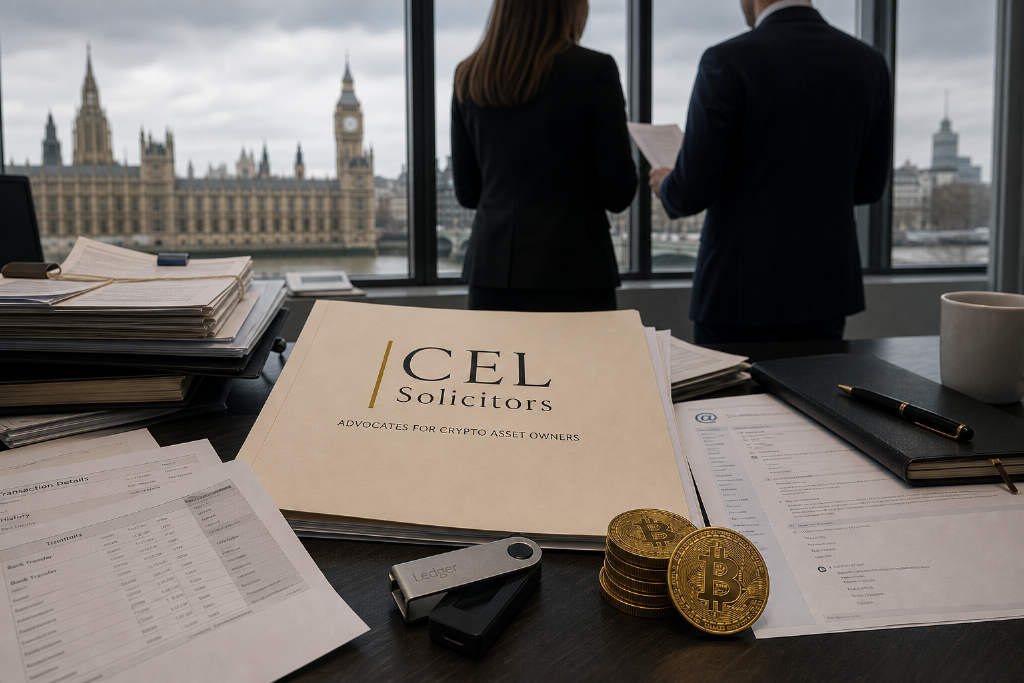
CEL Solicitors says it has identified the whereabouts of more than 5,500 BTC tied to former users of Intersango, an early Bitcoin exchange that shut down more than a decade ago. At Bitcoin’s current price of about $78,000, that pool is worth roughly $433.5 million.
One claimant has already recovered funds. According to CEL, a UK investor instructed the firm on Jan. 20, 2026, and reached a settlement on May 28, recovering 61 BTC in full. At current prices, those coins are worth about $4.81 million.
CEL said former Intersango users can bring ownership and recovery claims against the 5,500 BTC it has traced. Each claimant must submit evidence showing a legal connection to a historical account balance. Records that may now support claims worth millions of dollars include account emails, correspondence with Intersango, bank transfer statements and customer support tickets from more than a decade ago.
Balances once worth a few thousand dollars are now worth millions
Intersango operated when Bitcoin traded at only a little over $10. In October 2012, the exchange said it was shutting its U.S. dollar market because trading volume was too low to justify continuing the pair. At the time, the exchange sold 625 BTC at $12.10 each, for a total of about $7,563. At current prices, those 625 BTC would be worth about $49.3 million.
CEL said Intersango began winding down in late 2012, with its pound sterling and U.S. dollar businesses ending in stages. The website was fully shut in early 2014. Records at the UK Companies House show Intersango Ltd. was formally dissolved on March 22, 2016.
Emails and bank records now sit at the center of ownership claims
CEL said valid evidence can include the email address linked to an account, emails exchanged with Intersango and bank records showing transfers to the exchange. The firm said the biggest obstacle in the 61 BTC case was obtaining bank statements going back nearly 15 years.
California court filings show the latest recovery is only one piece of a wider ownership dispute involving former Intersango customers. A 2025 appellate ruling in Norman v. Strateman referenced allegations that Patrick Strateman kept customer Bitcoin after the exchange shut down and refused to return it. The litigation had produced a proposed settlement aimed at preserving and returning customer assets. The appellate decision required a fresh review of whether that settlement was fair, setting a judicial framework for unresolved Intersango ownership claims that may follow.
Another California court file records a separate customer balance of 15.46306965 BTC. The document says Intersango’s support ticket system had confirmed that balance before the exchange closed. At current prices, that holding is worth close to $1.22 million.
Taken together, the recovery of 61 BTC and the separate 15.46306965 BTC claim in court records show that account balance records from more than a decade ago may still carry legal force and can support lawsuits aimed at recovering assets.
Higher Bitcoin prices are pushing former users to search for proof
Rising Bitcoin prices have made it more worthwhile for former users to search old inboxes, request archived bank records and pay the cost of legal action. Assets that many users once treated as a write-off now carry substantial value.
If Bitcoin reaches $100,000, the recovered 61 BTC would be worth $6.1 million. The 15.46 BTC described in court records would be worth $1.55 million, and the 5,500 BTC traced by CEL would rise to $550 million. At a six-figure Bitcoin price, even smaller balances may justify significant effort and expense to assemble evidence. A former user with 5 BTC left on Intersango, for example, would be looking at assets worth $500,000.
CEL also said blockchain tracing has given investigators a new tool. Because public blockchain ledgers from the Intersango era remain available, investigators can reconstruct how funds moved over time. That alone does not settle ownership. Claimants still need documentary evidence linking on-chain assets and specific account balances to a named individual. Users who retained complete records have the strongest chance of succeeding. The 61 BTC settlement shows there is still a workable path to resolution even after an exchange has been gone for more than a decade.
The hardest part is missing evidence and the cost of pursuing a claim
Even if Bitcoin falls to $50,000, the 5,500 BTC traced by CEL would still be worth $275 million. The 61 BTC already recovered would still be valued at $3.05 million, while the 15.46 BTC claim would still amount to about $773,000. Larger balances may still justify the legal costs. For smaller claims, though, lawyer fees, archival record requests and cross-border litigation expenses can eat into most of the potential recovery.
The passage of time remains a bigger practical barrier. Many former users can no longer access old email accounts, have lost paper bank records or deleted their correspondence with the exchange. When Bitcoin was worth about $12, few people had a reason to preserve those materials indefinitely. Blockchain data can trace token transfers between wallets and addresses, but ownership litigation still requires written evidence tying the assets to a specific person. Those claims can also be affected by shareholder disputes, court decisions and competing claims over assets left behind by the exchange.
CEL’s figure of 5,500 BTC refers only to the total amount it says it has traced. How much users may actually recover will depend on how much of that pool can be matched to real, verifiable account balance records. Whether thousands of Bitcoin can ultimately be returned to their original owners may come down to whether early Intersango users still have an email, a support ticket or a bank transfer receipt from a time when Bitcoin traded at $12.