



Washington is likely to choose Treasury market stability and the AI investment cycle over a quick return to low inflation, according to Momir of IOSG, who argues that this trade-off would leave a lasting tailwind for both gold and Bitcoin. In his framing, the most important macro price now is not the federal funds rate, but the yield investors require to hold long-dated US government debt.
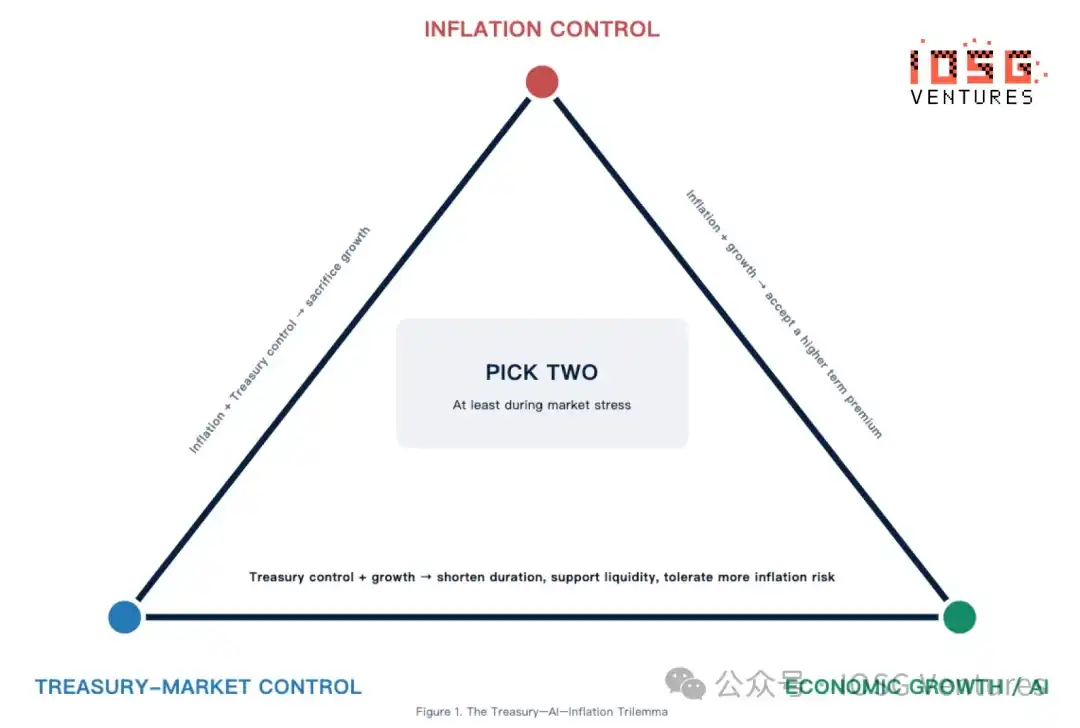
That matters because the policy mix he describes would do two things at once: add liquidity and move duration risk off private-sector balance sheets.
Long-dated Treasury yields remain elevated
As of Aug. 24, the 10-year US Treasury yield was about 4.70%. The 30-year had recently reached around 5.23%, close to a two-decade high. Momir says the move cannot be explained by one factor alone. He points to a combination of persistent inflation risk, continued heavy fiscal supply, thinning marginal demand for long duration, and a new rival for capital: AI infrastructure.
The result, in his view, is straightforward. Investors want more compensation before they are willing to own long-dated bonds.
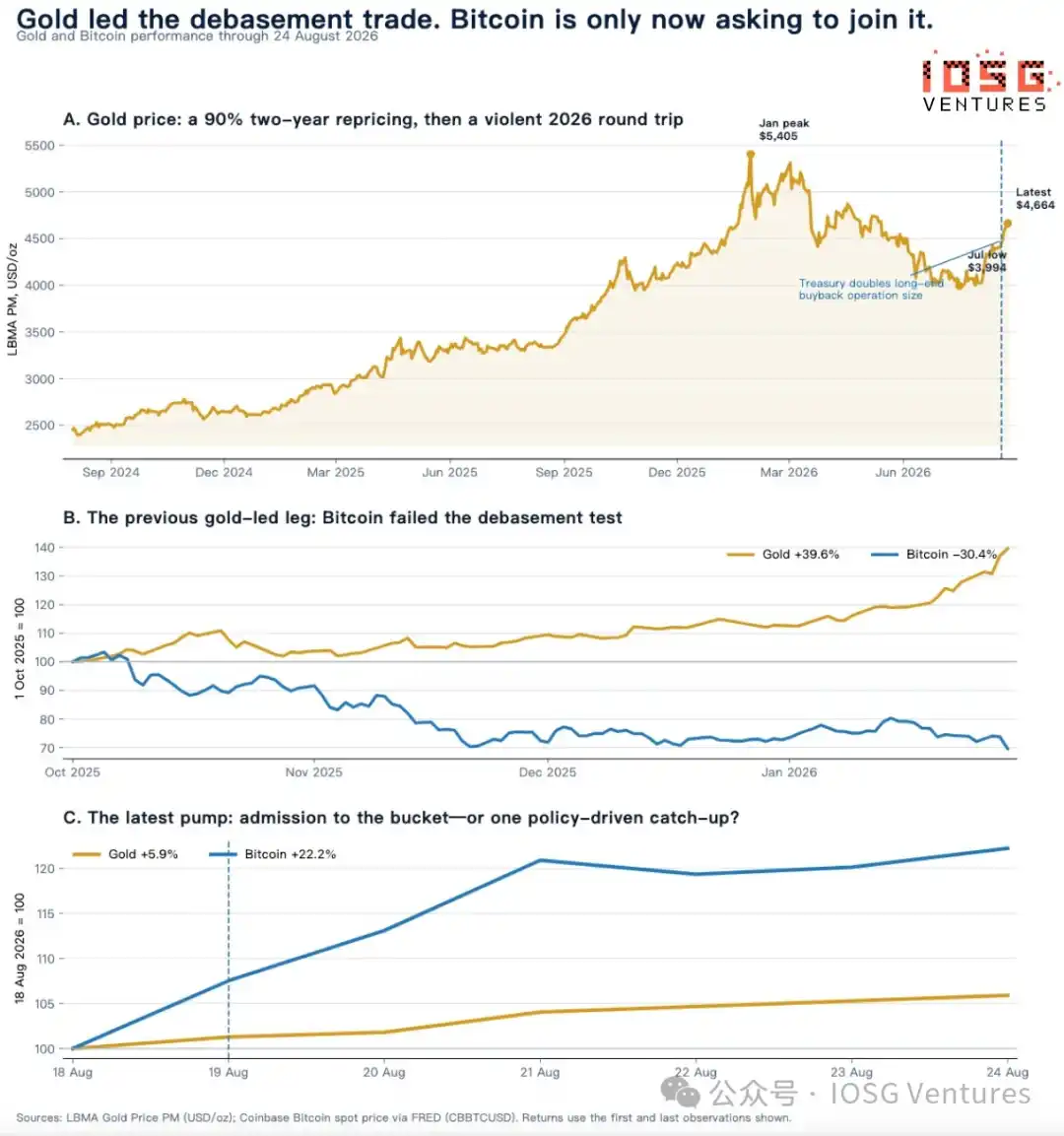
The US Treasury has said it will at least double the cap on liquidity-support buyback operations. Yields briefly fell after that announcement, but the pullback did not hold. Momir takes that as a sign that the deeper problems are supply and inflation, not something that can be reversed with buybacks worth only tens of billions of dollars.
Iran war and AI spending are pushing on the bond market in different ways
Momir describes the Iran war as a catalyst for Treasury pressure on several fronts. It has pushed oil prices higher and added to cost pressure, while also potentially weighing on real growth and tax revenue. At the same time, it has lifted expectations for government spending after exposing gaps in military supply and the investment needed to adapt to new forms of warfare.
AI, he says, is also a catalyst, but through a different channel. Large-scale investment can lift growth and near-term inflation. On balance, he sees that as positive because it improves the chance of shrinking the debt burden through stronger nominal growth. But there is another side: those projects have a huge appetite for capital, and that demand is already spilling into the bond market. Large cloud companies with strong balance sheets are now competing with the Treasury for funding in maturities that were previously dominated by the government.
The Bank for International Settlements estimates that hyperscalers will issue more than $100 billion in bonds in 2025, mostly in long maturities. A Dallas Fed analysis used roughly $300 billion to represent AI-related investment-grade issuance. After adjusting for duration, Momir says that amounts to as much as $360 billion of 10-year equivalent duration.
Put together, he argues, the US is facing a difficult trilemma. And of the three corners, strict inflation control increasingly looks like the one that is easiest to sacrifice politically.
Bessent’s response, in Momir’s view, is to defend the Treasury market first
Momir says recent moves by US Treasury Secretary Bessent show how closely he is watching the bond market.
- Support the yen and reduce the risk that Japan is forced to sell US Treasuries. Japan is the largest foreign holder of Treasuries. When it buys yen to support the currency, it needs dollars, and selling Treasuries is one way to get them. That would add to stress in the Treasury market, so backing the yen also lowers the odds of Treasury sales tied to intervention.
- Buy back less liquid long-dated bonds. Momir stresses that buybacks are not debt cancellation. If they are financed with newly issued short-term Treasury bills, the effect is to change the maturity structure of government liabilities: less duration on one side, more bills on the other.
- Shift issuance toward the front end, which he sees as a likely next step.
He notes that in 2023 and 2024, the Treasury under Janet Yellen relied heavily on short-dated bills as financing needs surged. In a 2024 paper, Stephen Miran and Nouriel Roubini called that approach “activist Treasury issuance.” Their argument was that roughly $800 billion of bill issuance above the normal path pulled duration out of the market, creating an effect similar to “stealth QE,” with easing in financial conditions roughly equivalent to a 1 percentage point rate cut. They also accused the Treasury of using that approach to support Joe Biden’s 2024 election prospects. Momir says the odds of the Trump Treasury using similar tools are rising.
If that playbook advances as expected, he believes it could inject a meaningful wave of liquidity and revive the debasement trade.
Gold has already earned its place
Momir argues that gold’s rally is not simply an inflation trade. From Aug. 1, 2024, to Aug. 24, 2026, gold rose from $2,455 an ounce to $4,664, a gain of about 90%.
He lists several drivers: lower trust in the US dollar after it was used as a policy weapon, persistent inflation concerns, and what he sees as the most important factor, the debasement thesis. Expanding money supply, he writes, may be the only politically workable way through the current debt cycle.
Is Bitcoin ready to sit in the debasement-hedge bucket?
His answer is not yet, but recent price action has made the question more serious.
In the previous gold-led move, from Oct. 1, 2025, to gold’s peak on Jan. 29, 2026, gold gained 39.6% while Bitcoin fell 30.4%. For an asset marketed as “digital gold,” Momir says that was a poor showing.
More recently, the pattern shifted. From Aug. 18 to Aug. 24, Bitcoin rose 22.2%, while gold gained 5.9%. Momir says the move accelerated after the Treasury increased long-end buybacks. But Washington was also pushing crypto legislation in the same week, so he does not treat the rally as having a single clean cause.
If the market reads the move as a stealth-QE trade rather than a pure debasement trade, then Bitcoin outperforming gold makes sense in his framework and could last longer. When global liquidity loosens, he says, crypto assets often react strongly.
What would weaken this view
Momir is not arguing that inflation must spiral out of control or that formal yield curve control is about to arrive. He presents the trilemma as a framework for identifying where the constraints sit.
If inflation stays above target, deficits remain around 6% of GDP, and AI-related borrowers keep adding long-duration supply, then the cost of preserving both Treasury stability and the growth cycle will increasingly show up as shorter debt maturity, routine liquidity backstops, and greater tolerance for inflation risk. In his view, that is supportive for both gold and BTC.
The case would weaken if inflation drops back near 2%, Congress delivers a credible fiscal path, AI infrastructure becomes self-financing, or private demand absorbs interest-bearing debt supply without demanding a higher term premium.
So the next market question, he argues, should not be when the Federal Reserve cuts rates. It should be which corner of the triangle Washington lets break first. If the Treasury accelerates this duration transfer, Bitcoin could be facing a more durable tailwind.