

Centralized cloud storage still underpins most of the internet, but Foresight argues that the model shows clear limits in Web3. In its latest explainer, the outlet says mainstream services such as Amazon Web Services, Alibaba Cloud and Tencent Cloud rely on vendor-controlled data centers, leaving storage subject to platform control, service outages, content changes and mounting long-term costs.
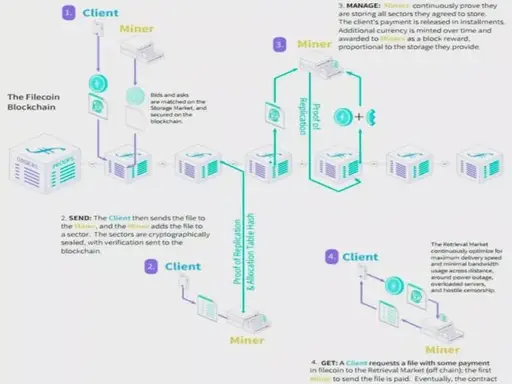
The article positions IPFS, Filecoin and Arweave as the three main decentralized storage layers now taking shape across Web3. In that framework, each protocol handles a different part of the stack, and together they support on-chain data, digital assets and AI datasets.
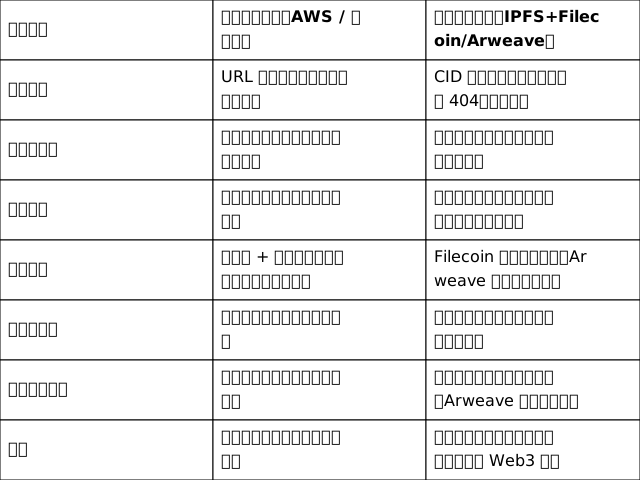
Why centralized cloud storage falls short in Web3
Foresight identifies four structural problems with centralized cloud storage.
The first is data ownership. Platforms retain the power to delete, block or remove files. Content can be censored or taken down, and when a provider shuts a service or scales back a business line, the files tied to it can disappear, leaving dead links behind.
The second is the risk of a single point of failure. Power failures at data centers, server outages or hacking incidents can trigger data leaks on a large scale or interrupt access across a service. The article notes that broad outages have hit major cloud providers more than once.
A third problem is mutability. Service providers can alter images, documents or videos in the background, while users usually lack a cryptographic way to prove the original version of a file. That weakens trust in digital art, archives and research data.
The fourth is cost. Monthly subscription fees and heavy egress charges make long-term archiving expensive, especially for large static libraries. Foresight specifically points to AI datasets and NFT image repositories as examples where storage bills can continue to pile up.
Decentralized storage, by contrast, uses peer-to-peer networking, cryptographic hashes and blockchain incentives to encrypt files, split them into pieces and distribute them across nodes around the world. In the article’s telling, that turns storage into an open market rather than a centrally controlled service.
Three protocols, three roles
IPFS as the general-purpose file layer
IPFS, short for the InterPlanetary File System, is described as a peer-to-peer file transfer standard rather than an incentive network. It does not come with a native token or mining rewards. Its central innovation is content addressing through the CID hash.
Under HTTP, a file is found by its server location. If that server disappears, the link breaks. IPFS works differently: once a file is uploaded, it receives a unique CID fingerprint, and any change to the file changes the CID as well. As long as at least one node on the network still stores that content, the file can still be retrieved.
The article says IPFS automatically breaks files into smaller chunks and stores redundant copies across global nodes. That makes it suitable for DApp front ends, NFT images, static websites and smaller documents.
Still, Foresight stresses that IPFS alone does not solve persistence. Without built-in economic incentives, nodes have little reason to host files indefinitely. That is where Filecoin enters the picture.
Filecoin as the incentive and market layer
Filecoin sits on top of IPFS as a blockchain-based incentive network designed to create a standardized market for storage supply and demand. Foresight describes it as the decentralized storage network with the largest effective storage capacity currently available.
The article highlights two proof systems at the core of Filecoin. Proof of Replication, or PoRep, verifies that miners are genuinely storing a user’s encrypted data shards instead of faking capacity. Proof of Spacetime, or PoSt, requires miners to keep submitting recurring proofs that the data remains stored over time. If they fail to comply, pledged tokens can be slashed.
Filecoin’s network is split into two markets: a storage market where users pay to rent disk space, and a retrieval market where nodes earn rewards for serving file downloads. Individuals and institutions can both contribute spare hard drive capacity and join as storage miners.
In the use cases listed by Foresight, Filecoin is a fit for terabyte-scale media libraries, AI training datasets, metaverse video, long-term institutional archives and raw transaction data for modular rollups.
Arweave as a permanent storage network
Arweave takes a different route. Instead of contract-based storage like the IPFS and Filecoin combination, it is built for permanence. The article says Arweave uses a Blockweave structure in which each new block is tied to a randomly selected historical block. Its SPoRA consensus mechanism forces miners to retain the full historical dataset, because miners that do not store older blocks cannot participate in mining and block production.
Its payment model also stands apart. Users pay once to upload a file, and most of that fee flows into a permanent endowment fund. Returns from that fund are then used to subsidize miners over time. Foresight says the model is designed, in theory, to preserve data for at least 200 years, without monthly renewals and without the risk of a contract expiring.
The article lists NFT metadata, historical archives, legal records, academic literature, decentralized static websites and undeletable on-chain credentials among Arweave’s core use cases.
Where decentralized storage is being used
Long-term preservation of digital information
Traditional web pages, images and archives often depend on centralized servers, and Foresight notes that large amounts of early internet material vanished when platforms closed down. Decentralized storage aims to change that through redundancy and token incentives.
Filecoin can lock in multi-year custody through storage contracts, while Arweave’s one-time payment model is positioned as a way to preserve data across generations. The article points to government archives, media records, open-source code and academic papers as categories that are moving onto decentralized networks.
NFT metadata and the value of digital assets
NFTs store ownership and transfer records on-chain, but images, videos and trait descriptions are usually too large to sit directly on a blockchain. Foresight says many early projects relied on centralized cloud providers for those assets. If the host removed the files, the NFT could remain on-chain as a shell without its underlying media.
The common solution described in the article is to upload NFT images and trait files to IPFS or Arweave, then record the unique CID hash in the smart contract.
Arweave is presented as a stronger fit for blue-chip NFTs and long-term collectibles because of its permanent storage model. IPFS combined with Filecoin is framed as better suited to large batches of profile-picture collections and blockchain game items, where scale and lower cost matter more. Since the metadata is tied to a CID hash, anyone can verify whether the files have been altered.
AI datasets and the push against data concentration
Foresight also extends the storage discussion to AI. It says training datasets are now concentrated in the hands of leading technology companies, while data owners have limited ways to share or monetize their own material. At the same time, model training can raise privacy leakage and copyright infringement concerns.
According to the article, decentralized storage offers several ways to address that. Training materials can be encrypted, sharded and stored in distributed form, then accessed only through permissioned authorization. Datasets can also be tokenized, with DataDAOs using smart contracts to distribute model-training proceeds so that contributors continue to receive a share. Combined with zero-knowledge proofs, institutions could verify dataset compliance without obtaining the full original data.
Foresight says Filecoin’s capacity makes it suitable for terabyte- and petabyte-scale training corpora, helping support repeated model training cycles at lower cost. The article argues that a decentralized market for AI datasets is now taking shape.
Storage mining and the economics behind it
The explainer breaks down mining on both Filecoin and Arweave.
For Filecoin, participants need spare hard drive space and must pledge FIL as collateral. Revenue comes from storage service fees paid by users, block issuance rewards and retrieval fees from downloads. If a miner fails to submit Proof of Spacetime on time or loses data, pledged tokens can be slashed. The article says the market self-adjusts: higher storage demand raises prices and attracts more capacity from miners.
For Arweave, miners must store the network’s full historical block set, but they do not need large long-term collateral. Income comes from the endowment fund’s long-term distributions and new AR issuance. Because SPoRA requires miners to retrieve rare historical blocks in order to produce new ones, miners that do not keep the complete history cannot mine effectively. That makes permanent storage part of the incentive structure itself.
On costs, Foresight says Arweave’s one-time payment structure avoids future renewals and offers a more stable long-term storage bill, without sustained repricing driven by short-term token volatility.
The article sums up the distinction this way: Filecoin is better aligned with commercial, high-capacity, on-demand storage, while Arweave is geared toward permanent archiving supported by a longer-cycle subsidy model.
What comes next for the sector
Foresight closes with five industry trends it expects to matter.
One is tighter integration with the broader Web3 stack. The article says decentralized storage will work more closely with Layer 2 systems, modular data availability layers and zero-knowledge cross-chain infrastructure. Raw rollup transaction data and on-chain credentials are expected to be stored on Filecoin, which the article says could reduce Ethereum Blob storage costs.
Another trend is standardization in NFT metadata storage. New projects are expected to adopt IPFS or Arweave more consistently, while centralized cloud hosting for NFT metadata gradually loses ground.
Foresight also points to the rise of decentralized AI data economies, where tokenized datasets and DataDAOs move into wider use as core infrastructure for large model training.
A fourth trend is hybrid architecture. In the model outlined by the article, IPFS handles high-speed hot data access, Filecoin carries large-scale cold storage and Arweave preserves permanent proof records. Used together, the three protocols balance speed, cost and persistence.
Finally, the article says the tooling barrier is falling. With one-click hosting and wallet-connected storage gateways becoming more mature, creators and small businesses may be able to use decentralized storage without deep blockchain expertise.
A core layer for data sovereignty in Web3
Foresight’s conclusion is that decentralized storage is not just a replacement for cloud storage. It is a data-sovereignty layer for Web3. In the article’s framework, IPFS provides the general file transfer standard, Filecoin supplies the commercial market for large-capacity storage, and Arweave addresses permanent data retention. Together, they support NFT, DeFi, AI, blockchain gaming and archival record use cases across the sector.
The original article also carries a disclaimer stating that markets involve risk, the content does not constitute investment advice, and readers should decide for themselves whether any of the views or conclusions fit their own circumstances.