
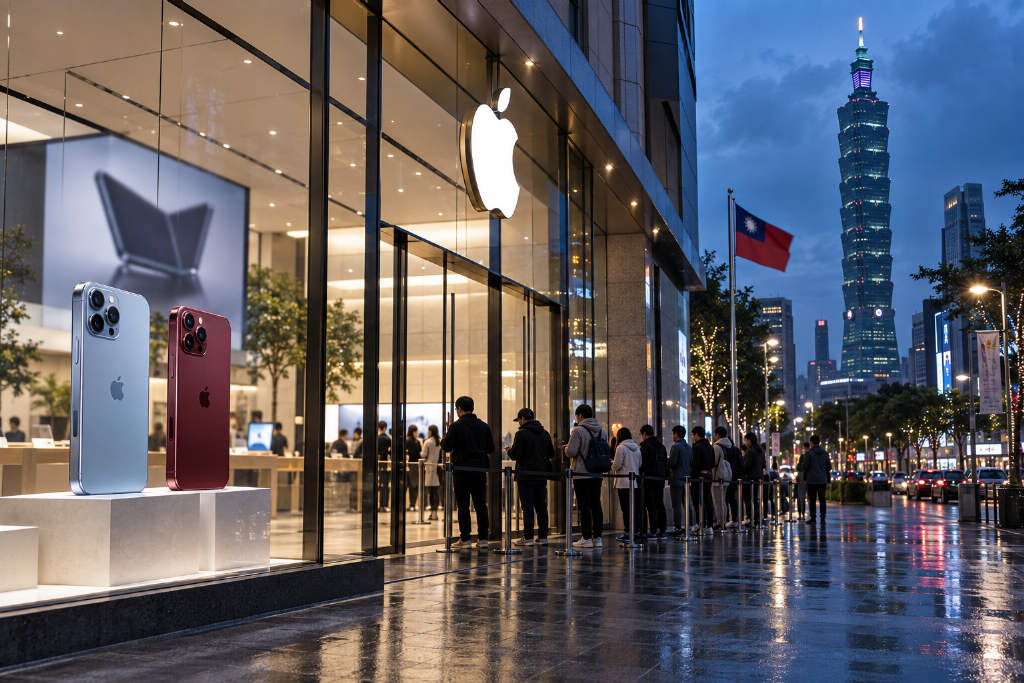
Apple’s iPhone 18 Pro went on sale on Sept. 18, and ABMedia’s visit to a department store launch site found a quieter debut than many buyers may associate with past iPhone release days. The report said the lack of heavy foot traffic raised a question: whether some upgraders are holding off for the foldable Duo, which has yet to reach the market.

Launch-day line was limited at one store
According to ABMedia, the reporter arrived at 6 a.m. and was 14th in line. There was no overnight queue stretching outside the store, and the first-sale atmosphere was calmer than expected.
At that location, the Glacier Blue version sold out earlier than Burgundy Red. ABMedia added that this was only a single-store observation and should not be treated as a measure of overall demand.
Starts at NT$44,900 with battery life, 2nm chip and camera changes in focus
The iPhone 18 Pro starts at NT$44,900 in Taiwan. ABMedia said Apple is positioning the device around battery life, its 2nm chip, and a camera system that now includes a physical variable aperture.
Apple’s EU product documentation lists the A3714 model with a rated battery capacity of 4,056mAh. Compared with the iPhone 13’s original 3,227mAh capacity as listed by iFixit, that is an increase of about 25.7%. Against the iPhone 17 Pro’s 3,988mAh, the increase is about 1.7%. The report said that difference helps show why users upgrading across several generations may notice more than those who switch year to year.
Apple Taiwan’s published video playback figures put the iPhone 13 at up to 19 hours, the 17 Pro at 31 hours, and the 18 Pro at 34 hours.
A20 Pro brings Apple’s first 2nm iPhone chip
ABMedia wrote that the A20 Pro marks the first use of a 2nm process in an iPhone. Apple said GPU performance is up by as much as 40% from the A19 Pro, while memory bandwidth has increased 50%.

The report also cited TSMC’s N2 technology in explaining the shift. It said nanosheet transistors improve current control and aim to balance computing performance with power use, though any process advantage still depends on chip design and thermal management before it shows up in the phone’s real-world experience.
Camera adds a physical variable aperture
The 48-megapixel main camera offers four aperture settings: f/1.48, f/1.8, f/2.8, and f/4.0. A larger aperture can help in low light, while a smaller one increases depth of field, making it easier to keep objects at different distances in focus. Users can leave those adjustments to the camera or manually control aperture, shutter speed, and white balance.
Upgrade cost from iPhone 13 depends on trade-in value and channel offers
ABMedia’s hands-on upgrade from an iPhone 13 to an iPhone 18 Pro found day-to-day operation noticeably smoother, from screen scrolling to photo capture and app response. The report singled out the display’s support for up to a 120Hz ProMotion adaptive refresh rate as one of the more obvious changes. At the same time, it noted that camera behavior and app responsiveness also depend on the processor, software, and the condition of the older device, so the improvement cannot be attributed to the display alone.
Under Apple Trade In estimates, an iPhone 13 can be worth up to NT$6,300, while the iPhone 13 Pro and iPhone 13 Pro Max can be worth up to NT$9,400 and NT$11,100, respectively. The final number still depends on device condition. Using the NT$44,900 starting price for the iPhone 18 Pro, a buyer trading in an iPhone 13 at the maximum quoted value would still need to pay NT$38,600 after handing over the old phone.
ABMedia said Apple’s official trade-in program applies through its website and retail stores, while buyback prices and promotions at department store reseller counters need to be checked separately. For buyers choosing that channel, the report suggested comparing anniversary sale deals, credit card promotions, and designated installment plans to see whether they can be combined, then calculating cash discounts, card rewards, and vouchers to determine the actual purchase cost.