
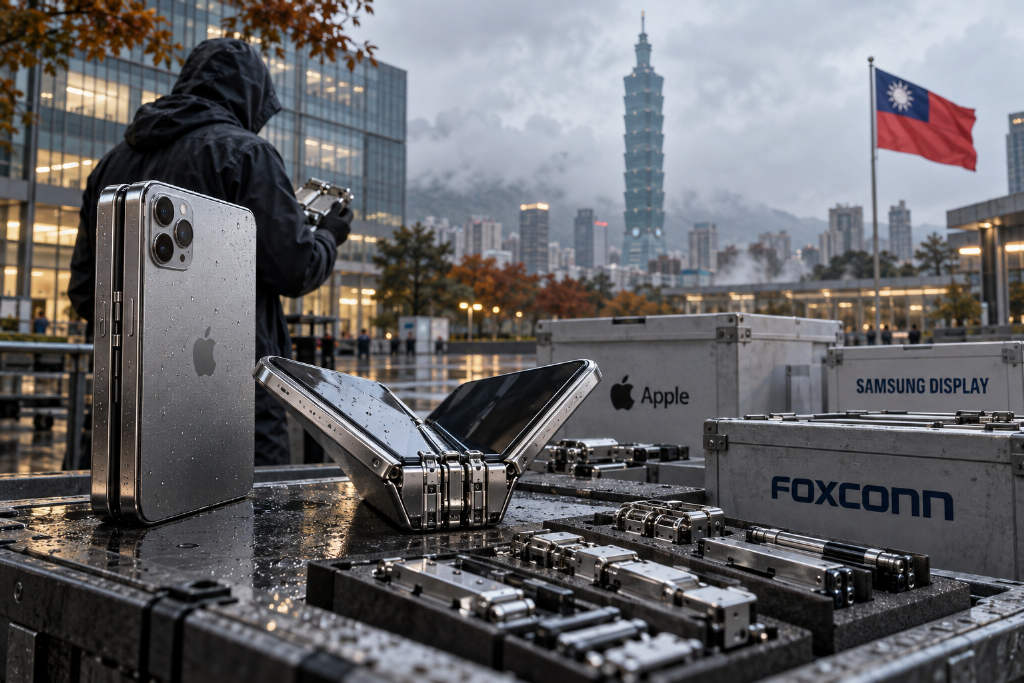
Apple introduced its first foldable smartphone, the iPhone Duo, on Sept. 9, with pricing starting at $1,999. Preorders are scheduled to begin on Oct. 16, and the device will go on sale on Oct. 23. After the launch, investors quickly turned to Apple suppliers, but the degree of benefit across the supply chain appears far from equal.
Companies such as Taiwan Semiconductor Manufacturing Co. (TSMC), Foxconn, and Largan Precision already supply parts used across the iPhone lineup. For them, the foldable model adds volume. Shin Zu Shing stands apart because its hinge is not a component used in standard iPhones, making it a source of entirely new demand.
The hinge is the main new hardware opportunity
The report described the hinge as the most difficult component in the foldable device. The iPhone Duo hinge consists of about 100 parts and uses liquid metal alloy, titanium, and stainless steel. That part count means it is not simply a rotating joint but a precision mechanical system, where a defect in any single element could render the phone unusable.
Order allocation has also begun to take shape. Multiple media outlets, citing supply-chain sources, said a joint venture formed by Shin Zu Shing (3376) and Foxconn subsidiary FII secured about 65% of hinge orders, while U.S.-based Amphenol (APH) took the remaining 35%. The article said the joint venture was set up in March 2026 as an early move to position for this business.
Goldman Sachs said Apple accounts for 75% to 85% of Shin Zu Shing's revenue, with iPhone-related hinge business contributing 40% to 45%. That leaves the company highly exposed to iPhone Duo sales. If demand is strong, the impact should show up directly in its financial results. If sales disappoint, the effect could work in the opposite direction.
Samsung Display has the foldable OLED panel contract
On the display side, Samsung Display is the exclusive supplier of foldable OLED panels for the device. According to the report, the two companies signed a three-year exclusive agreement. Panel production will take place at Samsung's Asan plant in South Korea, while module assembly will be handled in Vietnam. Taiwanese and China-linked panel makers did not secure any share of this part of the business.
For investors in Taiwan, that means one of the two most valuable new components in the foldable phone is not directly available through a local listed supplier. Exposure would have to come through a parent company such as Samsung Electronics, but the article noted that Samsung Electronics has a broad business mix, which would dilute the revenue contribution from foldable panels.
Existing Apple suppliers may see only diluted upside
Goldman Sachs gave buy ratings to a long list of Greater China Apple suppliers, including Foxconn, Shin Zu Shing, Auras (3017), Largan Precision (3008), Nan Ya Printed Circuit Board (8046), TSMC (2330), Delta Electronics, Zhen Ding, and Kinsus. Foxconn and Nan Ya PCB were listed among its conviction buys.
Still, the article argued that the benefits for these established suppliers need to be viewed against Apple's much larger annual iPhone shipment base. Total iPhone shipments run at about 260 million to 270 million units a year. Goldman Sachs' bullish case for the iPhone Duo is 35 million units, or roughly 13% of that total. Even in a strong launch scenario, that means the foldable model would add only a little more than one-tenth to the existing pool for suppliers already serving the full iPhone range, rather than changing their overall growth trajectory.
Two areas within that group were highlighted as more distinctive: cameras and thermal management. The article said a foldable phone's dual-screen design and broader use scenarios make camera configurations more complex than in conventional models, raising value per device. Largan Precision and Genius Electronic Optical (3406) were identified as the main suppliers. Goldman Sachs data showed Apple accounts for 45% to 50% of Largan's revenue.
Auras was cited as a beneficiary on the cooling side through vapor chamber components. The iPhone Duo uses a vapor chamber thermal system and a dual-battery design, making heat management more demanding than in bar-style phones.
Shipment forecasts vary widely
All of these supply-chain assumptions depend on one variable: how many iPhone Duo units Apple can actually sell. Right now, forecasts are spread across a very wide range.
Goldman Sachs estimated 14 million units in its base case and 35 million in its optimistic case, a gap of 2.5 times. IDC estimated first-year sales could exceed 10 million units. Some supply-chain estimates, constrained by production capacity, put the 2026 ceiling at 6 million units. That creates a range from 6 million to 35 million units, close to a sixfold difference. The article said that spread is too wide to support precise earnings calculations.
One reason is yield. Both the roughly 100-part hinge and the foldable OLED panel rely on new manufacturing processes, so early production ramp-up will determine how many units Apple can ship. The article said the better signal to watch is not preorder enthusiasm, but whether delivery times keep stretching after sales start on Oct. 23.
Price remains another test
The iPhone Duo starts at $1,999, making it Apple's most expensive iPhone to date. Goldman Sachs described the pricing as "affordable," based on the fact that Samsung's Galaxy Z Fold 8 Ultra is priced at $2,099.99 in the U.S.
The report drew a limit around that comparison. It works only against other foldables. For most consumers replacing an older phone, the iPhone Duo still costs about twice as much as an iPhone 18 Pro. That distinction may determine whether the device remains a niche flagship or moves into the mainstream.
The article said the first year of sales will not be enough on its own to determine whether foldable iPhones become a durable long-term product line. Even so, the split in component orders already makes one point clear: some suppliers are getting pure new business, while others are receiving only a modest increment.