
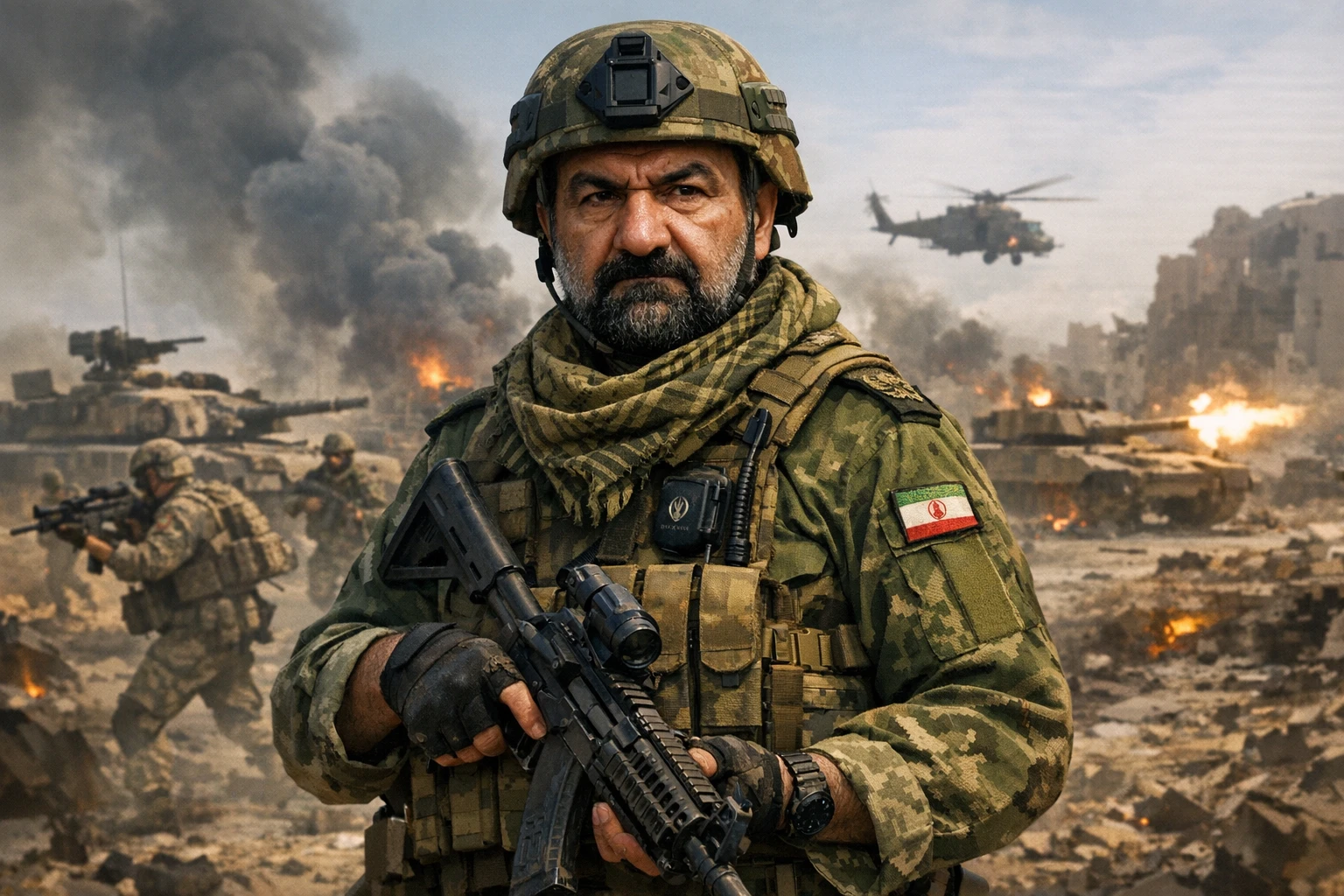
Mohsen Rezaei, a military adviser to Iran’s supreme leader Mojtaba Khamenei, said the United States would be heading down a dead-end path if it chose to continue the current war, adding that negotiations are the only workable option. He also said Iran is prepared to attack in order to break any ongoing U.S. maritime blockade.
Rezaei pairs diplomacy with a direct military warning
In the interview, Rezaei framed negotiations as the only realistic route for Washington while making clear that Tehran is not speaking from a defensive posture alone. His message was blunt: if pressure at sea continues, Iran says it is ready to respond militarily.
That warning was tied to a broader claim about Iran’s force structure. Rezaei said the Islamic Revolutionary Guard Corps has built a new combat system centered on asymmetric warfare, relying less on large warships or advanced fighter aircraft and more on cost-effective drones aimed at high-value targets.
Drones are presented as the center of Iran’s combat model
The logic, as described by Rezaei, is simple: use relatively cheap platforms to threaten assets that are expensive, fixed, or difficult to replace. The source material says this approach has already been tested repeatedly in the 2025–2026 U.S.-Iran confrontation.
It cites Iranian drone strikes on Saudi oil facilities and a U.S. base in Kuwait, saying those attacks pushed the U.S. military to deploy additional air defense systems at two naval ports. Rezaei also said Iran’s drone force has moved beyond mass production and into a more “smart” phase, with autonomous target recognition and coordinated multi-target attack capabilities. In practical terms, that would allow Iran to threaten U.S. military positions in the region even without air superiority.
The speaker is deeply tied to Iran’s military doctrine
Rezaei’s remarks carry weight because of his background. According to the source, he is a former IRGC commander who led organizational reforms from the late 1970s through the 1990s. He is also described as one of the principal architects of Iran’s layered asymmetric warfare doctrine, spanning missiles, drones, naval guerrilla units, and proxy forces.
He now serves as a military adviser to Mojtaba Khamenei and is also a member of Iran’s Expediency Council, with a role in top-level strategic decisions. That makes the interview more than personal commentary; it reads as a signal tied to both doctrine and deterrence.
Source links regional escalation to crypto market moves
The material also argues that geopolitical tension in the Middle East tends to support crypto prices. It points to several recent examples: in May, after a 60-day extension of the U.S.-Iran ceasefire agreement, Bitcoin briefly pulled back and then rebounded above $85,000; in April, after Iranian missile debris struck a U.S. base in Kuwait, Bitcoin posted a 3.2% one-day gain.
In derivatives, the source says BTC funding rates rise by an average of 0.08% each time the regional conflict intensifies, which it interprets as faster capital inflows. It also points to the Strait of Hormuz as a market variable worth watching: crypto trading volume across eight Middle Eastern countries accounts for 6% of the global total, meaning any renewed maritime conflict could affect on-chain capital flows and regional pricing.