
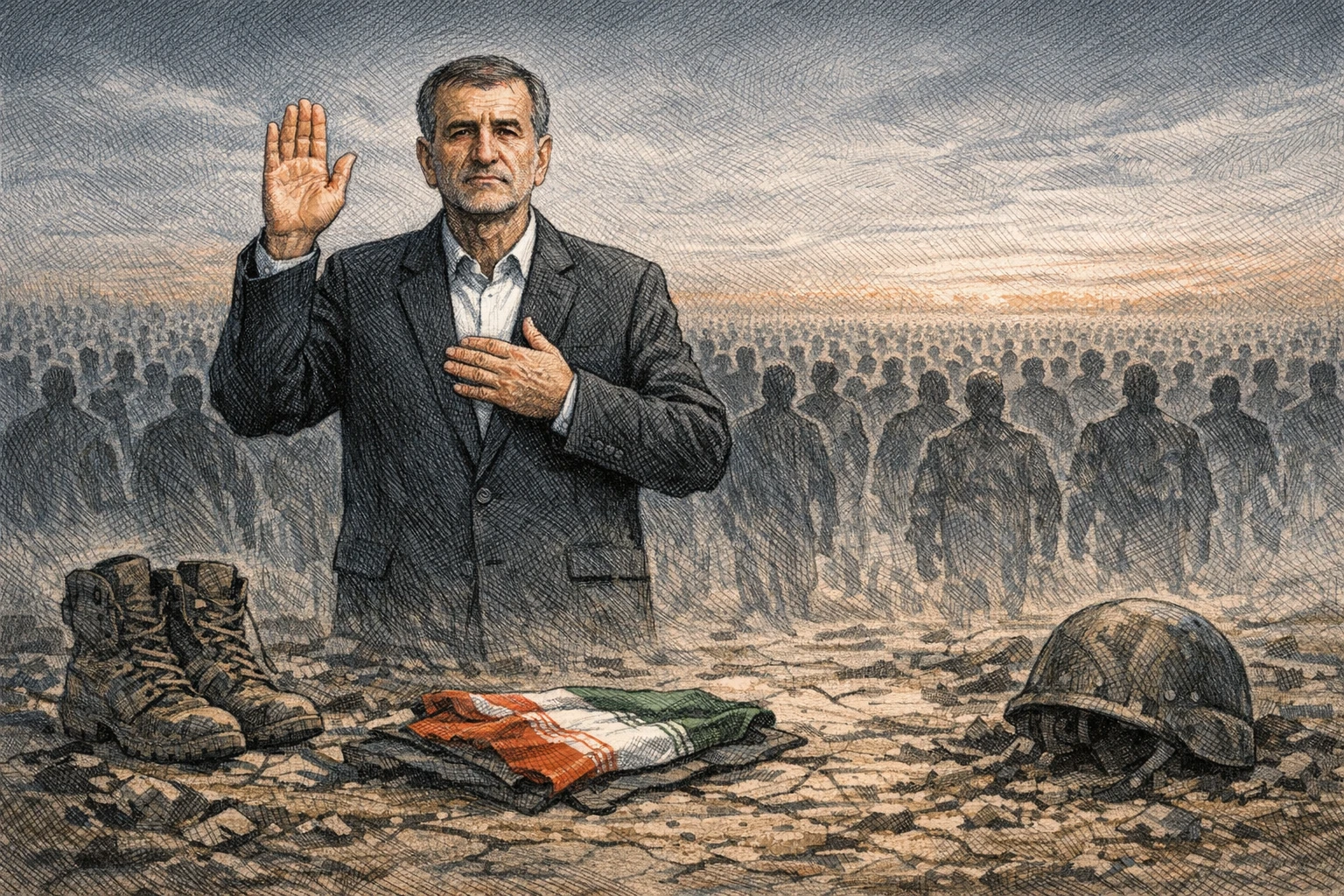
Iranian President Masoud Pezeshkian said on April 7 that more than 14 million Iranians have registered their willingness to give their lives in defense of the country, adding that he counts himself among them. The statement arrived in week seven of the U.S.-Iran war, and its immediate weight appears more political than military.
Based on the figures cited in the source, Iran’s population stands at about 87 million, which would put the claimed total near 16.1% of the population. That number has not been independently verified. Iran’s Interior Ministry and the Islamic Revolutionary Guard Corps have not published public documentation for any mobilization registration system, leaving the figure open to scrutiny.
No public verification for the 14 million figure
In his post, Pezeshkian said more than 14 million “brave Iranians” had declared they were ready to die defending Iran, and that he “was, is, and will be” among those willing to do so. The wording closely echoed his remarks delivered one week after his April 1 Islamic Republic Day speech, centered on sovereignty, morale, and endurance.
The number itself is politically useful. If accurate, it points to a massive pool of declared support. If it is a propaganda figure, it is still calibrated to sound striking without becoming instantly implausible. From the available public record, there is no outside confirmation that this is the result of a verifiable nationwide process.
War enters seventh week with no shared negotiating basis
The source says the war began in late February 2026, when the United States and Israel attacked Iranian nuclear facilities and military bases. Since then, shipping through the Strait of Hormuz has continued to face partial disruption, while global Brent crude has risen by more than 15% from pre-conflict levels. U.S. special forces have already deployed to the Middle East, but a full ground campaign has not started.
Before the war, Donald Trump issued a 48-hour ultimatum demanding that Iran either negotiate peace or reopen the Strait of Hormuz. Pezeshkian answered that Iran was prepared to end the war, but only under terms that protected the safety and interests of its people. The two sides are not working from the same definition of acceptable terms, which helps explain why talks remain stuck. In that context, the mobilization figure looks less like a military expansion plan and more like leverage.
Oil and crypto markets still price in geopolitical risk
The market response remains uneven. Early in the conflict, geopolitical stress pushed Bitcoin sharply lower for a short period, with traders treating it as a risk asset rather than a safe haven. As the conflict has dragged on and the Federal Reserve’s policy path remains unclear, some capital has started reassessing the role of crypto assets in a higher-inflation setting.
Arthur Hayes and other market figures have said they are staying out for now, waiting for the Federal Reserve to resume money printing before taking positions. Pezeshkian’s statement is unlikely to alter the battlefield on its own, but it does signal that Iran has no intention of accepting an unconditional ceasefire in the near term. The geopolitical premium around Hormuz, and its knock-on effects on inflation and monetary policy, remains in view.