
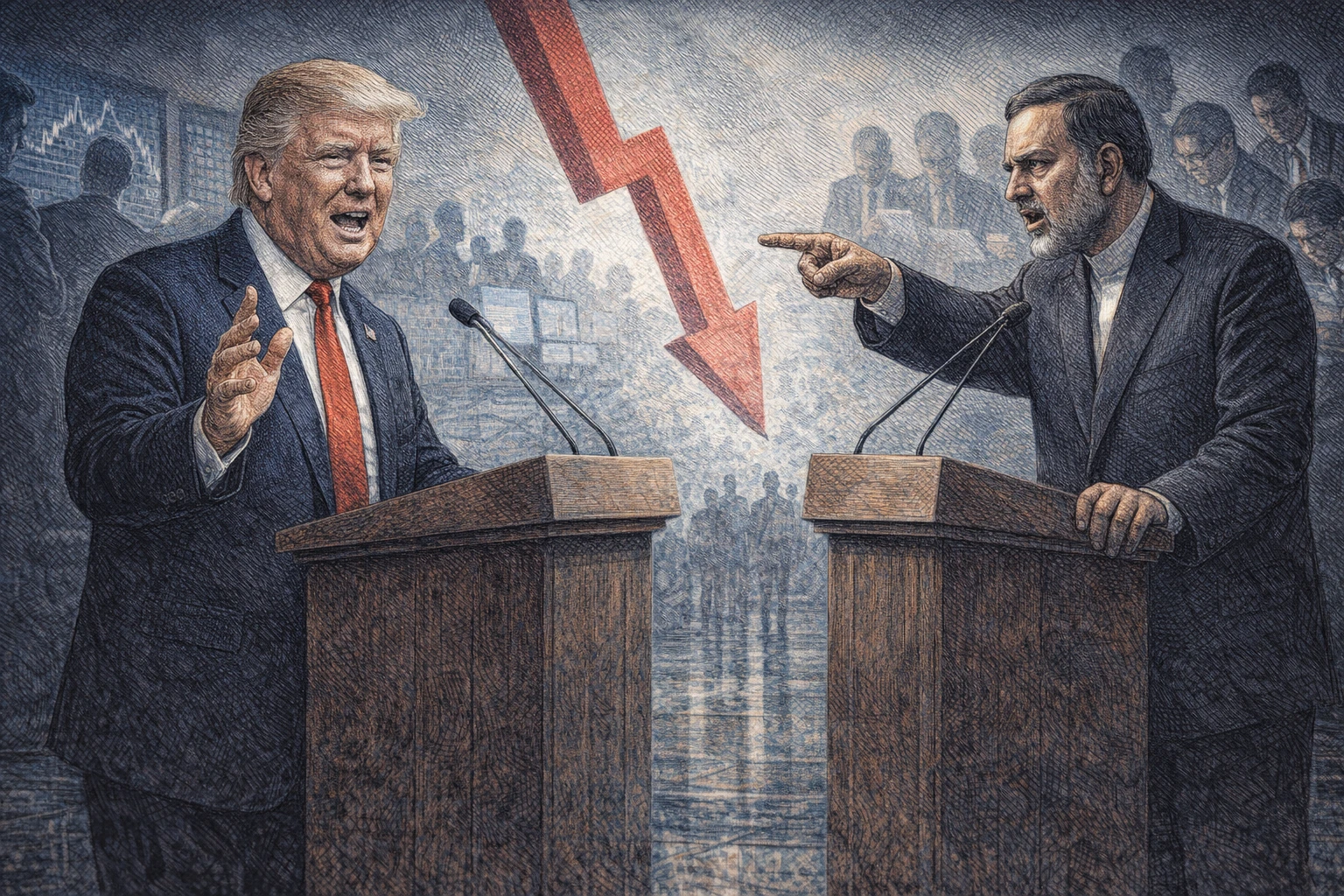
President Trump delivered a national address, threatening to unleash 'extremely violent' strikes on Iran within 2-3 weeks while offering no concrete plan to reopen the Strait of Hormuz. Markets reacted with immediate selling: the U.S. dollar index jumped to 99.925, Asian stocks tumbled—Japan's Nikkei fell 1.4%, South Korea's Kospi slumped 2.82%, and Hong Kong's Hang Seng dropped 0.5%. Brent crude surged 5% in a single session. Investors hoping for de-escalation got more threats instead.
Nomura Warns: Asian Currencies Under Pressure, Central Banks May Intervene
Rob Subbaraman, head of global markets research at Nomura, said Trump's speech 'failed to deliver the clear signal markets were hoping for' to ease tensions. He warned that Asian currencies could weaken further against the U.S. dollar, with the Australian and New Zealand dollars already down about 0.6%.
Subbaraman cautioned that if currency depreciation accelerates beyond central banks' tolerance thresholds, intervention will intensify. Selling foreign reserves to prop up currencies could tighten domestic liquidity and push up government bond yields, creating a double-edged sword for already-strained Asian fixed-income markets.
Iran Strikes Back: Trump's Plan 'Completely Failed'
Tehran responded aggressively. According to Iran's official Tasnim News Agency, authorities accused Trump of using the speech to 'justify war and ease deep public concern' inside the U.S. But Iran claimed the overwhelming negative market reaction proved Trump's calculations wrong. 'The market has seen through Trump's tricks and responded negatively,' the statement read, directy using market data as ammunition against White House psychological warfare. The core standoff over the Strait of Hormuz remains unresolved. Trump only said countries should 'take care of that passage themselves,' offering no commitment on reopening the global oil chokepoint.
UK to Host Diplomatic Summit, Strait Deadlock Lingers
The diplomatic baton passes to Britain. Reports indicate the UK plans to host an international conference this week, bringing together parties to discuss reopening the Strait of Hormuz in what is currently the most tangible multilateral effort.
Crypto Market: Safe-Haven Appeal vs. Dollar Strength
For the crypto market, geopolitical heat is a double-edged variable: safe-haven flows push some capital into Bitcoin, but if a stronger U.S. dollar coincides, overall risk-asset selling pressure tends to dominate. With Nomura's warning now in play, how Asian investors reallocate amid the triple squeeze of currency rates, bond yields, and oil prices will be the key focus in the weeks ahead.