
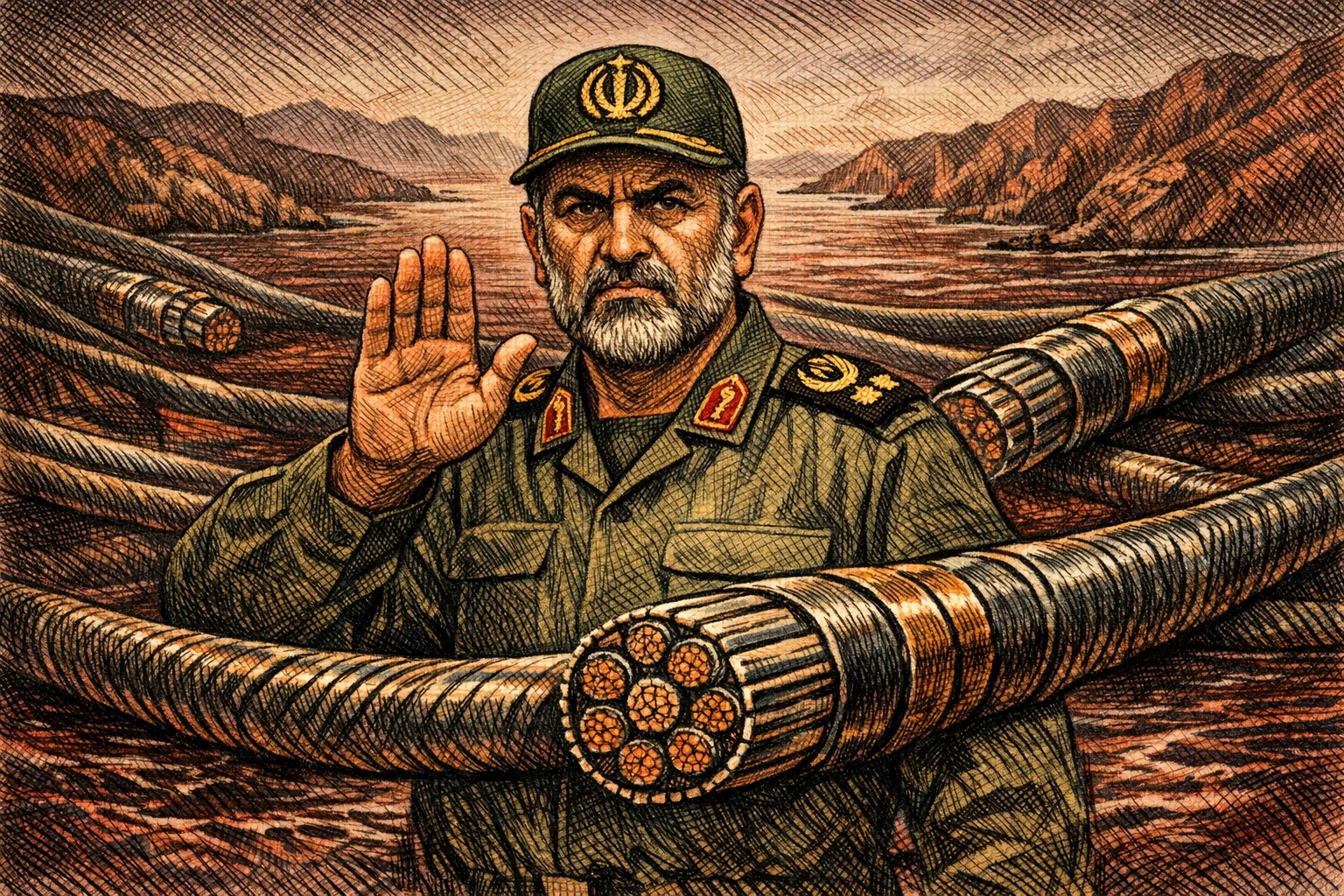
Iran's military spokesman Ebrahim Zolfaghari posted on X earlier this month: “We will charge for network cables.” Media outlets affiliated with Iran's Revolutionary Guard Corps (IRGC) followed up, demanding that Google, Microsoft, Meta, Amazon and other tech giants comply with Iranian law, requiring submarine cable operators to pay transit permit fees and granting exclusive cable maintenance rights to Iranian firms. State media added a veiled threat: any damage to the cables could disrupt trillions of dollars in daily global data transmissions and internet connectivity across the region.
Which Cables Are at Risk?
Several major intercontinental submarine cables pass through the Strait of Hormuz. Due to long-standing security risks posed by Iran, international operators have deliberately routed the vast majority of cables through a narrow corridor closer to Oman, avoiding Iranian waters. However, telecom research firm TeleGeography's research director Alan Mauldin noted that two cables — “Falcon” and “Gulf Bridge International” — do traverse Iran's territorial sea. Some tech companies have invested in cables traversing the Strait of Hormuz and the Persian Gulf, but it remains unclear whether those cables cross Iranian waters. Given U.S. sanctions prohibiting payments to Iran, most firms are likely treating Iran's declaration as political posturing rather than a concrete policy shift.
A Cascading Digital Catastrophe?
Research by Mostafa Ahmed, a senior fellow at the UAE-based Habtoor Research Centre, indicates that IRGC possesses combat divers, mini-submarines, and underwater drones capable of threatening submarine cables. A successful attack could trigger a “cascading digital catastrophe” across multiple continents. Persian Gulf states opposite the Strait of Hormuz would face severe internet disruptions, impacting oil and gas exports and the banking sector. India, which relies heavily on data flows through the region, could see its large outsourcing industry hit with losses in the billions of dollars. If Iran's proxy forces take similar action in the Red Sea, the damage would be even more severe. In 2024, Yemen's Houthi rebels severed three submarine cables when a ship dragged anchor, causing about 25% of the region's internet traffic to go down — a stark precedent.
Real Risk: Less Than 1% of Global Bandwidth
TeleGeography data provides a crucial reality check: as of 2025, cables through the Strait of Hormuz carry less than 1% of global international bandwidth. Even if Iran followed through, the direct impact on global internet traffic would be relatively limited. The bigger concern is repair. Iran's instability makes fixing damaged cables extremely difficult: repair vessels must remain stationary in the water, facing high risk. Of the five ships normally operating in the area, only one remains in the Persian Gulf.
Legal Basis: Can Iran Copy the Suez Canal Model?
Iranian media cite the 1982 United Nations Convention on the Law of the Sea (UNCLOS) as legal grounds for the fee. Article 79 of UNCLOS allows coastal states to set conditions for cables or pipelines entering their territory or territorial sea. Iran has signed but not yet ratified the treaty, though legal experts consider it binding under customary international law. Tehran points to Egypt as a precedent: Cairo has used the Suez Canal's strategic location to dominate submarine cable routes between Europe and Asia, earning hundreds of millions of dollars annually in transit and licensing fees. But Irini Papanicolopulu, a professor of international law at SOAS University of London, highlights a key difference: “The Suez Canal is a man-made waterway; the Strait of Hormuz is a natural strait, with a completely different legal framework. Existing cables must of course abide by contracts signed when they were laid. But for new cables, any country, including Iran, can decide whether and under what conditions to allow cables into its territorial sea.”