
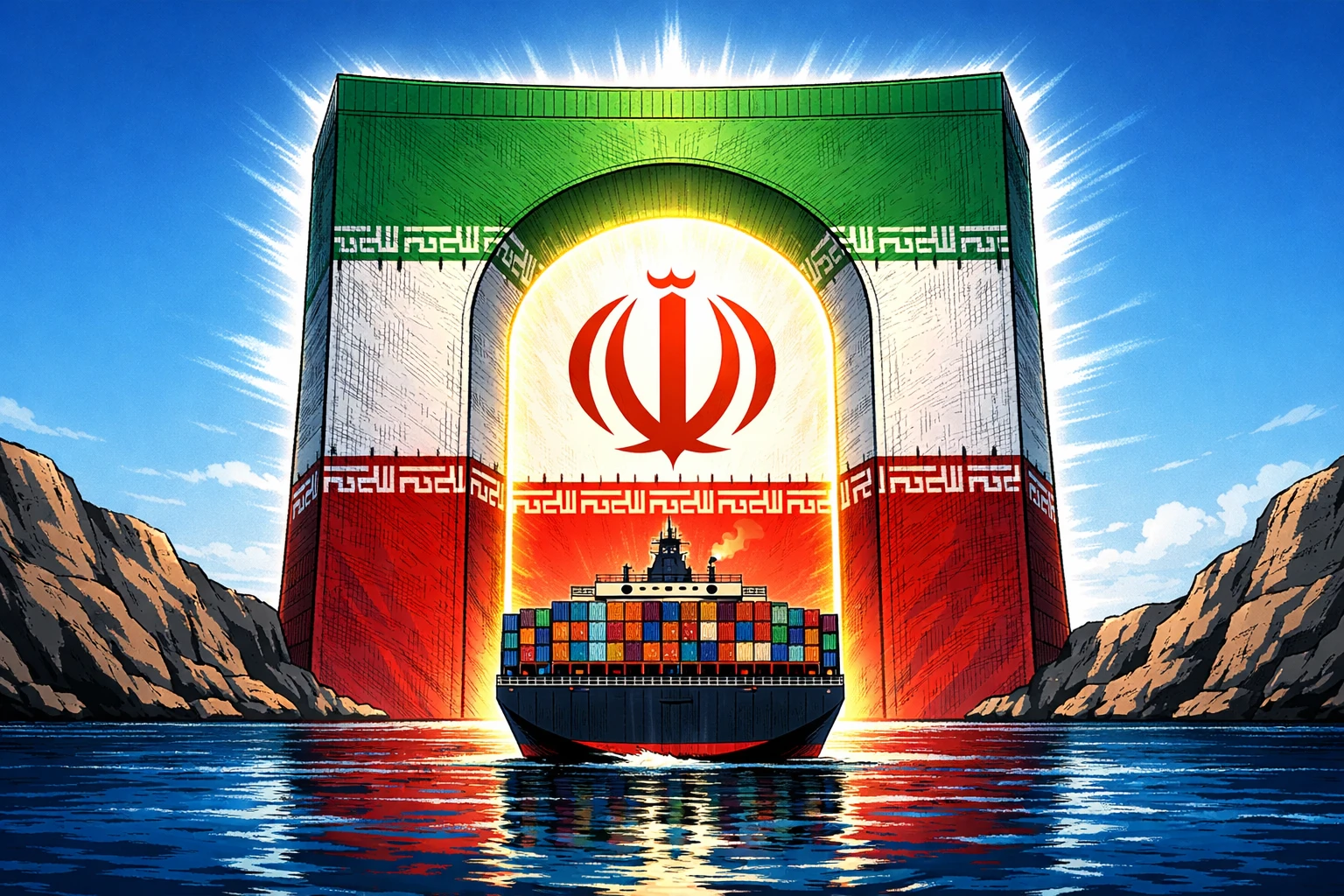
Iran has linked access through the Strait of Hormuz to a country's diplomatic stance toward the United States and Israel. Iranian state media reported Monday that the Islamic Revolutionary Guard Corps said any Arab or European state that expels Israeli and US envoys from its territory would be granted full freedom of passage through the strait. The message put energy transit and foreign policy on the same line, in unusually explicit terms.
Iran's ambassador to China, Fazli, made a similar point in an interview with Chinese state media. He said the insecurity in the region was being caused by the United States and Israel, and that if the world wanted secure energy transportation, those two countries had to leave the region. The statement matched the broader signal Tehran has been sending over Hormuz traffic.
Traffic Through the Strait Has Collapsed
According to a CSIS analysis, the Strait of Hormuz handled an average of 153 vessels a day before the conflict, with tankers and container ships accounting for 88% of traffic. By early March, that figure had dropped to 13 vessels, or just 8% of normal volume, and only 1 tanker was passing through. By mid-March, only 78 vessels had successfully crossed the strait since the conflict began, while more than 750 ships were stranded inside and around the Persian Gulf.
The wartime restrictions described in the report are openly selective. Vessels flying US, Israeli, or European flags are barred from transit and face the threat of drone attacks if they attempt passage. Ships from China, Russia, or states regarded as neutral and friendly are, at least in theory, allowed through. In practice, that distinction has not restored shipping. Most insurers have withdrawn war-risk coverage, leaving vessels unable to secure financing, while crews are unwilling to sail into a zone seen as too dangerous.
China's Position Shows the Limits of Selective Access
China is Iran's largest oil buyer. The report says Iranian supply accounts for about 13% of China's oil imports, with trade settled in renminbi and sold at a discount. Since 2021, China's purchases of Iranian oil have exceeded $140 billion, representing 80% of Iran's oil exports. On paper, that would make China one of the clearest beneficiaries of any selective transit arrangement.
But the disruption has hit Chinese shipping as well. Anadolu Agency reported that 55 Chinese-flagged ships were stranded in the Persian Gulf, and Chinese shipping companies had suspended all transits despite the stated exemption. Missile and drone threats do not disappear because a vessel is theoretically permitted to pass.
Legal Protections Remain, Market Stress Builds
Analysis based on the UN Convention on the Law of the Sea says Iran has no legal right to close the Strait of Hormuz, because transit through international waterways is protected. Still, the legal framework has done little to restore movement. Ali Larijani, secretary of Iran's security council, said security in the strait could not return while the war with the United States and Israel continued.
US President Donald Trump said Monday at a press conference in Miami, Florida, that Washington would temporarily lift some oil-related sanctions to help secure adequate supply and lower prices, though he did not provide details. He also said military action against Iran would end “very soon” and described the rise in oil prices as less severe than he had feared. After those remarks, crude fell overnight from a peak near $120 to about $85, a swing of more than 25%.