
Top stories
Fed uncertainty builds before the policy decision
Bitget UEX said divisions in the market over the Federal Reserve’s next move have widened sharply ahead of the rate decision. Open interest in fed funds futures rose to a record 967,000 contracts on Monday, a sign that traders are taking increasingly different views on where policy goes next. CME data cited in the report showed a 69.5% probability that rates stay unchanged in July and a 30.5% probability of a 25-basis-point hike. The cumulative probability of further tightening was described as higher by September.

A Reuters survey referenced in the note said analysts cut their gold price forecasts for the first time since late 2023, lowering the 2026 median estimate to $4,509 per ounce. In the report’s framing, policy uncertainty is supporting the dollar and market volatility while weighing on risk assets and reinforcing pricing around sticky inflation and geopolitical stress.
Iran strike on U.S. base in Jordan pushes crude higher
The report said Iran launched multiple ballistic missiles toward a U.S. base in Jordan and all were intercepted. It described the incident as Iran’s first missile attack on U.S. bases in the region since Washington paused strikes last Friday. U.S. Central Command later confirmed that the attack took place on the afternoon of July 28 Eastern Time and said U.S. forces remained on high alert.
Bitget UEX also noted that Iran’s deputy foreign minister proposed talks with Oman over temporary shipping routes through the Strait of Hormuz while insisting that inbound sea lanes remain fully under Iranian control. Otherwise, the threat was to keep the route closed and restart war. The report said that breakdown in an informal ceasefire expectation lifted the geopolitical risk premium, sent WTI up more than 3%, revived short-term supply concerns and added another layer to the inflation-versus-policy debate.
Market review
Commodities and foreign exchange
Spot gold was quoted around $4,015 per ounce, down 0.35%. Spot silver was around $57.2 per ounce, up 0.11%. WTI crude was around $82.6 a barrel, up 3.12%, while Brent traded near $81.2, up 4.31%. The U.S. Dollar Index stood around 101.39, down 0.02%.
The report tied those moves to the missile strike and the Fed meeting. Oil moved first as the previous ceasefire narrative broke down. Precious metals came under pressure as crude rebounded and disagreement over the Fed widened. The lowered medium-term gold forecast added to that pressure. The dollar held relatively firm, which the note linked to policy uncertainty.
Bitget UEX laid out the chain this way: geopolitical escalation leads to higher oil, higher oil revives inflation concerns, and that raises the perceived odds of a more hawkish Fed. In the near term, the report said commodity volatility would depend heavily on any development in Hormuz talks and on the FOMC outcome.
Cryptocurrencies
BTC was listed at $63,962, up 0.93%, and ETH at $1,917, up 2.31%. Total crypto market capitalization stood near $2.28 trillion, up 0.4%. Across the market, 24-hour liquidations reached about $372 million, including about $280 million in long liquidations.
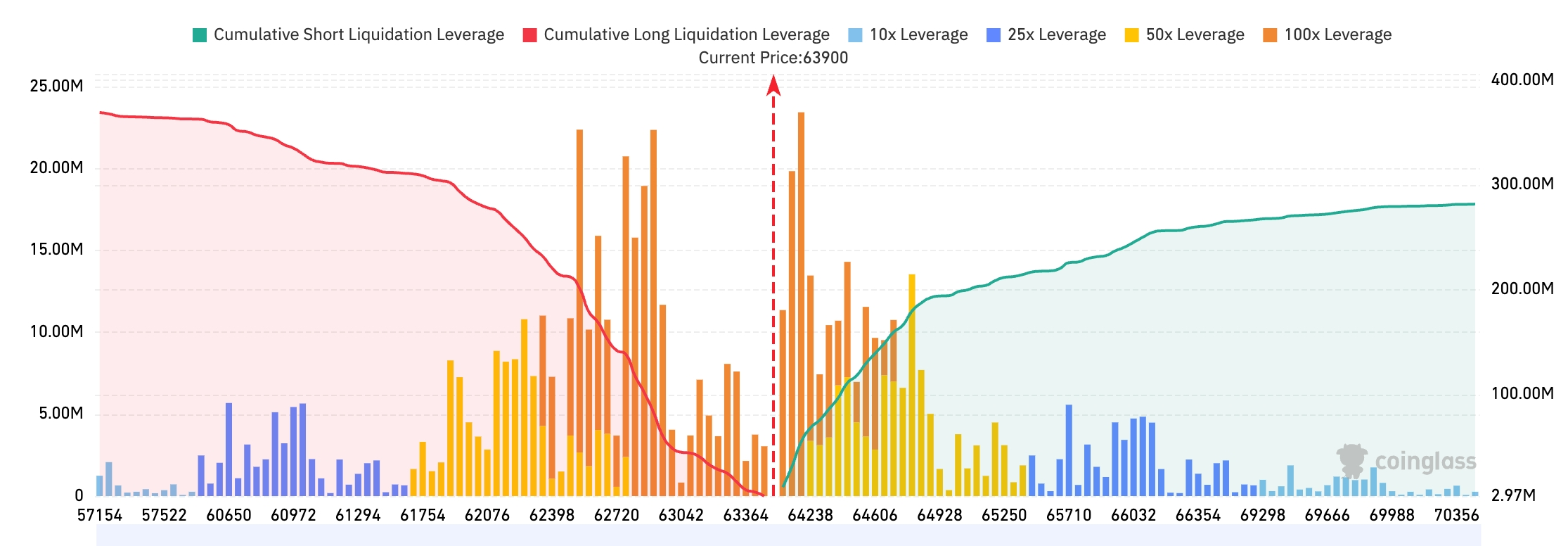
According to Bitget’s BTC/USDT liquidation map, liquidation pressure near the current price of $63,900 was limited. A much larger cluster of 50x and 100x short liquidations sat in the $64,200 to $65,000 range. If BTC breaks through that zone, the report said, it could trigger a chain of short stop-outs and push prices higher. Aggregate short liquidations above the market were estimated at about $280 million, compared with roughly $230 million in long liquidations below, leaving near-term liquidation pressure tilted to the short side.
Spot ETF flow data in the note showed about $11.6 million in net outflows from BTC spot ETFs on July 27, followed by dynamic net inflows of $5.1 million today. Bitget UEX said the combination of renewed geopolitical stress and pre-FOMC caution lifted demand for safety and weighed on risk assets broadly. It also said large-scale long liquidations showed levered longs had been flushed out, while softer ETF flows added to selling pressure. The report described oil prices and the FOMC result as the key short-term variables and said ETH’s relative weakness reflected the vulnerability of higher-beta assets when risk appetite fades.
U.S. equity indexes
The Dow Jones Industrial Average closed at 52,747.32, up 1.03%. The S&P 500 finished at 7,428.78, up 0.21%. The Nasdaq closed at 24,876.91, down 0.22%. Bitget UEX said stronger earnings outside technology helped the Dow, the S&P 500 edged higher in a narrow range, and semiconductor weakness dragged on the Nasdaq.
Big Tech and sector moves
Among major technology names, NVIDIA closed at $197.01, up 0.25%; Apple at $340.08, up 0.94%; Microsoft at $393.35, up 1.09%; Alphabet at $332.60, up 1.85%; Amazon at $230.86, down 0.23%; Meta at $593.41, down 0.08%; and Tesla at $307.44, down 0.58%.
The note said the split inside technology kept widening. Apple, Microsoft and Google rose in a relatively steady fashion, and the report added that Apple had already moved back ahead of NVIDIA by market value. At the same time, Micron and AMD dropped more than 8%, while Intel fell nearly 6%, weighing on the Nasdaq and the Philadelphia Semiconductor Index. In AI application software, Workday rose more than 8%, while Palantir retreated. Bitget UEX summed that up as resilience in non-tech and software versus continued pressure in hardware and storage as investors reprice returns on AI capital spending.
Sector-level moves were sharper. Storage names sold off across the board, with SanDisk down more than 14%, Micron and SK Hynix-related names down nearly 9%, and Seagate down more than 8% in that section of the report. Optical communications stocks also weakened, with Corning down more than 12%, Coherent down more than 10% and Lumentum down more than 8%. The Philadelphia Semiconductor Index fell 4.49%, with AMD and Micron off more than 8% and Applied Materials and Marvell down nearly 8%. The note linked the slide to cooling expectations for AI storage demand, broad chip selling and ongoing concerns about valuation and returns across the AI hardware chain.
Deep dive on U.S. stocks
1. Seagate Technology (STX): earnings beat stands out in storage hardware
Seagate reported fiscal fourth-quarter revenue of $3.65 billion, up 48% year over year. Adjusted earnings per share came in at $5.71, and operating margin reached 44.6%. The report said all three core metrics were well above market expectations. Seagate also raised first-quarter revenue guidance to $4.0 billion to $4.2 billion, above the roughly $3.79 billion expected by the market. After the results, the stock rose more than 9% in after-hours trading at one point.
Bitget UEX argued that Seagate, as a provider of enterprise hard drives and storage solutions, showed that real demand can still come through even while broader storage and semiconductor names are under pressure from questions about AI capex returns. The note contrasted Seagate’s numbers with the sharp pullbacks in SanDisk and Micron and said the gap highlighted a divide between companies delivering on earnings and stocks driven mainly by expectations. It said order visibility and large-customer capex plans would be key to judging whether demand holds.
2. Micron Technology (MU): nearly 9% drop extends weakness in storage sentiment
Micron fell nearly 9%, joining SanDisk, down more than 14%, and AMD in dragging lower both storage stocks and the Philadelphia Semiconductor Index. The report said investors have become more doubtful about the sustainability of the HBM and conventional memory pricing cycle. Expectations for AI server demand had lifted storage names significantly before, but capital has recently moved out of higher-valuation memory plays.
In the report’s view, that shift shows the market is repricing the idea of linear AI-driven demand growth. Because Micron is seen as a bellwether, its decline amplified bearish sentiment across the sector and stood in clear contrast to Seagate’s earnings beat. The note said investors should watch customer capex guidance, inventory levels and price trends closely.
3. Apple (AAPL): steady gains reinforce market-cap lead
Apple rose about 0.94% to $340.08. Bitget UEX said Apple had already overtaken NVIDIA in market value again and reached a fresh recent high.
The report attributed Apple’s strength to a premium on certainty at a time when hardware and semiconductor stocks are broadly under pressure. Investors are leaning toward Apple’s steady cash flow, continued services growth and relatively cautious AI capex strategy, which the note described as favoring leased computing power over large-scale in-house buildouts. That profile has made Apple a preferred shelter in a volatile tape. Its earnings this week, the report said, will test the quality of growth in devices and services as well as progress in monetizing AI-related spending.
4. NVIDIA (NVDA): slight rebound, but AI hardware sentiment remains weak
NVIDIA added 0.25% to $197.01 after what the report described as a notable pullback tied to concerns about AI infrastructure costs and rising competition.
Bitget UEX said the market is still working through questions around the payback period on large-scale capex, financing structures, including possible large support arrangements tied to OpenAI, and stronger competition from China. The small bounce did little to change the tone. The report said it showed that investor confidence in the long-duration AI infrastructure trade has not recovered. Set against Apple’s market-cap advantage, the gap between hardware names and certainty-driven assets appears even wider.
5. Corning (GLW): more than 12% drop highlights pressure on the optical chain
Corning dropped more than 12%, while Coherent fell more than 10% and Lumentum more than 8%. The report said Corning, as a supplier of optical communications and advanced materials, was directly exposed to lower expectations for AI data-center capex. Demand for optical modules and high-speed interconnects depends heavily on spending by cloud companies and hyperscale customers.
When the market starts questioning returns on AI infrastructure, upstream materials and equipment suppliers often reflect that shift first. Bitget UEX said Corning’s decline moved in step with storage and chip names, strengthening the signal that the hardware chain has entered an expectation-reset phase. It pointed to future capex guidance from cloud companies and equipment vendors as the next area to watch.
6. SK Hynix (SKHY ADR): record profit still misses expectations
SK Hynix reported second-quarter operating profit of 60.5 trillion won, or about $41.6 billion, up 557% year over year and a record high. Revenue came in at 79 trillion won. Both figures missed market expectations, which the report put at about 64 trillion won for operating profit and about 83.85 trillion won for revenue. The company said its higher mix of HBM meant it did not fully benefit from the latest sharp pricing cycle in conventional memory chips. It also said it plans a significant expansion of HBM4 capacity in the second half of 2026.
The note said the issue for the market was not the absolute profit level but the miss versus expectations. In that reading, a greater HBM mix became a short-term drag even though it represents higher-end exposure, because investors are focused on marginal change and expectation gaps. The result added to caution across memory stocks and again stood in contrast to Seagate’s report.
Market and project developments
1. Total value locked across Ethereum Layer 2 networks has fallen back to about $5 billion, the lowest level since 2023, according to the report. That has nearly erased the growth generated in 2024 by launches on networks including Optimism, Arbitrum and ZKsync. Optimistic rollups still dominate, with Optimism, Base and Arbitrum accounting for about $4.8 billion, or 96% of the total.
2. Analysts cited in the report said any dovish signal from the Fed could benefit Bitcoin. The market remains deeply split over whether the Fed will raise rates on Wednesday. CME FedWatch data showed a 70% probability of no change and a 30% probability of a surprise 25-basis-point hike. Block Scholes analyst Thahbib Rahman said Fed Chair Kevin Warsh has used less forward guidance, increasing market uncertainty and making this FOMC meeting the most uncertain in years.
3. SK Hynix said it plans a significant increase in HBM4 supply in the second half of 2026 and has signed long-term agreement contracts with 10 major industry customers. The company expects DRAM shipments in the third quarter of 2026 to rise about 10% from the second quarter. It expects NAND flash shipments in the same period to increase by a low single-digit percentage, defined in the report as 1% to 4%. Those long-term supply agreements use differentiated pricing based on customer type and chip characteristics to smooth out the storage price cycle and improve medium- to long-term demand visibility.
4. Jin10, citing foreign media, reported that U.S. officials said Iran fired ballistic missiles at a U.S. base in Jordan and that Jordan intercepted them. U.S. Central Command later said Iran launched multiple ballistic missiles at 5:45 p.m. Eastern Time in an attempt to strike U.S. forces in the Middle East, with all missiles intercepted successfully. U.S. forces remained alert and at a high state of readiness. WTI crude extended gains at the open on Wednesday and at one point rose as much as 4% intraday.
5. Bitcoin miner and AI infrastructure company Ionic Digital rose more than 25% on its first day of direct listing on Nasdaq. Its share price approached $63, implying a valuation of about $2.75 billion. The company was formed in January 2024 and acquired most of the mining assets from the Celsius Network bankruptcy restructuring, including mining rigs, infrastructure, about $195 million in cash and 540 BTC.
6. After SK Hynix released earnings, its U.S.-listed shares closed down 9% on Tuesday and at one point dropped another 9% after hours. SanDisk and Micron also fell more than 4%, erasing the boost that Seagate’s earnings had provided, according to the report.
7. Cointelegraph reported that a slide in Asian chip stocks pressured the U.S. technology sector and helped push Bitcoin below $63,000 shortly after the U.S. stock market opened on Tuesday, breaking a key support level and marking its lowest point in nearly 10 days. The report said Bitcoin’s move reflected a chain reaction in risk assets that began with a sharp drop in Asian semiconductor shares and spread into U.S. markets.
Market calendar
Data releases and earnings schedule
The report flagged this week’s FOMC rate decision on Wednesday as the top macro event. After the close, Microsoft, Meta and Qualcomm are scheduled to report earnings.
For July 29, Wednesday, Microsoft and Meta are due after the bell, with the market focused on returns on AI capex, cloud growth and advertising recovery. Qualcomm, Arm and Robinhood are also set to report after the close.
For July 30, Thursday, the Federal Reserve will release its rate decision. The market expects no change, followed by a press conference from Chair Warsh. Traders will watch closely for any signal on the future rate path and whether hikes could resume in September. The same day brings U.S. core PCE for June, the advance estimate of second-quarter annualized real GDP growth and weekly jobless claims. Apple and Amazon will also report earnings, while Samsung Electronics will release full second-quarter results. Coinbase and Strategy are due after the bell as well.
For July 31, Friday, Kioxia is scheduled to report earnings. The U.S. will also release July Chicago PMI and the final reading of the University of Michigan consumer sentiment index.
Institutional view in the report
The note said analysts broadly see Iran’s strike as the event that broke the ceasefire expectation, lifted crude quickly and revived inflation concerns, making the Fed’s policy path this week more uncertain. Record fed funds futures positioning reflects how large that split has become. Technology hardware and storage stocks remain under pressure, which the report said shows that repricing around returns on AI capital spending is still deepening. Some support has come from earnings outside hardware, especially in non-tech and software. In crypto, the pullback has taken place alongside weaker risk appetite and concentrated long liquidations. The report’s overall takeaway was that geopolitical stress and policy uncertainty together will drive short-term volatility, with the FOMC outcome and Big Tech earnings acting as the key pricing anchors.