
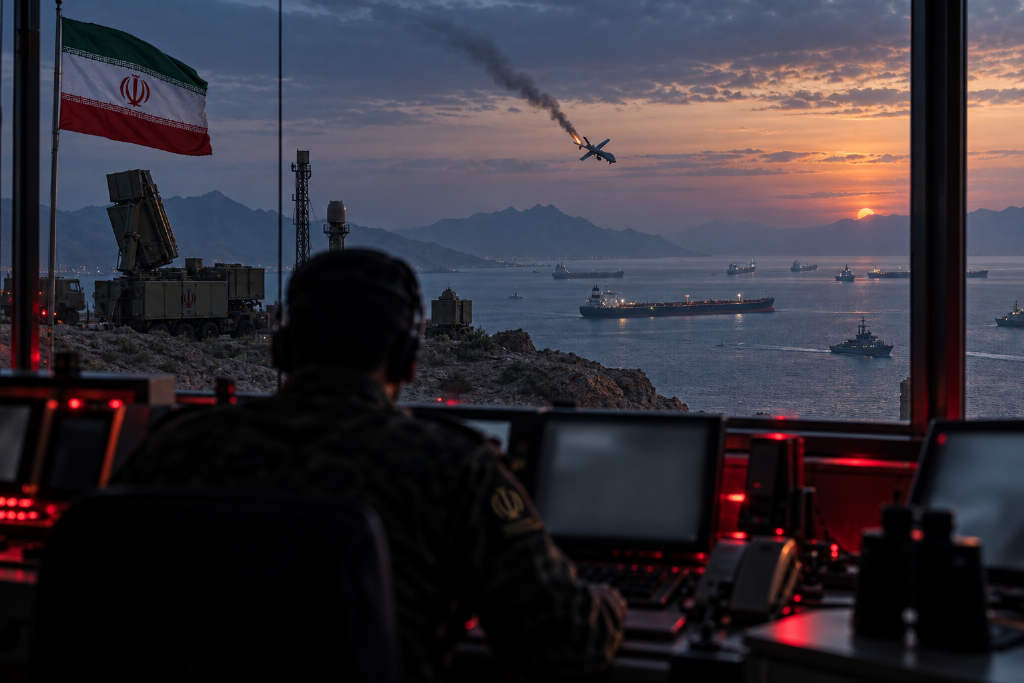
Iran’s Islamic Revolutionary Guard Corps said Monday that its Aerospace Force intercepted and destroyed a U.S. MQ-1 drone over the Strait of Hormuz with an advanced air defense system. PressTV published the statement, which said the operation was carried out under the control of Iran’s integrated air defense network.
Neither the U.S. military nor U.S. Central Command has publicly confirmed the incident.
Second such claim in six days
The Iranian statement said, 「This advanced MQ-1 drone was intercepted and destroyed over the Strait of Hormuz」, but did not say what mission the aircraft was carrying out.
The claim marks the second such announcement from Iran in six days, and the two statements came from different branches. On Sept. 8, Iran’s army air defense force said it detected, tracked and destroyed a U.S. MQ-1 in southeastern Iran. That statement also referred to a 「new advanced air defense system」 and said the action was taken under the country’s integrated air defense network.
The MQ-1 is made by U.S. defense contractor General Atomics and has historically been operated mainly by the U.S. Air Force and the Central Intelligence Agency. At this stage, both incidents remain unilateral claims from Iran, and the U.S. has not confirmed the loss of any aircraft.
Hormuz-related meeting delayed
Military tensions were not the only issue over the weekend. Oman Foreign Minister Badr Albusaidi said on X on Sunday that a meeting between Gulf states and Iran on arrangements tied to the Strait of Hormuz had been delayed because 「consensus」 was still needed.
According to CNBC, Iranian and Gulf state officials had been expected to meet on Monday and sign an agreement establishing a shipping route from Iran to Oman through the Strait of Hormuz. There are no direct talks currently under way between the United States and Iran.
Since fighting broke out in February this year, the Strait of Hormuz has gone through maritime blockades by both Iran and the United States, keeping global energy prices elevated. A June agreement between Washington and Tehran later fell apart over differences related to the waterway. ChainCatcher ABMedia reported on Sept. 10 on the standoff when Brent crude moved above $100 a barrel.
Saudi Petroline halt adds to supply pressure
Another variable emerged on the supply side. Saudi Arabia temporarily shut the roughly 750-mile East-West Petroline on Friday after repeated drone attacks from Iraq. The Saudi government said several people were injured and that pipeline segments in the Riyadh and Medina areas were targeted.
The pipeline carries crude from Abqaiq on the eastern Gulf coast to the Red Sea port of Yanbu. After recent expansions, its design capacity stands at about 7 million barrels a day. For Saudi Arabia, it is the main route for moving exports around the Strait of Hormuz, so the shutdown means that backup path is also offline.
Satellite images showed fire damage and broad blackened areas around one pumping station and nearby facilities.
Oil prices rose on Monday. U.S. West Texas Intermediate futures were up as much as 2.3% to $102.39 a barrel, while international benchmark Brent crude gained 2.4% to $107.11. Brent had only returned above $100 last week for the first time since May.