
IREN posted Q4 FY2026 revenue of $137.2 million, modestly ahead of the $136.0 million consensus estimate, but its GAAP net loss widened to $684.0 million, far above the expected $202.0 million loss, as the company accelerated its exit from Bitcoin mining and took large non-cash charges.
Revenue beats estimates, while net loss is driven by non-cash write-downs
According to the figures cited in the report, impairment on retired mining machines reached $450.4 million, and the fair value decline on mining machines held for sale came to $102.1 million. Those two non-cash items totaled $552.5 million, accounting for 81% of the net loss.
After excluding those one-off charges, adjusted loss per share was $0.41, better than the market expectation for a $0.50 loss per share.
Adjusted EBITDA, however, was only $19.2 million, a level the report said still reflects margin pressure during the company’s transition period.
AI cloud revenue moves ahead of Bitcoin mining for the first time
By segment, AI cloud services generated $70.5 million in revenue, or about 51% of total revenue, overtaking Bitcoin mining revenue of $66.7 million for the first time. The report described this as a clear sign that IREN’s operating focus has shifted past a key threshold.
Bitcoin mining is still being wound down. The company expects the retirement process to be largely completed by the end of December 2026.
Contracted ARR target rises, and operating ARR doubles
On forward-looking operating indicators, IREN said contracted ARR is expected to reach $4.00 billion in the fourth quarter, above its previous target.
Operating ARR stood at $1.00 billion as of Aug. 26, 2026. Following delivery and acceptance of Microsoft Horizon 1, that figure doubled from the quarter-end level.
Data center pipeline exceeds 5 gigawatts
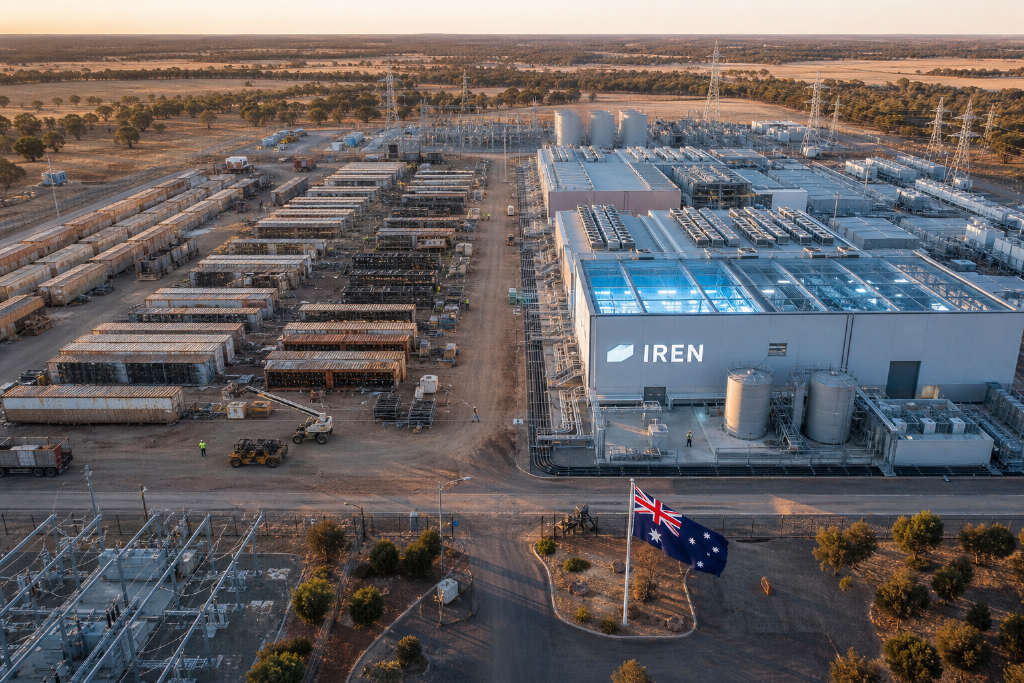
On capacity buildout, the company said its global data center reserve pipeline has surpassed 5 gigawatts. Its delivery target is 0.5 gigawatts in 2026, rising to 1.2 gigawatts in 2027.
MSX view included in the source report
The source report from MSX Research said the headline loss and the underlying business transition pointed in different directions. In its words, $553 million of the $684 million net loss came from non-cash impairment tied to the active shutdown of mining machines, and after stripping that out, the adjusted per-share loss came in better than expected. MSX wrote that this was "an accounting cost paid to free up resources for the shift to AI, not operating blood loss."
MSX said the more important signs of progress appeared in three areas. First, AI cloud revenue moved above 50% of the total while mining is close to zero, showing the transition has passed a critical point. Second, on orders, contracted ARR was lifted from a $3.7 billion target to $4.0 billion, while operating ARR doubled to $1.0 billion, which MSX said showed capacity moving from being built to generating rental income. Third, on infrastructure, a pipeline above 5 gigawatts and the higher 2027 delivery target together outline the company’s growth framework for the next two years.
MSX also said profitability remains the weakest link. It wrote that adjusted EBITDA of $19.2 million is "almost negligible" relative to the scale of the current expansion plan. In MSX’s description, IREN is betting on "build capacity first, collect rent later," with the outcome depending on how quickly the 5 gigawatt pipeline converts into contracted ARR and whether computing rental prices can hold after a large amount of capacity enters the market.
MSX platform description and disclaimer
The source article also included a description of MSX as an RWA trading platform focused on access to global financial markets. It said the platform integrates blockchain technology with a compliance framework and offers spot and derivatives trading for nearly 400 tokenized stocks and pre-IPO assets, alongside services including U.S. stock spot, perpetual contracts, crypto-to-crypto trading, pre-IPO products, and research.
The article ended with a risk reminder stating that macroeconomic conditions and U.S. equity markets can be highly volatile, and that the content is for research observation only and does not constitute investment advice.