
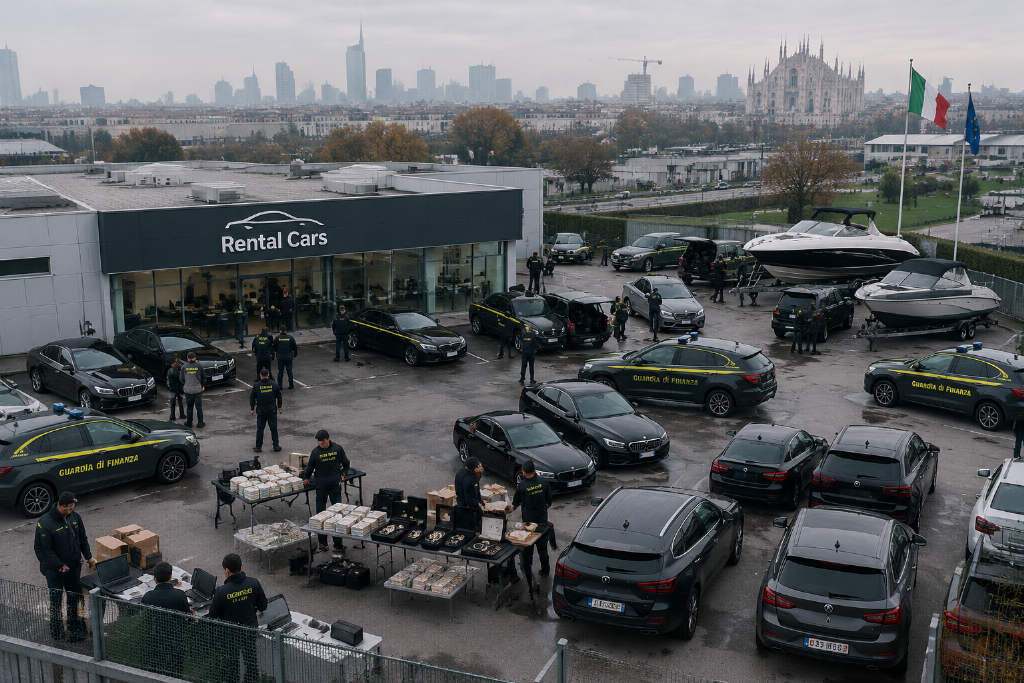
Italian prosecutors have accused a car rental company in Pero, on the outskirts of Milan, of operating as an underground bank shared by the ’Ndrangheta and the Camorra. Authorities said the scheme used false invoices, cash refunds, bank transfers and crypto exchange conversions to launder money tied to drug trafficking, tax evasion and online investment fraud.
The operation was made public on Oct. 21, 2026. Italy’s finance police said they seized assets worth €21 million, or about $23.6 million, including cash, bank deposits, cryptocurrency, boats, jewelry and luxury watches. Thirty people were placed under arrest measures.
The raids were coordinated by the Milan prosecutor’s anti-mafia division, known as the DDA, with more than 350 finance police officers searching locations across the country. Of the 30 suspects, 16 were sent to jail and 14 were placed under house arrest. Spanish police arrested two people under European arrest warrants, and another suspect was being pursued in Switzerland.
According to Bloomberg, Milan prosecutors said the case involved more than €110 million in false invoices, with about €68 million transferred abroad.
Three alleged leaders and a network active for about three years
Based on prosecution material compiled by ilsud24, the car rental business was run by three Italians. Two were described as long-time contacts of a ’Ndrangheta family from Crotone and had already received final convictions in the Infinito and Aemilia cases. A third was linked to the Casalesi clan.
LaC News24, citing the detention order, identified the three alleged leaders as Giuseppe Piscioneri, Paolo Pelaggi and Luigi Mercadante. The same order said Chinese and Albanian accomplices helped keep the system running, and that the operation had been active in Lombardy for about three years.
A four-step laundering structure ending in crypto wallets
Prosecutors said the laundering process had four stages. The first was cash collection. Two Chinese nationals allegedly gathered funds, much of it tied to tax evasion. A man from the Calabria region was also said to have delivered, either personally or through couriers, more than €5 million in drug cash, receiving equivalent cryptocurrency in return or arranging transfers to accounts in Asia, Canada and South America.
The second stage involved shell companies. These entities were registered under nominees and listed fake addresses. Prosecutors said they issued invoices for services never provided to clients in construction, logistics and the service sector, allowing those clients to reduce taxable income. Once used, the companies were pushed into bankruptcy and replaced by new ones controlled by the same group.
The third stage was the cash refund. After clients paid invoice amounts by bank transfer, the organization allegedly returned the same value in cash through couriers and kept fees ranging from 2% to 5%.
The final stage was cryptocurrency conversion. Funds accumulated in shell company accounts were first moved to banks in Luxembourg, Lithuania and Germany, then converted into crypto through exchanges and sent to wallets controlled by the group. Prosecutors said proceeds from online crypto investment scams followed the same route.
Milan preliminary investigations judge Luca Milani described the mechanism in a detention order running more than 500 pages and covering nearly 90 charges. He wrote that the structure had a regenerative capacity, able to keep operating through 「always new methods, new companies」.
Crypto appeared at the end of the chain, not at the start
The prosecution’s account does not describe a mafia group simply shifting into crypto trading. Cash handling, false invoicing and bank transfers remained the traditional core of the operation. Cryptocurrency appeared in the last leg, serving as the channel used to move money across borders to places that were harder to trace.
Investigators also alleged leaks inside public institutions
One of the most sensitive parts of the case concerns alleged help from inside state institutions. The detention order said a finance police inspector was accused of taking €3,000 in cash from a Chinese suspect, who has since been jailed. Prosecutors said the inspector leaked confidential information related to tax debts and indicated a willingness to help deal with the matter. The conduct was dated between May and September 2025, and the inspector was placed under house arrest.
Another line of inquiry reached the Milan court system. Prosecutors alleged that a court employee, with help from a lawyer, illegally accessed computer records to check the progress of the investigation and then reported back to senior figures in the organization.
Wiretap records included a claim about being the “thirteenth brother”
The detention order also cited an environmental wiretap dated Nov. 20, 2025. In that conversation, Piscioneri boasted about his ties to the Bellocco family and said, 「He has twelve brothers... I am the thirteenth.」 Investigators said the remark showed that he saw himself as closely aligned with that ’Ndrangheta family.
Another suspect, Salvatore Morabito, was described as linked to the family of the same name and as a frequent visitor to the office in Pero. He was also jailed. The order added that the suspects’ contacts extended to law enforcement personnel, lawyers and administrative staff, though the nature and scope of those relationships still need to be tested in court.


