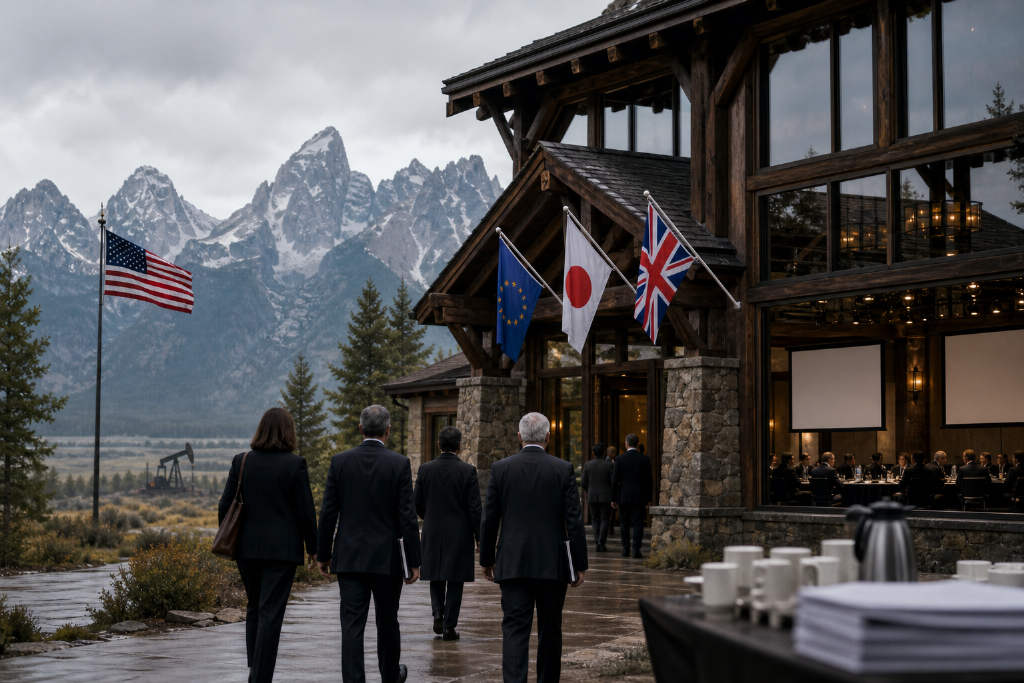
Global central bank officials are set to gather in Jackson Hole, Wyoming this week to revisit the inflation outlook and weigh the prospect that borrowing costs may need to stay higher for longer in the face of fresh price pressures. Comments cited by BlockBeats, referencing Jin10, show policymakers and economists focusing on supply-driven inflation risks rather than a clean return to price stability.
Spiros, an economist at Frankfurt-based Thin Ice Macro, said central banks are likely to remain cautious and continue treating inflation as the risk they most want to avoid, warning that a new supply shock can emerge without much notice. Subadra Rajappa, head of U.S. rates strategy at Societe Generale, said the urgency around inflation differs across countries because exposure to swings in energy costs depends in part on import needs. She said Europe and Japan are more sensitive to developments in the Middle East and to oil prices.
Jari Stehn, chief European economist at Goldman Sachs, said policy rates in the U.S. and the U.K. are still restrictive. He added that different starting points across economies leave the Federal Reserve and the Bank of England with more time to watch how the latest energy shock develops. Former Philadelphia Fed President Patrick Harker said the war in Iran has changed both the policy debate and decision-making environment, making this year’s Jackson Hole meeting materially different.
Global central bank officials are due to gather in Jackson Hole, Wyoming this week to discuss how to reassess inflation worldwide and whether borrowing costs may need to rise further as new inflation threats emerge, according to BlockBeats, citing Jin10.
Inflation remains at the center of the discussion
Spiros, an economist at Frankfurt-based Thin Ice Macro, said central banks are likely to take a cautious stance and keep viewing inflation as the risk they most want to avoid.
「You never know when the next supply shock will suddenly appear.」
Energy exposure differs across economies
Subadra Rajappa, head of U.S. research at Societe Generale, said the degree of urgency around inflation varies from country to country, in part because they are affected differently by swings in energy costs. That sensitivity, she said, depends on import exposure.
She added that Europe and Japan are 「more sensitive to the situation in the Middle East and to oil prices.」
Fed and BOE seen with more room to watch developments
Jari Stehn, chief European economist at Goldman Sachs, said, 「We estimate that policy rates in the United States and the United Kingdom are still restrictive.」
He added, 「Different starting points mean countries face different levels of pressure in responding to energy shocks, which gives the Federal Reserve and the Bank of England more time to observe how this shock evolves.」
Former Fed official says this year’s event is different
Former Philadelphia Fed President Patrick Harker said, 「The war in Iran has changed the way people discuss these issues and the way they make policy choices, and there seems to be no end in sight at the moment.」
He also said, 「That makes this year’s Jackson Hole conference completely different, because we are now in a classic supply-shock environment, or more precisely, in a situation where multiple supply shocks are hitting the global economy at the same time.」
This article was originally published by Bit.Fan. For more cryptocurrency news and market insights, visit www.bit.fan. Disclaimer:
The market information, project data, and third-party content displayed on this platform are for industry information sharing only and do not constitute any form of investment advice or return commitment.
Cryptocurrency trading carries high risks. Users should fully assess their risk tolerance and make independent decisions. All profits, losses, and legal responsibilities are borne by the users themselves.