
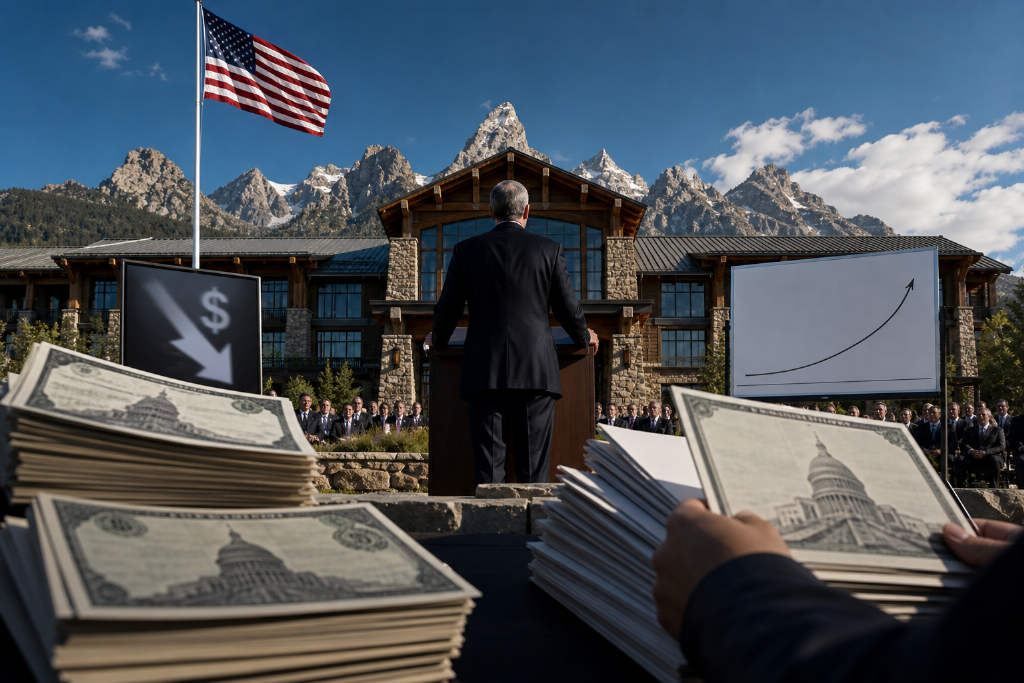
Federal Reserve Chair Warsh is heading into the Jackson Hole symposium with markets treating his speech as the key near-term risk event for both US Treasuries and the dollar. In a research report published on Aug. 24, Bank of America warned that if Warsh fails to clearly spell out the inflation outlook and the Fed’s monetary policy reaction function, the 30-year Treasury yield could quickly test 5.5% or even move above that level, while the dollar could face a fresh round of downside pressure.
According to Cailian Press’s Chasing Alpha trading desk, BofA strategists Mark Cabana, Stephen Juneau, and Alex Cohen said expectations around the speech have shifted quietly. The bond market’s sustained rally is now pushing Warsh, who has long resisted forward guidance, to adjust the way he communicates. With the US Treasury stepping up buybacks of long-dated government bonds and the dollar remaining under pressure, markets are looking for an explicit anti-inflation signal that could shape the direction of long-end yields.
Barclays economists led by Marc Giannoni made a similar case in a report dated Aug. 21. They said Warsh is unlikely to provide a specific path for rates, but investors will closely watch whether he states clearly that the Fed would be willing to restart rate hikes if inflation does not improve. Barclays said the probability of such a signal is above 50%, and argued that it would reinforce the policy reaction function already embedded in current market pricing.
Why Jackson Hole matters this time
The Jackson Hole symposium is the Kansas City Fed’s annual economic policy conference, bringing together central bank officials, policymakers, academics, and economists from around the world. This year’s event runs from Aug. 27 to Aug. 29 under the theme “Financial Innovation: Implications for Payments and Policy.” Warsh is scheduled to speak at 10:00 a.m. Eastern Time on Aug. 28, or 22:00 Beijing time the same day. Historically, there is no public Q&A after the speech.
Bank of America said markets are unusually focused on Jackson Hole for two reasons. First, the seven-week gap between the July and September policy meetings is the longest of the year, and two nonfarm payrolls reports plus two CPI releases will arrive during that stretch. Investors have often treated the symposium as a window for the Fed to signal policy intent ahead of the next decision. Second, summer liquidity is typically thin, which can magnify price swings after any policy remark.
A fragile backdrop for bonds and the dollar
BofA said the conference stands out this year because both the bond market and the dollar are already in a vulnerable position. The US Treasury announced last week that it would increase buybacks of long-dated Treasuries, and the dollar fell sharply on the day of that announcement. BofA read that move as a sign that the government is concerned about the persistent rise in long-end yields.
That comes on top of what the bank described as a dovish July FOMC meeting and weaker US economic data in August, both of which have added to the dollar’s headwinds. In that setting, Warsh’s speech is no longer seen as routine conference communication. Markets are treating it as a potential driver of rate pricing, curve moves, and foreign-exchange direction.
BofA says markets are pushing Warsh away from his old stance
Warsh has long resisted forward guidance. At the press conference after the July policy meeting, he said the direction of his Jackson Hole speech had not been decided and laid out two broad possibilities. One was to focus on long-run macro topics such as productivity, demographics, and the global economy. The other was to address the policy outlook from September through December more directly.
Bank of America argued that market pressure is changing that calculation. The report quoted Mike Tyson’s line, “Everyone has a plan until they get punched in the face,” saying the bond market’s repeated blows have made it difficult for Warsh to keep avoiding a policy signal.
BofA expects Warsh to borrow from the recent communication style of Fed officials Paulson and Cook, laying out separate policy paths under two different scenarios. If recent disinflation continues, the current stance would stay in place. If inflation remains elevated, he would make clear that the Fed is prepared to restart hikes. In BofA’s view, that kind of framework would communicate the reaction function without locking the central bank into a precise path for rates.
Barclays took a similar view. It also said Warsh could comment on the forward-guidance regime itself. According to Barclays, Warsh has consistently criticized forward guidance for constraining policy flexibility and contributing to historical policy mistakes. After taking office, he also set up a dedicated working group to review the framework.
Beyond rates, Barclays said Warsh may offer more information on balance-sheet policy. But with long-end yields already elevated, any signal pointing to a further shortening of portfolio duration would have to be handled carefully.
Two scenarios for rates, the curve, and the dollar
Bank of America laid out two distinct market scenarios based on the content of Warsh’s speech.
Scenario one: Warsh delivers a hiking signal
If Warsh says clearly that the Fed is willing to resume rate increases if inflation does not come down, BofA expects the implied probability of a hike at the September FOMC meeting to rise from pricing equivalent to about 9 basis points now to 12.5 basis points, roughly a 50-50 outcome. It also expects the total amount of tightening priced into this cycle to increase from about 40 basis points to close to 50 basis points. Under that outcome, nominal and real yield curves would flatten, and the dollar could recover part of its recent losses.
Scenario two: Warsh avoids a near-term policy signal
If the speech leans toward structural themes such as productivity or AI-driven disinflation, or if Warsh deliberately avoids near-term policy guidance on the grounds that he does not do forward guidance, BofA warned markets may read that as a dovish message. In that case, the curve could continue a bearish steepening move, the 30-year Treasury yield could quickly break through 5.5%, and the dollar could come under renewed selling pressure.
BofA added that the recent weakness in the dollar has already shown what it called a troubling signal. After the Treasury buyback announcement, the dollar fell even as rate differentials between the US and other countries widened. The bank described that as a classic sign of expanding risk premia and said it points to market concern over potential “fiscal dominance” risk. If Warsh’s remarks deepen doubts about the Fed’s monetary-policy independence, the weaker-dollar camp would gain more ammunition.
History suggests a limited effect, but BofA says this year may be different
Historically, Jackson Hole has not usually been a major turning point for the Treasury market. Bank of America said its data show that since 2010, the 10-year Treasury yield has often edged lower after the symposium, but those moves have generally reversed within 10 trading days. The bank said 2025 was an exception, when the Fed’s emphasis on downside risks to the labor market triggered a more persistent decline in yields and a marked weakening in the dollar.
The historical pattern in foreign exchange has been similar. The dollar often softens modestly around Jackson Hole, then tends to recover in the following weeks. BofA said the average dollar reaction during Jerome Powell’s tenure has been larger than before. It pointed to 2022 as the clearest recent example, when Powell delivered a forceful anti-inflation speech that drove rates sharply higher and lifted the dollar.
BofA said this year’s backdrop differs from past Jackson Hole meetings. The Treasury has already moved first to influence long-end yields, and in the bank’s words, “Bessent acted, Warsh now holds ball.” At this point, if Warsh fails to meet the market’s minimum expectation for policy credibility, this year’s symposium could become the most consequential one for markets in recent years.