

Australian trader Jake Pahor has published the rules he uses to manage his own Bitcoin position, saying he is currently 100% allocated to BTC and holds no altcoins. His buying process runs through the CSH scoring system, with purchase size increasing as the score moves lower.
Pahor framed the piece as an answer to a question he says he gets repeatedly: whether people should buy now, wait, or choose something else. His point was that no one can answer that for everybody, because investors bring different time horizons, different tolerance for drawdowns and different personal circumstances.
He said that repeated question is also why he and Tom built CSH, and used this week’s note to show how his own money is managed and what kind of system sits behind it. According to the article, everything discussed can be run on the app’s free version.
The latest CSH reading and market backdrop
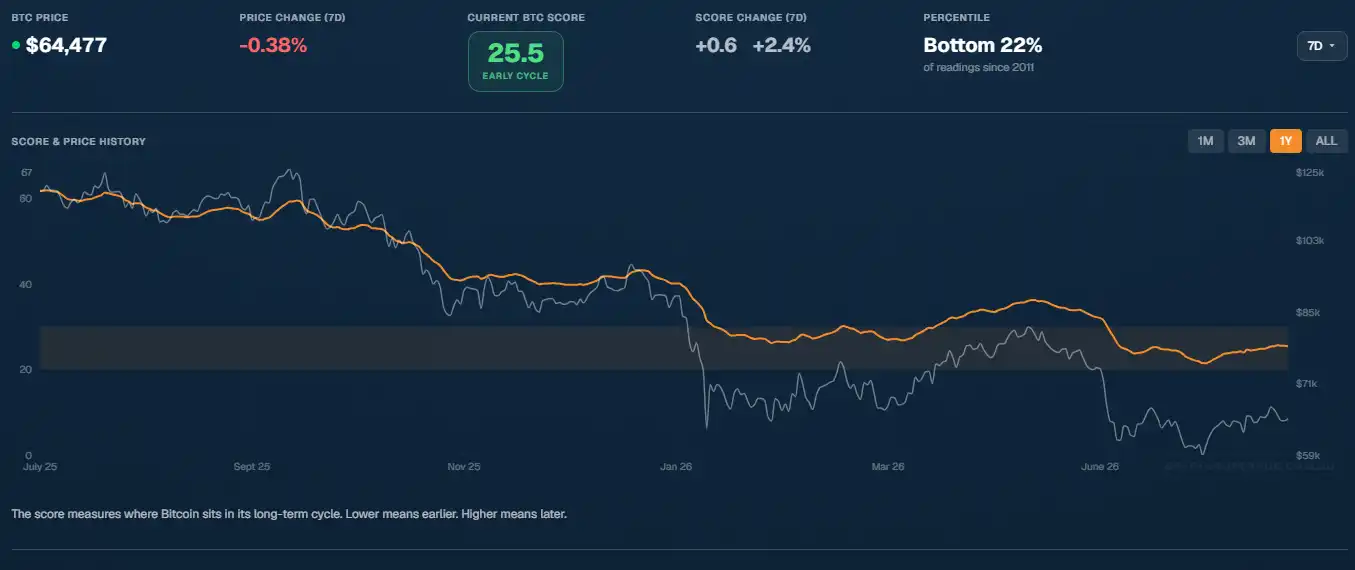
The CSH risk dashboard currently shows a score of 25.6 out of 100. Pahor described the regime as an early cycle and stable, with a weekly change of +0.7. He said the reading sits in the bottom 22% of all observations since 2011 and has now spent 52 straight days in the 20 to 30 band.
He listed the following market indicators:
- BTC at $64,492 / A$91,717, roughly flat over seven days
- BTC dominance at 59.2%
- ETH/BTC at 0.029
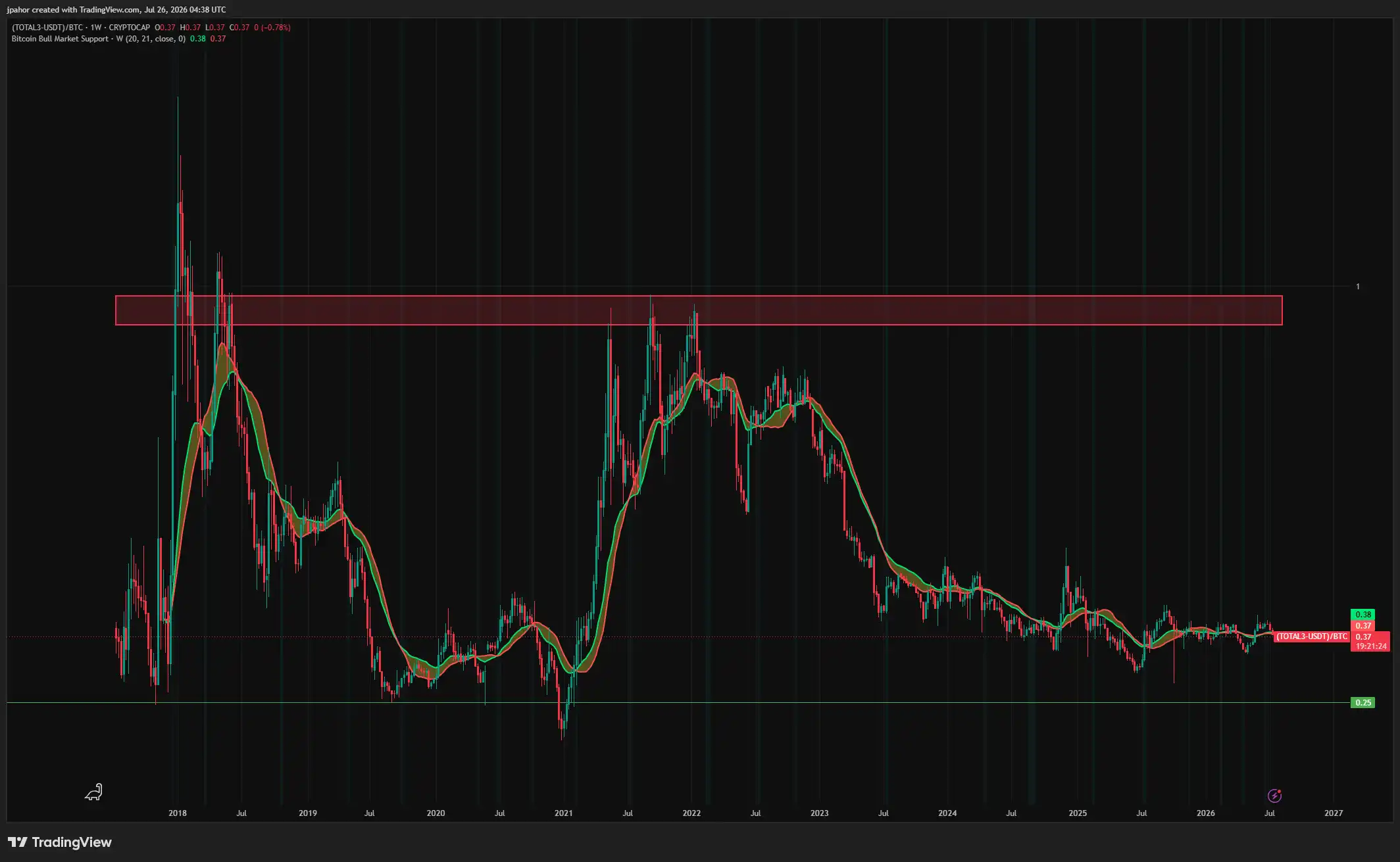
- TOTAL3/BTC at 0.37, with prior cycle bottoms near 0.25 according to his note
- Fear and Greed Index at 26, or fear
- Total market capitalization at $2.27 trillion
Pahor said that in his previous update he argued three things still needed to happen before the bear market could end, and that none of them had happened. A week later, he said, the count was still zero out of three. The one change he highlighted was Bitcoin climbing back above the 200-week moving average, around $63,300, which he called necessary but far from sufficient.
His read on recent price action was straightforward: Bitcoin has spent two weeks moving sideways between roughly $62,000 and $66,000, while the score stayed in the 20s the whole time. Price action was dull, macro headlines were loud, and his plan did not change.
The three rules behind his portfolio
Rule one: measure against dollars and against Bitcoin
Pahor said he tracks his portfolio in both U.S. dollar terms and Bitcoin terms. The second number matters because it changes the benchmark. In his example, if an altcoin doubles while Bitcoin triples, the position is still losing relative to BTC even if the dollar value rises.
He wrote that after 15 years, Bitcoin remains the benchmark for the entire asset class. If he is going to own something else, the reason has to be a genuine belief that it can outperform BTC. Otherwise, he sees little case for holding it.
Rule two: keep the core simple and fit it to real life
For now, that means a portfolio made up entirely of Bitcoin. Pahor said the choice is not a permanent ideological stance but a practical one that matches his life as it is today. He said he has a family, works full-time at an exchange, and spends his spare time building CSH. In that setup, altcoin rotation is work reserved for people who have the time to do it properly.
He tied that view to his experience in the previous cycle, when he held a basket of altcoins without a plan and, in his words, got hit hard while Bitcoin quietly outperformed almost everything he owned. The lesson he drew was not that altcoins are inherently bad, but that a portfolio has to match the investor’s real constraints. Start with BTC as the core, then add complexity only if time and skill can support it.
Rule three: let the system buy
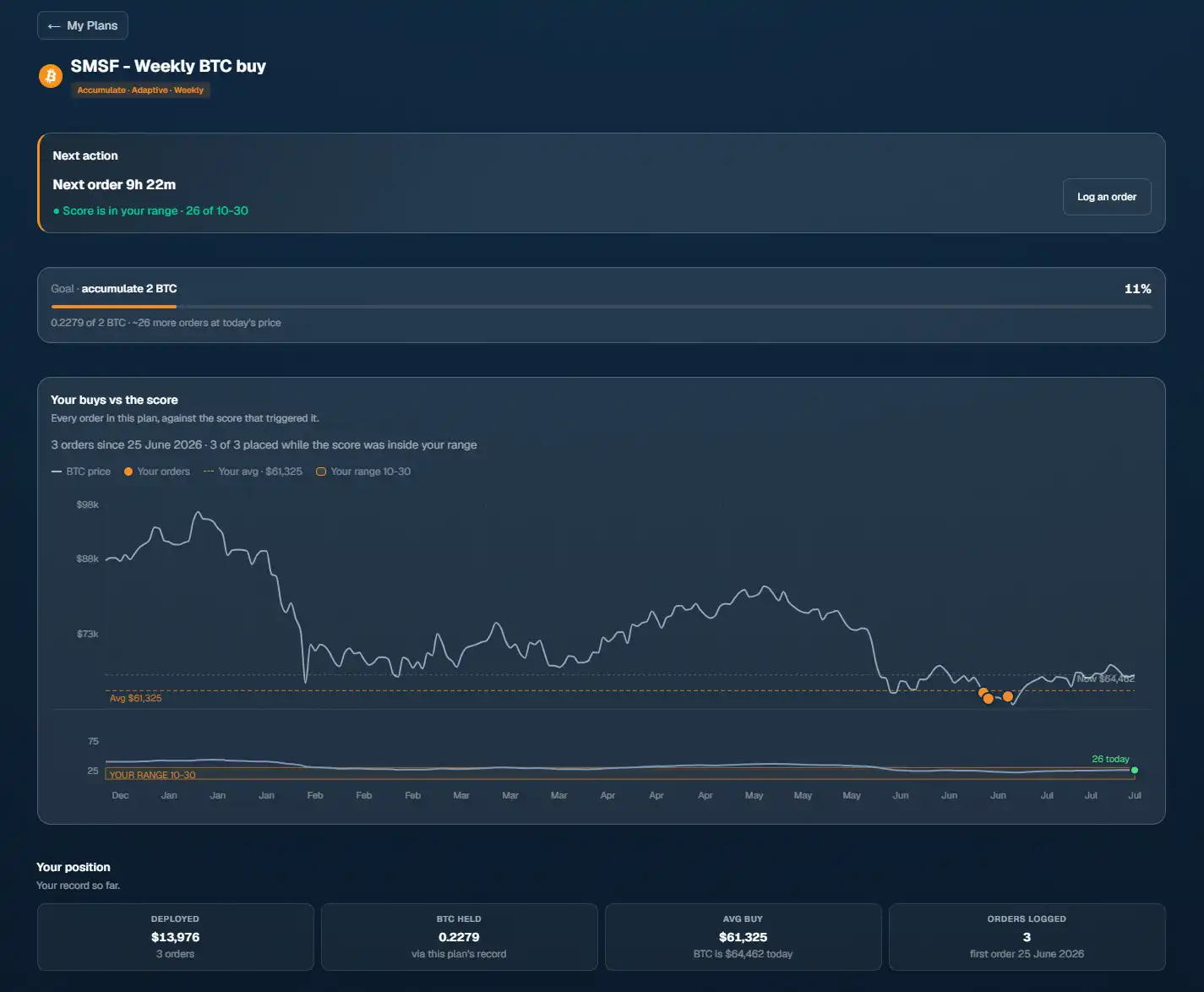
His money is deployed through a dynamic dollar-cost averaging plan tied to the CSH score. Purchases are made only when the score is inside his 10 to 30 range, and the size shifts with the reading. A score of 30 calls for a moderate entry, while a score of 15 means a position several times larger.
Pahor said those decisions were made months ago when he was calm, not in the middle of market noise. He summed it up by saying the market does not get to renegotiate with him at 11 p.m.
The same structure also works in reverse on the way out. His plan scales into selling above a designated exit zone. He said writing those exit rules down in the last cycle made the difference between actually locking in cycle gains and simply riding the full roller coaster. In his view, Bitcoin has moved in a rhythm very close to four years throughout its history, and he has no intention of fighting that by instinct.
Where the plan stands this week
At a score of 25.6, Pahor said routine buying remains active because the reading is inside his range. The larger tranche is still waiting for a sub-20 trigger that has not appeared yet. He added that he deliberately did nothing new over the last two weeks, and that no action is itself a position.
Plan dashboard changes and the screenshot from his own account
Pahor also highlighted a broader update to the plan feature inside the app. The overhaul includes email alerts, portfolio targets and a faster way to log orders. The portfolio view now shows an investor’s average entry price alongside the live score.
He then shared a screenshot from his own plan. It shows three logged orders since late June, with 0.2279 BTC bought toward a 2 BTC target at an average buy price of A$87,755.
He added an explanation to avoid confusion: the plan only tracks purchases recorded since the feature went live a few weeks ago. It is a slice of his holdings rather than the whole portfolio, but it is the part of the system now running publicly with records accumulating from here. The next steps for the dashboard are CSV uploads and exchange syncing to make order logging easier.
Altcoin season talk is back, but his indicators are not there yet
Pahor said his feed is full of calls for rotation into altcoins, but the indicators he watches still do not support that trade. In Bitcoin terms, altcoin market capitalization, measured through TOTAL3/BTC, stands at 0.37. He said that in prior cycles the ratio pushed closer to 0.25 before altcoins started to run. At the same time, BTC dominance is still rising and ETH/BTC remains flat.
His response was blunt: if someone is pitching altcoin rotation this week, ask what benchmark they are using.
The outside developments he flagged
On macro, he noted that the Federal Reserve is due to meet on Wednesday U.S. time. Market pricing, he wrote, implies roughly an 85% chance of rates staying unchanged, though talk of another hike is getting louder. His conclusion was that unless someone’s plan depends on next month’s interest-rate move, the noise should remain just that. His own system does not depend on it.
He also pointed to Visa launching a stablecoin platform that would allow banks to issue their own stablecoins without building the infrastructure themselves. For Pahor, that is what bear markets are for: infrastructure keeps getting built when fewer people are staring at the screen.
Another item on his list was Morgan Stanley enabling spot trading in BTC, ETH and SOL for E*TRADE clients. He said that puts Bitcoin one click away for millions of mainstream brokerage accounts, and argued that the next wave of buyers will not come from crypto Twitter but from the screens those users already rely on.
What he is watching next week
Pahor listed three things on his watchlist for the week ahead.
- The FOMC decision at 4 a.m. Thursday, Australian Eastern time. He said a hold is largely priced in, so the market response will depend on the wording. Two-way volatility is possible, but he stressed that volatility is not a signal by itself.
- The 200-week moving average around $63,300. Bitcoin is trading almost exactly on that line, and he said the weekly close above or below it is something the whole market is watching.
- A score below 20. This cycle has still recorded zero days under that threshold, and that is the trigger for his larger buy allocation. If it happens, he said, readers will hear it there first.
Pahor closed by returning to the same question that helped start the company: whether now is the right time to buy. His answer was not a date or a token. It was a system written before the market turns noisy again, one that fits a person’s life and matches the way they handle risk. He said his own framework is laid out in full, and that the score and plan builder are available for free. He also asked readers to reply with a single number showing what percentage of their portfolio is in Bitcoin, saying he would share the results next week.