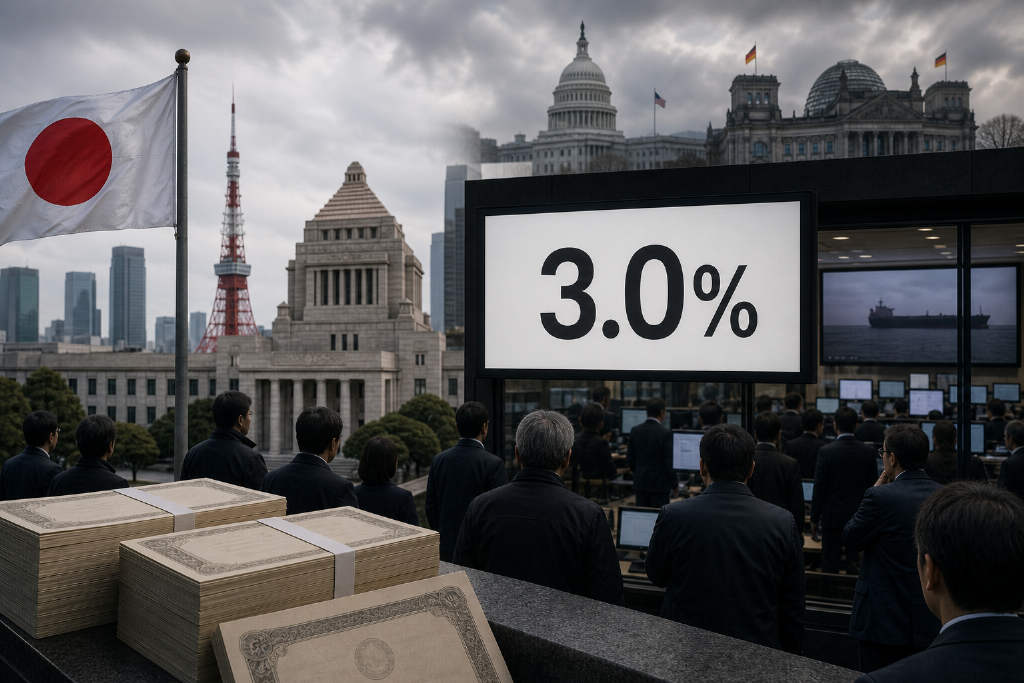
Japan's 10-year government bond yield breached 3% for the first time since 1996, joining a global rout in fixed-income markets. The US 10-year Treasury yield briefly hit 4.79%, while Germany's 10-year Bund yield reached its highest since 2011. The selloff is driven by inflation fears, rate hike expectations, and fiscal financing pressures. Japanese investors may reduce overseas bond allocations, and analysts say Japan's diminished role as a marginal buyer of foreign debt could lift global term premiums and long-term yields. Other factors include Middle East tensions, US debt surpassing $40 trillion, Japan's fiscal expansion, and tech giants issuing long-term bonds for AI infrastructure, adding to supply pressures.
Japan's 10-year government bond yield broke above 3% on Monday for the first time in 30 years, joining a global selloff in fixed-income markets. The benchmark 10-year JGB yield climbed to 3%, a level not seen since 1996. Meanwhile, the US 10-year Treasury yield briefly rose to 4.79%, and Germany's 10-year Bund yield advanced to its highest since 2011.
The selloff reflects a shift in market focus from growth concerns to inflation and bond supply. Rising yields in Japan could prompt domestic investors to cut back on purchases of foreign bonds, including those from the US, Europe, and Australia. Analysts say even if there is no massive repatriation of capital, Japan's diminished role as a marginal buyer of overseas debt could lift global term premiums and long-term yields.
Other factors are adding to the supply pressure: escalating Middle East tensions pushing up oil prices, US government debt surpassing $40 trillion, Japan's expanding fiscal spending plans, and tech giants issuing long-term bonds to fund AI infrastructure. The market is now more concerned about inflation and the growing supply of bonds, moving beyond mere growth worries.
This article was originally published by Bit.Fan. For more cryptocurrency news and market insights, visit www.bit.fan. Disclaimer:
The market information, project data, and third-party content displayed on this platform are for industry information sharing only and do not constitute any form of investment advice or return commitment.
Cryptocurrency trading carries high risks. Users should fully assess their risk tolerance and make independent decisions. All profits, losses, and legal responsibilities are borne by the users themselves.