
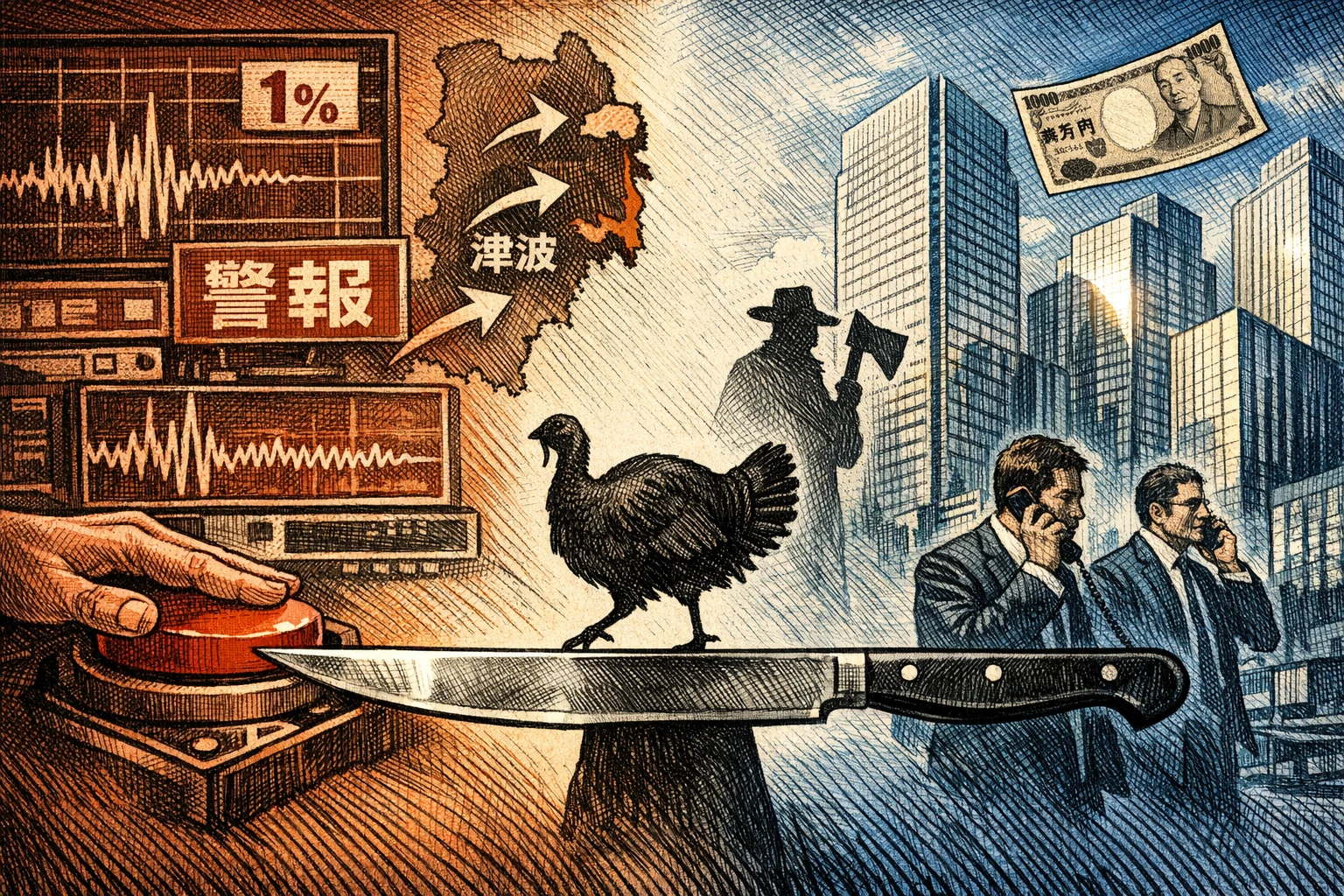
At 4:52 PM on April 20, 2026, an M7.4–M7.7 earthquake struck 100 km off Iwate Prefecture, at a depth of 20 km, shaking the Sanriku coast and triggering a tsunami of 80 cm at Kuji Port. Japan's Meteorological Agency activated for the first time the 'Hokkaido-Sanriku-oki Post-Earthquake Caution Information' system, warning that the probability of an M8.5+ quake within the next seven days (until April 27) is 10 times normal – at 1%. Some 170,000 people evacuated and 36,000 were stranded on Shinkansen lines.
Market Response: Nikkei +0.7%, Yen Flat, Insurers Unfazed
On April 21, the Nikkei 225 index rose 0.7% to 59,200 points, led by AI and semiconductor equipment stocks. Investors focused on US-Iran talks, Fed rate cuts, and Nvidia's next-quarter outlook – none mentioned the earthquake. The yen did not rally (in 2011 the yen surged to a post-war high of 76.25 after the 3/11 quake). Japanese government bonds (JGBs) were not sold, and insurance stocks held steady. Bitcoin closed at $75,324, moving on US-Iran tensions, not the Japan earthquake alert. Markets simply did not price this risk.
The Math of 1% Tail Probability: The Turkey’s Day 1,001
Most people see 1% and think 'almost zero.' But Nassim Taleb in The Black Swan wrote about a turkey that is fed every day for 1,000 days, concluding humans are kind – until Day 1,001, Thanksgiving. A 1% probability should not be seen as 'small' but as 'what happens if it materializes.' Moreover, this 1% applies to the next seven days, not the next century. On March 9, 2011, an M7.3 quake hit off Sanriku, ignored. Two days later, the M9.0 Great East Japan Earthquake struck. The current caution system (established in 2022) was used for the first time now.
If the Big One Hits: Fragility in Finance and Industry
Japan's Cabinet Office estimated in 2022 that a worst-case M9 quake on a winter night would kill 199,000 people and cause 31 trillion yen ($215 billion) in economic damage. Miyako City's maximum tsunami height could reach 29.7 meters, and power outages could last 15 weeks.
On the financial side, the yen carry trade stands at an estimated $1–2 trillion (BIS). An M9 quake would force the Bank of Japan into emergency easing, spiking the yen and triggering a forced unwind of carry trades – potentially magnifying the August 2024 turmoil when a mere 0.25% BOJ hike caused a multi-trillion-dollar global risk asset rout and a 12.4% one-day Nikkei crash. Semiconductor firms like Tokyo Electron, Shin-Etsu Chemical, and SUMCO have factories concentrated in Tohoku; a major quake would sever global chip supply chains. Insurance claims from a M9 quake could be at least five times the 1.3 trillion yen payouts from 2011.
History Shows: Calm Accumulates Risk, Not Eliminates It
On 3/11/2011, the Nikkei fell only 179 points on the day, but then tumbled 6.2% on the Monday after, and another 10.6% on Tuesday – a 16% two-day drop. By March 18 the index was 10.2% below the quake-day close. For the full year 2011, the Nikkei lost 17.3%. The yen soared to a post-war high, prompting a rare G7 joint intervention. Even earlier, after the 1923 Great Kanto Earthquake, the government issued 'earthquake bills' to prop up the financial system; the bills exploded four years later in the 1927 Showa Financial Panic. Taleb’s 'antifragility' concept warns that systems that accumulate fragility in quiet times eventually release it in one massive jolt.
Bitcoin and Crypto: Untested Tail Exposure
Japan is one of the top three crypto markets. After FTX’s collapse, its regulatory framework became relatively mature – but most Japanese users keep assets on exchanges, with low self-custody rates. Major exchanges like bitFlyer, GMO Coin, and Coincheck have data centers in Tokyo and Osaka (not the epicenter), but they share the same power grid. If an M8.5+ earthquake causes the predicted 15-week power outage, how long can exchange hot wallets operate? Can clients withdraw funds normally in a crisis? No historical data exists – in March 2011, the crypto market barely existed.
This article is not a prediction that Japan will be hit, but rather a reflection on tail events. The turkey’s Day 1,001 is coming.