
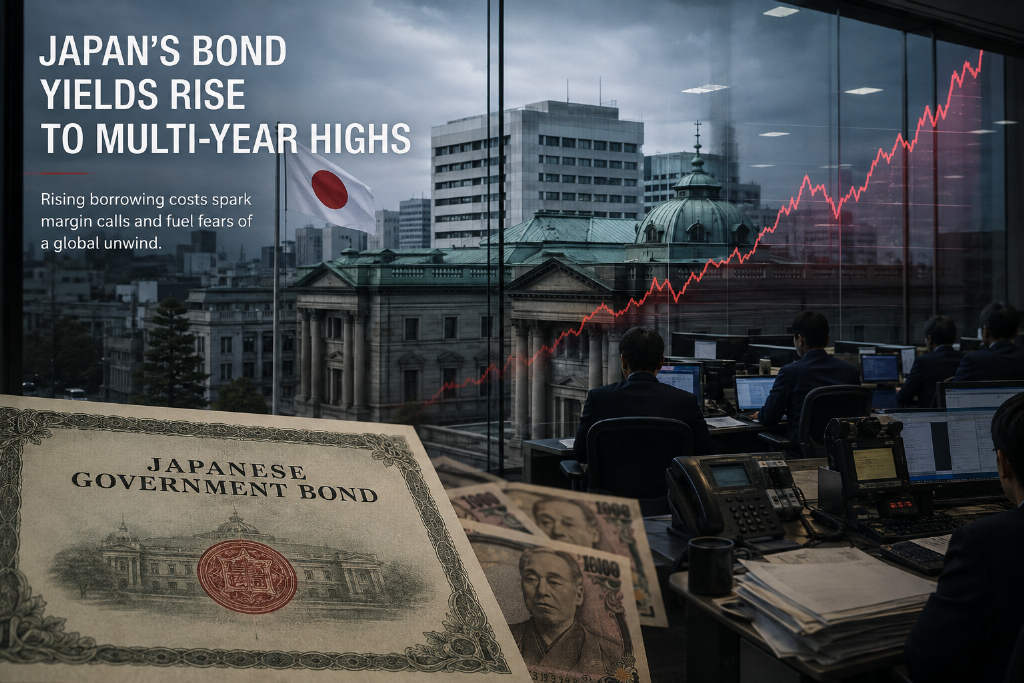
Japan’s 10-year government bond yield climbed above 3% this week, its highest level in nearly 30 years, and the move has pushed the risk of a yen carry trade unwind back to the center of global market discussions.
The break above that level, combined with a weaker yen and rising expectations for additional Bank of Japan rate hikes, has led investors to reassess how shifts in Japanese rates could ripple through global assets. U.S. Treasury Secretary Bessent has publicly warned that disorderly moves in the yen market could trigger forced liquidations, hit global markets, and ultimately raise borrowing costs for U.S. households and businesses.
Why Japan’s 10-year yield moved above 3%
Japan’s 10-year government bond yield rose above 3% on Tuesday, the first time it has done so since September 1996.
The move is not happening in isolation. Bond markets globally have been under pressure as investors reset inflation expectations and expect major central banks to keep raising rates. Traders and economists, though, say Japan stands out.
The Bank of Japan has already ended decades of ultra-loose policy, and markets broadly expect its main policy rate to move higher from the current 1% level. At the same time, continued yen weakness and rising inflation have added to the pressure on the central bank to tighten more quickly.
Policy signals are adding to that pressure. Bessent said he expects Bank of Japan Governor Kazuo Ueda could raise rates as early as this month. Japan Prime Minister Sanae Takaichi’s government has also publicly leaned toward larger fiscal stimulus, a stance that has added to investor concerns over fiscal stability and is seen as one reason behind yen weakness and rising bond yields.
Carry trades are large enough to matter
The logic of the yen carry trade is straightforward: borrow in low-yielding yen and buy higher-yielding assets.
The strategy became widespread during Japan’s long period of very low interest rates. Two years ago, when the Bank of Japan raised its policy rate to 0.25%, markets saw sharp turbulence that was attributed to a sudden unwind in carry positions.
According to the Financial Times, analysts say the buildup in carry positions since 2024 has been substantial. Osamu Takashima, a foreign-exchange analyst at Citigroup, said: 「Hedge funds and other short-term investors have been shorting the yen against the dollar while going long higher-yielding currencies such as the Mexican peso.」
Analysts at Capital Economics, citing data, said that by early August this year, outstanding loans from Japanese residents to overseas borrowers had already exceeded the 2024 peak. They also said lending from Tokyo branches of foreign banks to their headquarters had reached the highest level since the global financial crisis.
Bank of America’s latest global fund manager survey showed that short yen positions remain one of the three most crowded trades worldwide.
Even so, most analysts still see the risk of a large and sudden carry unwind as manageable for now. Kamakshya Trivedi, Goldman Sachs’ chief FX strategist, said yen-funded carry trades have shown more resilience this year than they did during the 2024 intervention period, and that a structural unwind would require Japanese investors to bring funds back from overseas assets on a large scale. He added: 「For now, there is almost no sign in official portfolio flow data that such a rotation has started.」
James Lord, Morgan Stanley’s head of global FX strategy, made a similar point, saying Japanese investors are still buying U.S. assets in large amounts and that the market has not seen a meaningful shift back into local assets.
Why U.S. Treasuries and global markets are watching Japan
Japan is the largest foreign holder of U.S. Treasuries, with holdings of more than $1 trillion, most of them in the hands of financial institutions.
As domestic yields rise, investors are watching whether large pension funds and life insurers could change course and move money back home from overseas markets. Those institutions have already built up tens of billions of dollars in paper losses on bond holdings.
Naka Matsuzawa, a rates strategist at Nomura, said Japan’s 30-year government bond auction on Thursday would be an important signal for whether that shift is starting. If life insurers participate aggressively, he said, markets could quickly take that as a sign that some funds are rotating back into Japanese assets from overseas.
Takashima of Citigroup said life insurers have been waiting for the 20-year Japanese government bond yield to reach 2.5% to 3%, but they have not entered in size because they still fear bond prices may fall further. 「If they think downside risk has peaked, we could see larger fund flows,」 he said.
Markets fully price a September BOJ hike
Markets have now fully priced in a 25-basis-point Bank of Japan rate hike in September, a faster pace than the central bank had signaled at the start of the year.
Economists say part of the rationale for that move is to align with the Japanese government’s broader effort to support the yen.
Attention is also shifting to what comes after that. Some market participants have started to price the chance of another rate hike in October. BOJ policy board hawk Hajime Takata said on Wednesday that a 25-basis-point move is not fixed and that conditions have changed. Ueda said the same day that the Bank of Japan will discuss rates at all of its subsequent meetings.
Even with that, the yen remains weak and is hovering near 160 per dollar. Joint intervention by Japanese and U.S. authorities in July and August had pushed the yen sharply higher, but more than half of that gain has already been erased. Analysts partly link the renewed weakness to rising equity markets, because foreign equity investors often hedge exposure by shorting the yen and may be forced to add to those positions as stocks rise.