
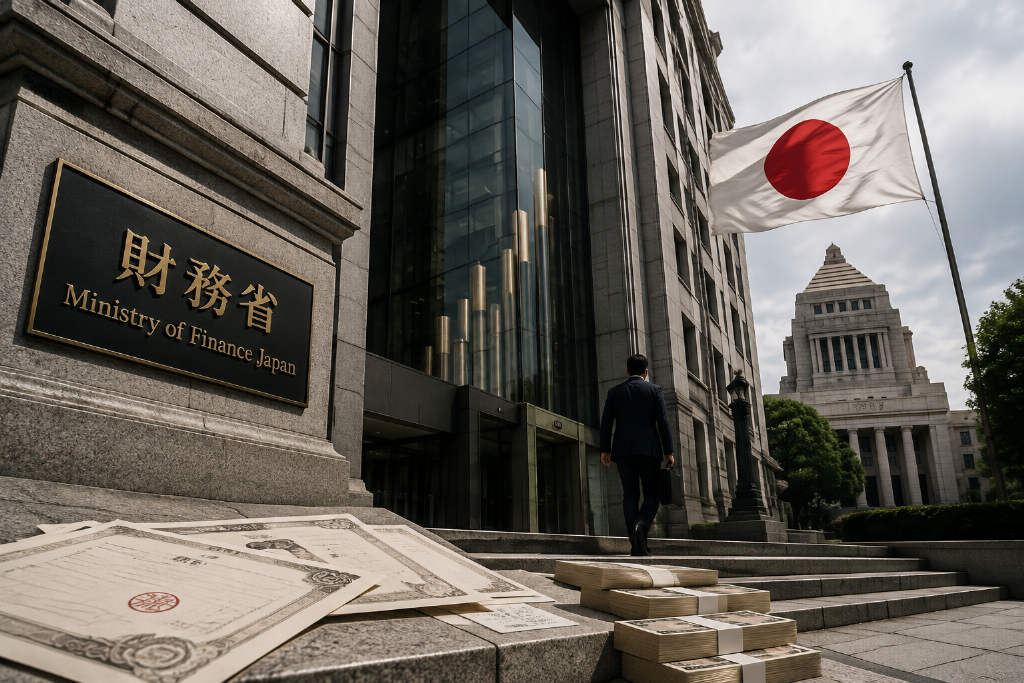
Japan’s Ministry of Finance on Aug. 25 compiled its initial budget request for fiscal 2027, putting debt-servicing costs at 36.6386 trillion yen, or about $229.94 billion, for repayments of government bond principal and interest. That is 17.1% above the initial budget for the current fiscal year.
Both the amount and the pace of increase marked record highs, according to the source material. The year-on-year rise of roughly 5.3 trillion yen was described as the biggest in nearly 20 years.
The fiscal 2027 request covers the year starting in April 2027. On that basis, Japan would spend 36.6386 trillion yen on debt repayment and interest alone in the next fiscal year.
Assumed rate raised from 3.0% to 3.8%
The main factor behind the jump is the ministry’s assumed interest rate, the figure it uses to estimate debt interest payments for the coming year. That assumption stood at 3.0% for fiscal 2026 and was lifted to 3.8% for fiscal 2027.
According to Jiji Press, the ministry calculated the 3.8% level by taking the current market rate and adding about 1.1 percentage points as a buffer for the risk of a sharp rise in interest rates. In practical terms, the budget framework reflects an expectation that borrowing costs could move higher still.
The shift looks sharper when placed against earlier budget assumptions. At the initial request stage for fiscal 2026, the ministry had set the rate at 2.6%. It was then raised to 3.0% at the end of last year when the budget was being drafted, as markets worried about the fiscal expansion stance of the Sanae Takaichi administration. It has now moved again to 3.8%. Over the span of a year, the ministry’s assumption for its own funding cost has risen by 1.2 percentage points.
Bond yields remain near multi-decade highs
In the cash market, Japan’s 10-year government bond yield climbed to 2.93% on Aug. 17 and touched 2.945% the next day, its highest level since October 1996, or roughly 30 years, before easing back to around 2.88% on Aug. 24.
Pressure has been more pronounced at the long end. The 30-year Japanese government bond yield reached a record 3.520% in January this year.
Rate expectations and fiscal decisions are converging
The source material states that the Bank of Japan’s policy rate currently stands at 1%, while markets assign about an 80% chance of a rate hike at the central bank’s Sept. 17-18 policy meeting. That outlook has drawn attention because of its links to yen carry trades and liquidity in crypto markets.
The timing also overlaps with a separate fiscal policy move. On Aug. 5, the Takaichi cabinet approved a plan to cut the food consumption tax rate from 8% to 1% for two years starting in April 2027. The remaining 1% would be offset through income-linked benefits to create what the source describes as an effective zero tax rate. That start date is the same point at which the 36.6 trillion yen debt-service burden begins to apply.
Total ministry requests may top 130 trillion yen
At the broader budget level, combined initial requests from Japan’s ministries and agencies for fiscal 2027 are expected to exceed 130 trillion yen for the first time, also a record high. Debt-servicing costs alone would account for nearly 30% of that total, with the rest of the budget then allocated across growth investment, social security and defense spending.
Japan’s outstanding government debt is equal to about 204.4% of GDP, the highest ratio among major developed countries, according to the source material.
Why crypto markets are watching
The source material says the yen has long been used as one of the world’s cheapest funding currencies. Investors borrow yen, convert it into dollars and buy higher-yielding assets, including cryptocurrencies. If Japan raises rates, funding costs rise and the yen may strengthen, which could force those positions to unwind, draw capital back into Japan and squeeze liquidity across global risk assets.