
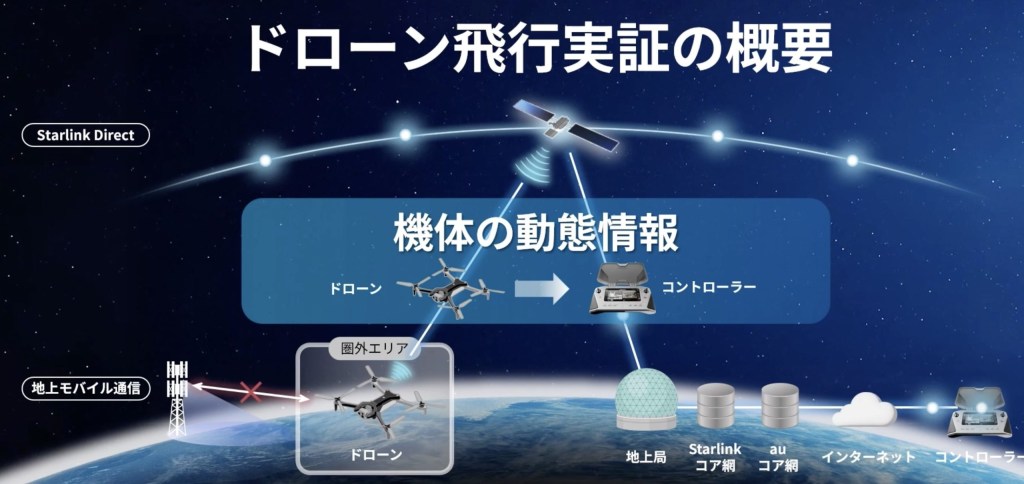
Japanese telecom operator KDDI has completed what the report describes as Japan’s first drone flight controlled directly through Starlink. The test took place in an area outside mobile network coverage, where KDDI connected a Skydio X10 drone to its au Starlink Direct service for satellite-based telemetry and flight control.

KDDI used MWC26 to show satellite-linked drone communications
KDDI presented the result at MWC26, the Mobile World Congress, as part of a broader communications infrastructure demonstration. According to the report, the company completed a remote transmission test for the Skydio X10 in an area where conventional mobile signals could not reach, using the au Starlink Direct satellite service.
The point of the demonstration was to show that drones can still operate in places with weak reception or no base-station signal at all. The report says au Starlink Direct, developed by KDDI in cooperation with SpaceX, uses a direct satellite-link model to work around terrain constraints and cellular dead zones.
KDDI said the service is not limited to smartphones. It can also be used with drones and Internet of Things, or IoT, devices. By linking to low Earth orbit satellites, remote operators can monitor a drone’s flight status and data in real time. The report adds that if a disaster damages terrestrial base stations, the setup could be used to gather the latest information from affected areas quickly and support emergency response work.
Dedicated dock is part of a larger automation plan
KDDI also outlined a deployment model built around a dedicated drone dock designed for the Skydio X10. The dock supports remote deployment, and the company’s stated target is to get a drone to any location in Japan within 10 minutes after receiving an alert.
According to the report, the dock handles charging as well as automated takeoff and landing. That reduces the need for on-site staffing and maintenance.
AI, multiple sensors, and flight-control software enable autonomous missions
The report says the drone can carry out missions without personnel on site by relying on artificial intelligence, multiple sensors, and advanced flight-control software. The system can set routes in advance and avoid obstacles in real time during flight, allowing it to complete more complex navigation tasks.
A remote management center can then oversee flight plans and data transmission across multiple locations through automated processes. In the report’s description, that operating model helps keep data collection consistent and cuts down the time spent on repetitive manual work. It also says the automated platform can provide protection in poor weather and keep operations stable.
Regulatory limits still apply before wider commercial rollout
The article notes that even as autonomous flight technology matures, real-world operations still have to meet aviation rules in different jurisdictions. It references safety protocols and risk-assessment standards set by the U.S. Federal Aviation Administration, or FAA, and the European Union Aviation Safety Agency, or EASA, for unmanned systems.
That is especially relevant for beyond visual line of sight, or BVLOS, operations, where operators must obtain special authorization in advance. According to the report, broad commercial deployment would still require compliance with regulatory requirements alongside data validation.