
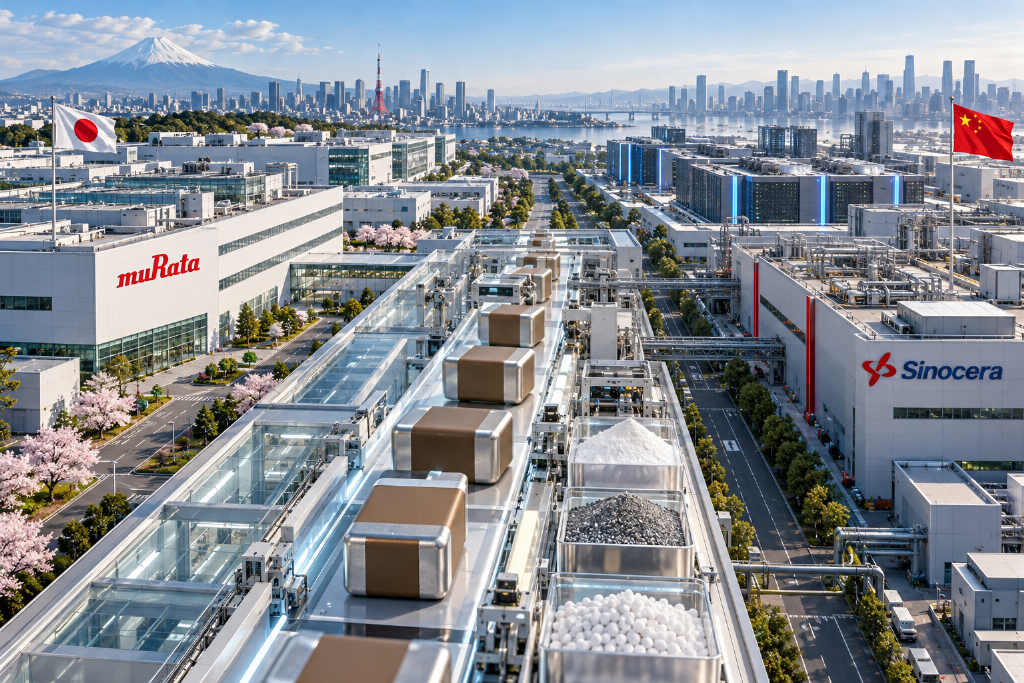
Technology and semiconductor analyst Jukan said Japanese suppliers of electronic materials, components and equipment have been too cautious about capacity expansion, a stance he believes is giving Chinese companies a rare chance to break into higher-end markets. He argued that if Chinese suppliers complete customer certification while supply remains tight, those new entrants may stay in the market even after the cycle turns, leaving Japanese companies facing a longer-term erosion of market share.
Jukan points to Sinocera's progress in high-end MLCC materials
Jukan specifically named China's Sinocera, saying the ceramics materials supplier recently disclosed that some key raw materials used in high-end multilayer ceramic capacitors had passed customer certification. The market for these higher-end materials has long been dominated by Japanese companies, but a surge in AI server demand is creating an opening for Chinese suppliers to move into products with higher added value.
MLCC, short for multilayer ceramic capacitor, is a core passive component used to stabilize voltage, filter noise and store charge in electronic devices. It is widely used in smartphones, automobiles and servers.
According to Jukan, Sinocera said at a recent earnings briefing that some key raw materials required for high-end MLCCs had already passed customer certification. Japanese suppliers have historically led the high-end MLCC materials market, while Chinese manufacturers were more often seen as suppliers of mid- to low-end products.
In Sinocera's first-half 2026 report, the company said it had built capabilities in several key raw materials, including MLCC dielectric powder, internal and external electrode pastes, and zirconia microbeads used for grinding. Helped by rising demand from AI servers and automotive electronics, sales of its MLCC dielectric powder and electronic pastes grew quickly. The company also said it is developing dielectric powder for AI server and automotive-grade MLCCs, while pushing customer verification and capacity expansion. Part of that new capacity has already been completed.
Murata's cautious AI stance draws criticism
Jukan contrasted that push from Chinese suppliers with what he described as overly cautious capital spending decisions by Japanese companies during the current AI supercycle. He specifically referred to Murata Manufacturing and its president, Norio Nakajima, who has expressed doubts about the durability of AI demand. Jukan said that posture could cause Japanese companies to miss a key opportunity to expand market share.
Nakajima has said data center demand driven by AI should continue for at least several years, but he has also stressed the need to judge real end demand carefully and avoid investing on excessively optimistic forecasts. By late July, he was still questioning whether the data center investment boom would last.
Actual orders, however, have continued to rise. Murata's MLCC book-to-bill ratio remained close to 1.5, and some customer orders were turned away because supply was insufficient. The company had already planned to invest about JPY 80 billion to increase MLCC production capacity. In September, it said it was evaluating a larger round of capacity investment. By mid-October, Nakajima also confirmed that Murata was studying additional investment plans to respond to demand continuing to exceed supply. Even so, the industry is still questioning whether the pace and scale of that expansion will be enough to keep up with fast-growing AI demand.
Certification could reshape supplier relationships beyond this cycle
Jukan said that once substitution happens in the supply chain, incumbent Japanese suppliers may not easily win the business back. Product qualification standards in electronic materials and semiconductor supply chains are high. For high-end MLCCs, suppliers must show that their materials meet customer requirements on electrical performance, heat resistance, long-term reliability and batch consistency.
Once customers spend the time and money to certify a second source, a new supplier can gradually move from a backup role to a long-term procurement target. Jukan said this may be the biggest cost of excessive caution for Japanese companies.
He argued that when demand is strong and Japanese incumbents do not have enough capacity, downstream customers have a stronger incentive to test and adopt Chinese materials. By the time the AI investment cycle cools, Chinese companies may already have secured access to customer supply chains that had previously been difficult to enter, even if they then face oversupply.
Jukan also raised two questions: how much capacity Chinese companies will add by the next industry cycle, and how much market share Japan will have to give up.
Taiwan passive component makers may also benefit
Jukan extended his view to Taiwan and said he finds Taiwanese stocks more attractive than Japanese materials and components shares. As AI servers drive demand for higher-capacity MLCCs, major Japanese and South Korean manufacturers are gradually concentrating capacity on higher-value products, squeezing supply for some mid- and lower-spec segments.
That could leave Taiwanese manufacturers in position to take over existing orders released after Japanese and South Korean producers adjust capacity. At the same time, if demand for high-end MLCCs used in AI servers keeps growing, Taiwanese suppliers with the right technology may also have a chance to compete for new higher-value product markets.
Yageo, Taiwan's leading passive component maker, has already planned capacity additions in Kaohsiung, Suzhou, Vietnam and Mexico to meet market demand. Still, the opportunity is not identical for Taiwanese and Chinese companies. Sinocera is focused on upgrading upstream materials such as MLCC dielectric powder, while Taiwan's Yageo and Walsin Technology compete mainly in finished capacitors and broader passive component product portfolios.



