
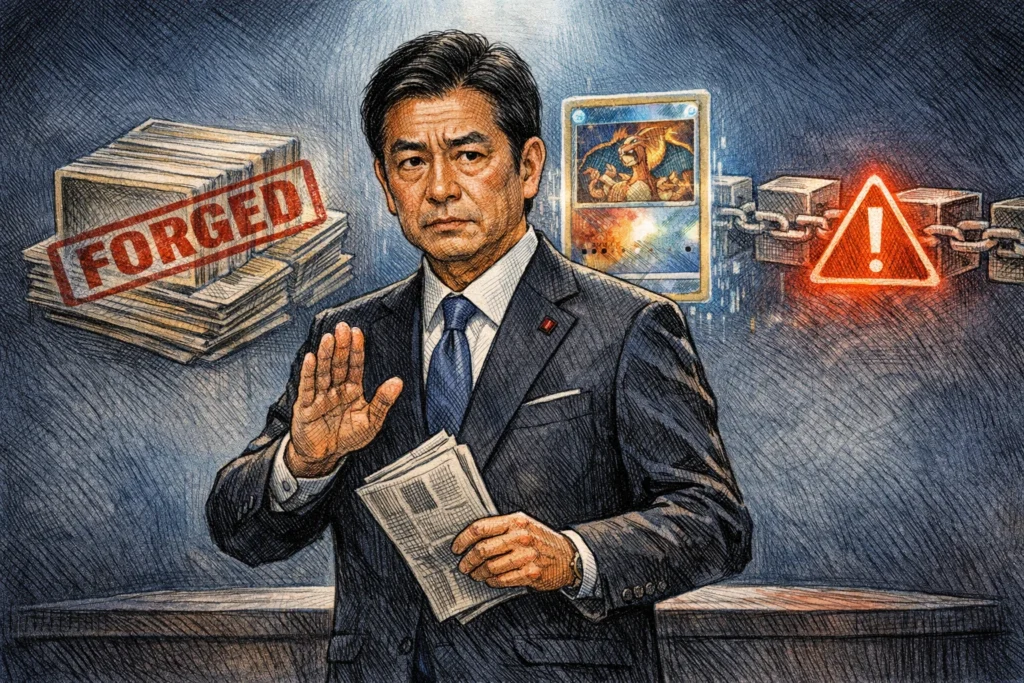
Japan has launched a cross-party parliamentary group to examine the trading card market after a rare Pokémon card sold for about $16 million in February, a sale the report said drew attention inside the ruling Liberal Democratic Party.
On July 23, the group, formally named the Trading Card Promotion Parliamentary League, held its inaugural meeting in the Diet. The report said Seiji Kihara, who heads the caucus, described trading cards as an industry that can compete on the world stage, while warning that hoarding, resale, counterfeiting and money laundering have become visible issues.
The card referenced in the report sold for roughly NT$517 million, with Logan Paul identified as the seller.
Three issues raised at the launch meeting
Kihara chaired the founding meeting. House of Representatives member Masataka Ishihara outlined how the caucus will operate, while Junichi Kanda discussed regulatory direction.
Kihara grouped the market’s risks into three areas:
- counterfeit cards are circulating, with oversight now relying heavily on private grading and authentication firms;
- large-scale stockpiling aimed at resale;
- money laundering risks tied to the lack of individual identifiers, which makes it difficult to trace a card from printing to each transfer of ownership.
Market size has nearly doubled in four years
Data cited from Japan’s Ministry of Economy, Trade and Industry put the market at ¥177.6 billion in fiscal 2021. By fiscal 2025, that figure had risen to ¥338.4 billion, or about $2.1 billion.
As more money flows into the sector, the report said internal LDP assessments now treat these cards as something beyond ordinary consumer goods, with trading activity increasingly resembling transactions in a financial asset.
Japanese IP, overseas influence on pricing
The report also highlighted a second layer of concern. Pokémon and Yu-Gi-Oh! were both created in Japan, but the eventual market price of a card is often shaped by the grade assigned by U.S. authenticator PSA. That grade affects market value, liquidity, and whether a card can be used as collateral, split up, or settled as an asset.
After hearing from industry participants, the caucus identified this structure as a core weakness: the intellectual property is domestic, but authority over certification and valuation sits elsewhere, leaving Japan with limited influence over prices for assets derived from its own content industry.
Financialization of collectibles enters the policy debate
The report compared the regulatory path for high-value collectibles with the path seen in crypto. When a physical collectible has a high unit price, can be moved easily, crosses borders, and lacks individual identifiers, it can be used for money laundering. Regulators often respond only after market size and case volume become too large to ignore, then add licensing, disclosure duties and transaction tracking.
Japan, according to the report, is trying to move earlier this time. The stated aim is to address counterfeit and money laundering risks before they become harder to control, while also avoiding a repeat of the talent outflow seen in crypto.
The report said the caucus will continue gathering views from manufacturers and grading companies. Whether its eventual policy draft becomes a reference point for other countries dealing with the financialization of collectibles remains to be seen.