
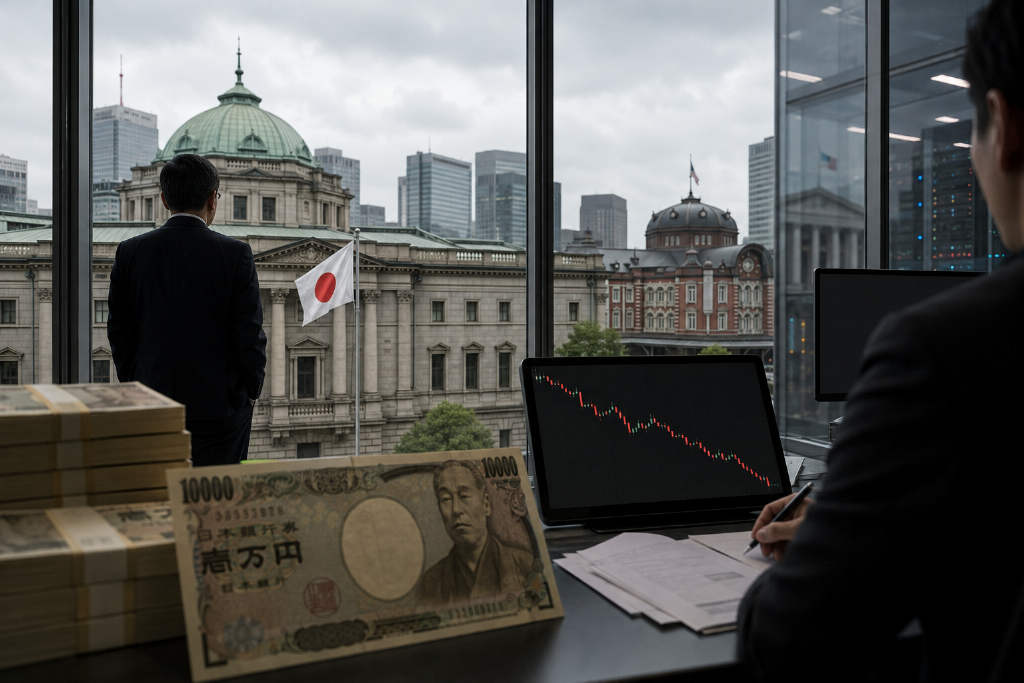
A sharp rise in the Japanese yen is again drawing attention far beyond Tokyo’s foreign-exchange market. On Friday, Sept. 4, the U.S. reported stronger-than-expected August nonfarm payrolls, with 162,000 jobs added. Under normal conditions, that kind of release would support the dollar. Instead, USD/JPY failed to rebound with higher U.S. Treasury yields and continued to slide, briefly falling below 155. Over the week, the yen gained about 2.5%, its biggest weekly rise since the U.S.-Japan joint intervention in late July.
On the surface, the move reflects an unusual burst of hawkish communication from Bank of Japan officials and renewed market speculation that Washington and Tokyo are once again aligned on exchange-rate policy. The broader point in the report is that the story does not stop at currency trading. It runs through yen funding costs, the unwinding of global carry trades, and tighter liquidity conditions, then reaches U.S. AI and technology growth stocks.
Why USD/JPY matters well beyond Japan
USD/JPY measures how many yen one U.S. dollar can buy. A higher number means a weaker yen. A lower number means a stronger one. The pair’s move from around 160 to around 155 over the past week is the clearest expression of the yen’s rebound.
The pair matters globally because the yen has long served as a funding currency. For nearly three decades, the Bank of Japan kept rates near zero or below zero, allowing financial institutions to borrow yen at very low cost, convert them into dollars or other higher-yielding currencies, and invest in U.S. stocks, U.S. bonds, and emerging-market assets. That structure is the yen carry trade.
For that reason, USD/JPY has often been treated as a real-time gauge of global risk appetite and liquidity. As long as yen funding stays cheap and the currency remains stable or weak, carry trades can keep feeding low-cost capital into risk assets, especially U.S. technology and other growth shares.
A week of sharp reversal in the yen
From Sept. 1 to Sept. 4, USD/JPY moved steadily lower after opening the week near 160.39, its highest level since the late-July intervention. The trend then reversed hard as BOJ officials delivered back-to-back signals favoring more rate increases. On Sept. 3 alone, the pair fell almost 2%, the biggest one-day move since the intervention episode.
By Friday, even with the U.S. payrolls report beating expectations, USD/JPY still could not reclaim 156.
The comparison with the July 31 intervention is central to the report. On that day, USD/JPY dropped quickly from 163.99 to around 155.23, a move of about 5%. But the effect faded in less than a month. By late August, the yen had weakened again and the pair had returned close to 160.
The report says the closest precedent in terms of intensity was the August 2024 shock, when an unexpected BOJ rate increase triggered a global carry-trade unwind and sent the Nikkei 225 down nearly 20% over three trading days. The current rally in the yen has not yet turned into a 2024-style liquidation wave, but the absolute move, the trigger, and the level of market sensitivity to possible official action all place it near a critical threshold.
Three forces behind the yen’s rebound
1. A clear hawkish turn from the BOJ
On Sept. 2, BOJ Governor Kazuo Ueda said the Sept. 17-18 policy meeting would assess upside price risks and that financial conditions remain accommodative, adding that he hopes to continue raising rates. BOJ board member Hajime Takata then struck a more forceful tone, saying the central bank would proceed with hikes flexibly and would not rule out consecutive increases. Citi described that as its “strongest signal.”
Those comments pushed overnight index swap pricing for a September hike to as high as 94% to 99%. The market has largely priced in a 25 basis point increase on Sept. 18, which would take the policy rate to 1.25%. If delivered, it would mark the shortest interval between rate hikes under Ueda, about three months after June.
2. Higher Japanese yields are narrowing the U.S.-Japan spread
On Sept. 1, Japan’s 10-year government bond yield rose above 3% for the first time since 1996. The report links that move not only to BOJ tightening expectations but also to the fiscal stance of the Sanae Takaichi government, a record fiscal 2027 budget, and additional spending on semiconductors and AI. Together, those factors increased long-end issuance pressure and lifted the yield structure.
As Japanese yields rise and hike expectations build, the U.S.-Japan rate gap narrows. That directly weakens the economics of borrowing yen to fund positions elsewhere.
3. Crowded short-yen positions are being forced to cover
CFTC data cited in the report show that, as of Aug. 25, leveraged funds still held 81,600 net short yen contracts, while asset managers held 18,300. Shorting the yen remained one of the most crowded trades in global markets.
Once rate expectations and bond yields began moving against that trade, the cost of maintaining those positions rose quickly. Stop-loss buying then amplified the move. That helps explain why the yen stayed firm, and even strengthened, on Sept. 4 despite the strong U.S. payrolls report and a rise in the implied probability of a September Federal Reserve rate increase from around 50% to 58.6%. In the report’s framing, the repricing on the yen side was simply stronger.
From the “Takaichi trade” to intervention dependence
The report argues that the latest yen volatility cannot be understood only through interest-rate spreads. For a long time, USD/JPY moved closely with the U.S.-Japan 10-year government bond yield differential. Lately, that relationship has become less clean. The spread has narrowed, yet the yen has not strengthened in lockstep. At the same time, the gap between Japan’s 10-year and 2-year government bond yields has widened, and concern over fiscal-risk premia has grown.
In that setup, a narrower rate differential has coexisted with a weaker yen because fiscal worries have undermined confidence in the currency itself.
The report attributes much of this to what it calls the “Takaichi trade.” Since taking office, Sanae Takaichi has pursued what the article describes as “responsible active fiscal policy”: large-scale debt issuance, tax cuts, and more investment in strategic industries. It says this is the biggest stimulus package since the pandemic. Japan’s government debt stands at about 263% of GDP, compared with 142% during the Greek debt crisis. In that environment, investors have expressed concern over a wider deficit through a three-part trade: selling Japanese government bonds, shorting the yen, and favoring Japanese equities.
Official intervention has also become a defining part of the market pattern. Japan’s Ministry of Finance data show spending of about 11.73 trillion yen from April 28 to May 27, and another 15.40 trillion yen from July 30 to Aug. 26, for a total of about 27.13 trillion yen. That exceeds the combined intervention total for 2022 and 2024, around 24.5 trillion yen. According to the report, authorities have stepped in whenever USD/JPY approached 160. It argues that this is why so many rebounds have later faded: the support came mainly from official buying, not an improvement in fundamentals.
Where the idea of U.S.-Japan “coordination” comes from
In late July, the U.S. Treasury and Japan’s Ministry of Finance both confirmed a joint currency-market intervention. On Aug. 3, Japan’s finance ministry formally confirmed coordinated yen buying and said it planned to use the FIMA repo facility in the future. On the day of the intervention, USD/JPY fell from 163.99 to around 155.23. The report says the yen then rebounded nearly 4% over one week, its biggest weekly gain in roughly two years. Donald Trump called the move “a sign of friendship” and said it was also good for the world economy.
In September, U.S. Treasury Secretary Bessent’s comments added to that interpretation. On Sept. 1, the Treasury said Bessent had met BOJ Governor Ueda and urged “sound monetary policy to avoid excessive exchange-rate volatility.” The statement also said he “strongly supports Japan’s decisive market and monetary steps to address the yen’s substantial undervaluation,” adding that “yen weakness has intensified domestic inflation pressure in Japan.”
Bessent later told CNBC, “I know things the market doesn’t know,” a line the report reads as a signal that he had substantial confidence in upcoming BOJ action. He also warned that disorderly moves in the yen market could force carry trades to unwind, hit global markets, and raise borrowing costs for U.S. households and businesses.
How a stronger yen can hit U.S. AI and tech stocks
The report’s core argument is that yen strength matters because of how it reaches U.S. markets.
The 2024 reference point
In July 2024, the BOJ unexpectedly raised rates by 0.15 percentage point, triggering a global unwind of yen carry trades. During the week of Aug. 5, the Nikkei 225 fell nearly 20% in three trading days, including a 12.4% one-day decline, its worst daily drop since the 1987 Black Monday crash. South Korean equities fell more than 10% at the same time. In U.S. overnight trading, Nvidia fell as much as 14%, Apple dropped 10% after Warren Buffett sharply reduced the related position, the Nasdaq 100 lost 5%, and bitcoin fell 15%.
JPMorgan later estimated that the liquidation cleared less than 60% of speculative positions, meaning the risk was not fully removed.
The four-step transmission chain
The mechanism described in the report is straightforward. If the BOJ raises rates and Japanese bond yields continue higher, the U.S.-Japan spread narrows further and yen funding becomes more expensive. Investors who borrowed in yen to hold U.S. stocks or U.S. Treasuries may then need to cut those positions, sell overseas assets, and buy yen to repay debt.
Because that capital has historically favored long-duration, richly valued growth assets, which are highly sensitive to risk-free rates and liquidity conditions, AI leaders and major technology names in the U.S. equity market are likely to feel the pressure first.
The report adds a second channel. If Japanese life insurers, banks, and pension funds can again earn 3% on domestic 10-year government bonds, they may scale back overseas allocations, especially U.S. Treasuries, and allow some capital to move home. That could put upward pressure on long-end Treasury yields, raise discount rates for growth stocks, and add to the impact of carry-trade unwinds.
Current exposure may be larger than in 2024
Data cited in the article suggest the potential carry-trade overhang is now larger than at the 2024 peak. Japanese residents’ outstanding loans to foreign borrowers have already exceeded their 2024 high. Loans from Tokyo-based foreign banks to their headquarters have climbed to the highest level since the global financial crisis. And as of Aug. 25, CFTC net short yen positions remained elevated and had not gone through a meaningful washout.
That means a stronger-than-expected policy path from the BOJ after Sept. 18 could trigger an unwind larger than the one seen in 2024, according to the report.
Sept. 18: the path matters more than the first 25 basis points
The article says Japanese officials broadly favor a conventional 25 basis point move, partly because it is easier to communicate than a larger one-off increase. But the decisive factor for the yen and for global repricing is not the first 25 basis points by itself. It is the path that comes afterward.
The market is focused on whether the BOJ sticks to a gradual sequence or opens the door, as Takata suggested, to consecutive hikes or even larger moves.
After Sept. 18, the yen story is no longer just about domestic Japanese monetary policy. The report frames it as a systemic global repricing event. Whether the spillover is mild, accelerates, or has already been largely priced in will depend on next week’s CPI data, BOJ meeting minutes, and updated CFTC positioning.
Signals the market is watching next
- Whether the U.S.-Japan 10-year spread and USD/JPY resume moving in the same direction. If they do, the classic carry-trade framework may again become dominant.
- Japan’s 2s10s curve and demand at 30-year and 40-year government bond auctions. If long-end yields continue to underperform short-end yields, fiscal-risk premia may still be rising.
- The BOJ’s pace of future hikes, real rates, and inflation expectations. The report says the yen’s rally is more likely to last if the real return on yen assets genuinely improves.
- How clearly the Takaichi fiscal package identifies funding sources, net new debt issuance, and the scope of tax cuts. That will shape whether markets accept the idea of “responsible active fiscal policy.”
- If authorities intervene again after Sept. 18, how quickly the market gives back the move. A return to pre-intervention levels within days or weeks would suggest policy signals still are not strong enough to overcome underlying fundamentals.
The original article includes a disclaimer saying it is for reference only and does not constitute investment advice or a product solicitation. It says the data are current through the Sept. 4, 2026 foreign-exchange close in U.S. Eastern time and are based on public information.